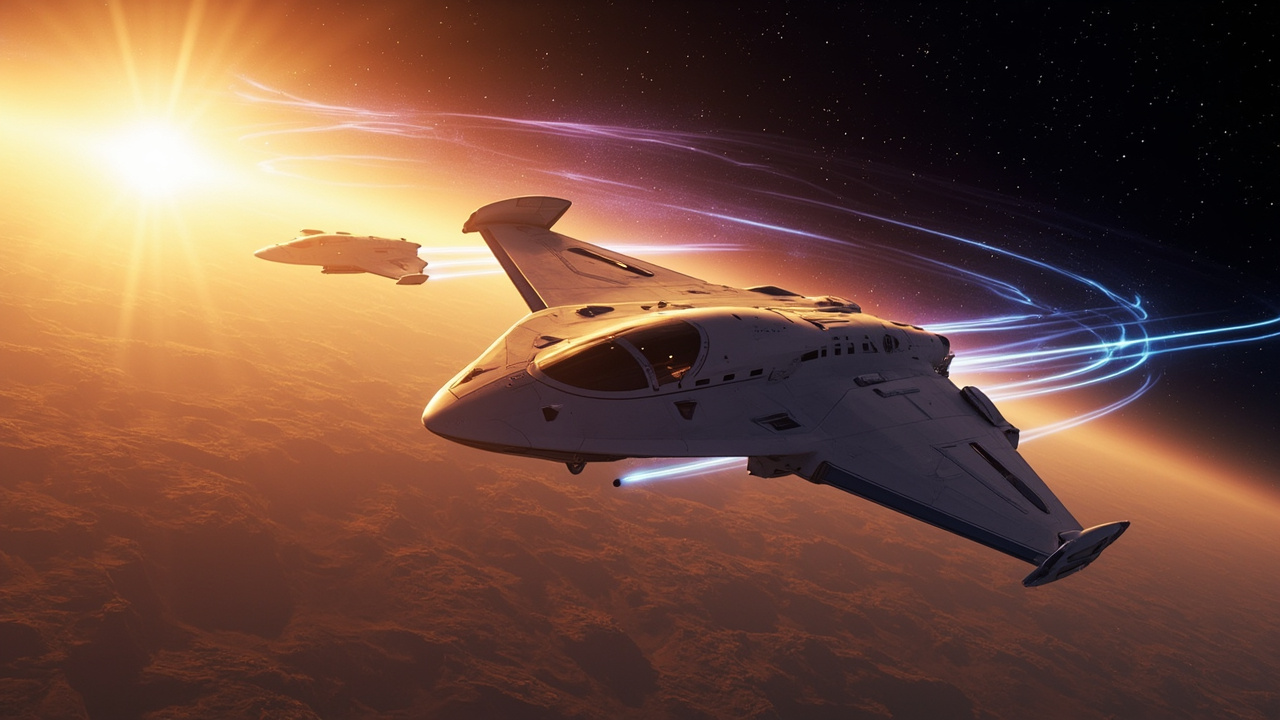
TL;DR: Virgin Galactic and the Air Force Research Laboratory disclosed a 24-month agreement on Oct. 14, 2026 to advance space weather science using Virgin Galactic capabilities.
What was announced on Oct. 14
Virgin Galactic and the Air Force Research Laboratory entered an agreement to advance space weather science, according to Aviation Week in its report titled Virgin Galactic, AFRL Reveal Space Weather Study Agreement.
The disclosure was credited to Guy Norris and dated Oct. 14, 2026. Aviation Week listed the story under launch vehicles and propulsion coverage.
A separate market report titled Virgin Galactic signs 24-month space weather research deal with AFRL described the arrangement as a 24-month space weather research deal, according to StreetInsider. That duration is the central confirmed term publicly available about the pact.
A companion summary titled Virgin Galactic and the Air Force Research Laboratory Enter Agreement to Advance Space Weather Science also dated Oct. 14, 2026 described the aim as leveraging Virgin Galactic capabilities to advance understanding of space environment conditions, according to MarketMinute.
No contract value, flight number, payload manifest, or instrument list was stated in the available summaries. The announcement establishes the parties, the topic, the date, and the two-year time frame.
Why the parties framed it as space-weather science
Space weather covers solar, solar-wind, and ionospheric effects that can disrupt operational systems. The Air Force Research Laboratory has described that research area as work to understand and quantify how the space environment affects Department of War and national-security systems, according to Bidscope AI reporting on AFRL solicitation materials.
That same AFRL research description lists a goal to develop capabilities to specify, predict, mitigate, and exploit disruptive effects, according to Bidscope AI. The language matters because it distinguishes observing the environment from using forecasts to protect satellites, communications, navigation, and other systems.
AFRL pursues that work through its Space Warfare Directorate under a long-running Space Environment Technologies and Science Broad Agency Announcement, according to Bidscope AI. The BAA structure uses individual calls to request interdisciplinary proposals on specific topics.
The most recent public call example concerns Topic 1 of that BAA, described as solar, solar-wind, and ionospheric effects, according to Bidscope AI. That call was posted Sept. 30, 2026, with offers due Oct. 29, 2026 at 7 p.m., and performance centered in Albuquerque, New Mexico.
The Virgin Galactic agreement is separate from that open solicitation. But the solicitation shows why AFRL treats solar and ionospheric research as an operational priority rather than academic curiosity.
How Virgin Galactic fits into airborne research
Virgin Galactic operates an air-launch system in which a carrier aircraft carries a piloted spaceship to altitude and releases it for rocket-powered flight to suborbital space, according to Space.com.
The current Delta-class vehicles are broadly similar to the earlier Unity vehicle in concept. They are piloted vehicles that seat six passengers and take off beneath the wings of a carrier plane, according to Space.com.
After release, the spaceship ignites its rocket motor and conducts a suborbital flight before gliding back to a runway landing. Published descriptions place carrier release at about 50,000 feet, or about 15,000 meters, with total flight duration likely lasting 60 to 90 minutes and ending at the same runway where operations started, according to Space.com.
That profile is relevant to atmospheric and near-space data collection because it provides repeated access to high altitude, a period of microgravity, and return of hardware and samples to the departure site. Virgin Galactic has previously emphasized rapid turnaround and reuse as central to its next-generation system design.
The company has said its Delta-class iteration is designed to fly much more frequently than Unity did, with a planning goal of twice per week if operations mature as intended, according to Space.com. Higher cadence would matter for research because repeated flights allow comparison across solar conditions, seasons, and instrument configurations.
Where Delta stands ahead of the two-year study window
Virgin Galactic has not reached space since June 2024, according to Space.com. The company retired its first-generation VSS Unity vehicle after its seventh operational, customer-carrying flight, following a first commercial spaceflight overall in June 2023, according to Space.com.
Development is now focused on two Delta aircraft. The first Delta spaceship is the vehicle expected to lead flight testing and entry into service, while the second Delta spaceship is expected to join the first at Spaceport America in New Mexico in March 2027, according to Space.com.
Virgin Galactic said Aug. 12, 2026 that its first commercial spaceflight had moved to February 2027 to allow additional time to complete avionics and systems installations, according to its investor news release titled Virgin Galactic Announces Second Quarter 2026 Financial Results and Provides Business Update.
Chief Executive Michael Colglazier said no single issue drove the schedule change. He described modest time-duration extensions across hundreds of relatively small but important installation tasks involved in the first build of the new spaceship, according to Space.com.
Upcoming milestones listed in the August business update included commencement of the flight-test phase with a spaceship captive-carry flight in October 2026 and start of rocket production in the fourth quarter of 2026, according to the Virgin Galactic investor release.
The company substantially completed structural assembly of the first Delta-class spaceship before moving into systems installation and ground testing, a sequence tracked through 2025 and 2026 in trade-press program updates. The October captive-carry step is intended to begin the flight-test phase while the spaceship remains attached to its carrier aircraft.
Virgin Galactic returned its first-generation SpaceShipTwo vehicle Unity to flight in May 2026 for pilot and ground-team training, a step intended to support preparation for the Delta test program. That return-to-flight activity preserved crew proficiency during the gap since the June 2024 spaceflight.
AFRL's parallel space-environment research track
AFRL's Space Vehicles Directorate and later Space Warfare Directorate organization has managed space-environment work from facilities in Albuquerque, according to federal solicitation summaries. The SETS program seeks interdisciplinary proposals on space-environment technologies and their impacts on Department of Defense and national-security systems.
The program description emphasizes understanding, predicting, and mitigating space-environment effects on operational systems, according to GovTribe summaries of AFRL materials. Technical evaluation in that program has prioritized scientific merit, mission relevance, and soundness of technical approach.
The Topic 1 area now highlighted alongside the Virgin Galactic announcement includes solar activity, solar wind, ionospheric conditions, and related effects on communications, command-and-control systems, positioning, navigation, timing systems, and radar systems, according to federal notice text reproduced by NoticeRegistry.
That context helps explain commercial interest. Reusable suborbital vehicles can carry instruments, test components after exposure, and return them for inspection. AFRL officials explored that concept years ago, including buying cargo space for experiments on commercial flights and studying zero-gravity effects on satellite components before operational use, according to SpaceNews reporting from 2008.
The 2026 agreement does not, in the materials available, specify whether AFRL instruments will fly on Virgin Galactic test flights, commercial flights, dedicated research flights, or ground-based campaigns tied to flight data. It also does not state whether work will occur at Kirtland Air Force Base, Spaceport America, or other sites.
Virgin Galactic's prior government and research flights
Virgin Galactic describes itself as an aerospace and space travel company enabling commercial human spaceflight and high-altitude scientific discovery with air-launch vehicles, according to its investor communications.
The company has said it flew suborbital research missions on six flights, including both autonomous and human-tended experiments, according to its Research Fact Sheet. It has flown payloads for NASA's Flight Opportunities program since it began spaceflights in 2018 and describes itself as the only suborbital flight provider to successfully conduct human-tended research in microgravity.
NASA's Flight Opportunities program provides flights on commercial suborbital platforms to give access to microgravity and bridge ground testing and operational demonstration, according to the same fact sheet. Virgin Galactic said it worked with Flight Opportunities for over a decade and flew autonomous and human-tended payloads through the program.
The company's first revenue-generating flight in December 2018 carried four research payloads for NASA's Flight Opportunities program, according to the Research Fact Sheet. Since then it reported flying a dozen payloads over four research flights for that program, including two flights separated by only three months that allowed quick payload adjustments.
With Italy's Galactic 01 research mission, Virgin Galactic said it doubled the amount of research payloads flown on its vehicles and demonstrated use of suborbital flights to train astronauts for future orbital missions, according to the Research Fact Sheet. Galactic 05 was described as its sixth research mission and carried the first private researchers to suborbital space.
The fact sheet also describes a piloted, reusable design intended for frequent suborbital flights from Spaceport America, where researchers can load payloads shortly before flight and recover them shortly after landing. The company says researchers can fly rack-mounted autonomous payloads or accompany payloads to conduct experiments in microgravity after specialized training.
That history does not establish the design of the AFRL study. It does show a template Virgin Galactic has used before: government or institutional payloads, rapid payload integration, human-tended operations when needed, and same-site launch and recovery.
Business conditions surrounding the announcement
The AFRL agreement arrived while Virgin Galactic was managing toward commercial restart and cash-flow targets. The company reported cash, cash equivalents, and marketable securities of $286 million as of June 30, 2026, according to its second-quarter 2026 investor release.
Revenue was $0.1 million in the second quarter of 2026, compared with $0.4 million in the second quarter of 2025, attributable to access fees related to future astronauts, according to the same release. GAAP total operating expenses were $65 million, compared with $70 million a year earlier, while non-GAAP operating expenses were $54 million versus $58 million.
Net loss was $56 million, compared with a $67 million net loss in the second quarter of 2025, with improvement driven in part by a gain on extinguishment of debt and lower operating expenses, according to the release. Adjusted EBITDA was negative $52 million, consistent with the prior-year quarter.
Net cash used in operating activities was $50 million versus $55 million a year earlier. Cash paid for capital expenditures was $41 million versus $58 million. Free cash flow was negative $91 million versus negative $114 million, according to the release.
The company generated $134 million in gross proceeds through issuance of 41 million shares under an at-the-market offering program during the second quarter, according to the release. It also reduced principal on notes due in December 2028 and February 2027 during the quarter.
For the third quarter of 2026, the company expected free cash flow between negative $95 million and negative $100 million. For the fourth quarter, it expected improvement to between negative $80 million and negative $90 million, according to the release.
On operations, Chief Financial Officer Doug Ahrens said the company continued to forecast 10 or more spaceflights per month by the end of the second quarter of 2027 once two Delta spaceships entered service, according to Space.com. He described that cadence as unprecedented in human spaceflight and tied it to a highly reusable design.
Ahrens also said each new spaceship was expected to cost approximately $60 million to produce, according to Space.com. Using a conservative lifetime estimate of 500 flights per spaceship, six astronauts per flight, average pricing of $600,000 per expedition, and contribution margin over 80% per flight, he said each spaceship had potential to generate over $1.4 billion of lifetime contribution margin.
Demand signals cited by management included a recently offered tranche of spaceflight expeditions priced at $750,000 per seat that was oversubscribed and booked ahead of schedule, according to the investor release. The company said that tranche represented more than $50 million of expected future spaceflight revenue and planned to open a new tranche in fall 2026 at higher prices.
What remains undisclosed
The public summaries do not identify the agreement mechanism, such as whether it is a Cooperative Research and Development Agreement, a contract, or another transaction type. Virgin Galactic has previously used a Cooperative Research and Development Agreement for work with Lawrence Livermore National Laboratory on sensor assessment, but that precedent does not define the AFRL structure.
They also do not state flight dates, test locations, data rights, publication plans, or whether AFRL personnel will participate in flight operations. Those details would determine whether the study produces openly available space-weather datasets or primarily internal technical results.
For now, the verified record is narrow: Aviation Week reported the agreement on Oct. 14, 2026, StreetInsider characterized it as a 24-month research deal, and MarketMinute summarized it as work to advance space-weather science. The surrounding program facts show a Delta fleet working toward February 2027 commercial service and an AFRL research enterprise focused on solar, solar-wind, and ionospheric effects on national-security systems.