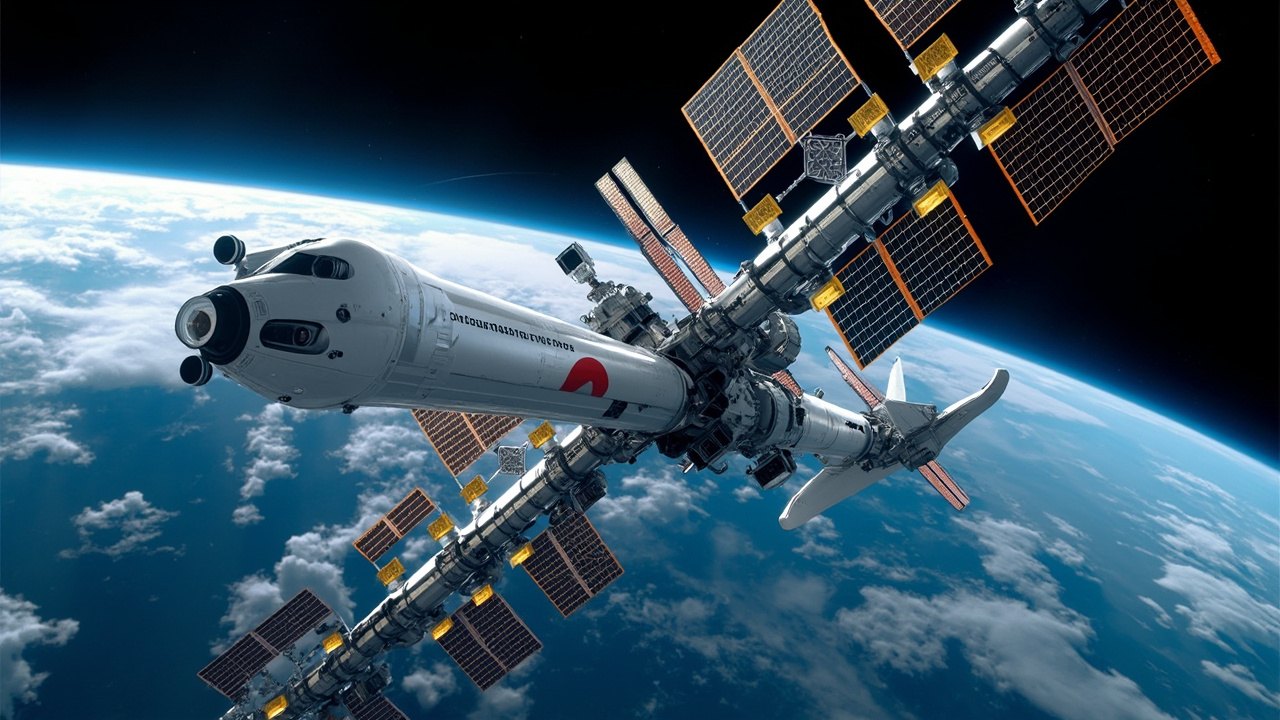
TL;DR: NASA wants commercial stations to replace ISS functions, while SpaceX flies cargo and Voyager readies a Moon lander
NASA released its final Request for Proposals for commercial space stations on Oct. 9, 2026, with proposals due Dec. 8 and awards expected in spring 2027, according to NASA's report titled "NASA Seeks US Industry Plans for Commercial Space Stations."
That solicitation anchors a busy stretch for U.S. commercial spaceflight that also includes NASA's SpaceX 35th commercial resupply mission targeted for no earlier than Oct. 13, environmental testing of Voyager Technologies' Griffin Mission One lunar lander at the Jet Propulsion Laboratory, and two NASA-funded satellite communications demonstrations launched aboard SpaceX Bandwagon-5, according to NASA's reports titled "NASA's SpaceX 35th Commercial Resupply Mission Overview," "NASA JPL Testing Readies Voyager Technologies Lander for Moon Mission" and "Two NASA Commercial Satellite Communication Demonstrations Launch."
The throughline is NASA's stated strategy of buying services from American companies that build, own and operate space systems, as described on NASA's "Commercial Space" program page.
NASA asks industry for station designs, build plans and operations
The commercial station solicitation invites industry to submit plans for next-generation commercial space stations, as detailed in "NASA Seeks US Industry Plans for Commercial Space Stations."
Under the solicitation, NASA outlines requirements for designing, building, testing, certifying and operating commercial low Earth orbit destinations capable of providing end-to-end destination and transportation services for human spaceflight use.
NASA said it intends to award firm-fixed-price, multi-award, indefinite-delivery/indefinite-quantity contracts supporting development, certification and services for continued low Earth orbit research and exploration. The agency said the approach will allow NASA to select two or more contractors through early development, followed by a competitive task order for final design, test and evaluation, as well as certification and services from one or more contractors.
Proposals are due Tuesday, Dec. 8, with contract awards expected in spring 2027.
NASA Administrator Jared Isaacman said the agency is committed to maintaining a sustained American presence in low Earth orbit long after the International Space Station retires. He said NASA will continue to need a place to conduct research, develop technologies, train crews and prepare for missions to the Moon and Mars.
NASA said the final request builds on engagement earlier this year. The agency cited its Ignition event earlier this year, two Requests for Information in March concerning low Earth orbit destinations and transportation, and a draft Request for Proposals in July followed by an industry day and one-on-one meetings that let interested companies review and comment on the planned acquisition approach.
Isaacman said NASA has spent time listening to industry and working through what a transition will take to succeed. He said the agency wants credible plans, strong technical execution and companies prepared to invest in destinations that can serve NASA while developing additional customers and markets.
Aviation Week's "Commercial Space" listing summarized related coverage with the headline "NASA Opens Bidding For Next Space Station" on Oct. 16, 2026, and "NASA Seeks Bids For Post-ISS Space Stations" on Oct. 12, 2026, noting an ambitious scope for developing, building and flying a new station in low Earth orbit.
SpaceX 35th resupply targets Oct. 13 with 6,300 pounds and new science
NASA and SpaceX targeted no earlier than Tuesday, Oct. 13, to launch scientific investigations, supplies and equipment to the International Space Station, according to "NASA's SpaceX 35th Commercial Resupply Mission Overview."
The mission will use the company's Dragon spacecraft on the SpaceX Falcon 9 rocket. Loaded with more than 6,300 pounds of supplies, Dragon was scheduled to lift off from Space Launch Complex 40 at Cape Canaveral Space Force Station in Florida.
After arrival, Dragon was to autonomously dock to the space-facing port of the station's Harmony module. NASA astronaut Anil Menon and Canadian Space Agency astronaut Joshua Kutryk were assigned to monitor arrival from the International Space Station.
Dragon was expected to remain docked for about a month before splashing down in the Pacific Ocean, returning critical science and hardware to teams on Earth. NASA said return was expected in mid-November.
For more than 25 years, the International Space Station has supported research by scientists from more than 110 countries, enabling more than 4,000 experiments in microgravity, according to the same NASA overview. Research aboard the station helps advance long-duration missions to the Moon as part of the Artemis program and to Mars, while also providing benefits to humanity.
Science aboard the 35th mission includes LambdaVision-1, which studies artificial retinas in microgravity and could help patients with incurable retinal diseases. NASA said the experiment tests manufacturing artificial eye retinas in microgravity, building them one thin layer at a time. Reduced settling in microgravity may create more uniform, stable layers, potentially improving implant performance.
Another experiment, Stellar Spheroids, examines growth and function of 3D heart tissue models in microgravity. Researchers will assess whether microgravity improves formation of advanced vascular networks. Results could help develop more realistic heart tissue models for disease research and support larger-scale drug testing on future space missions.
A third payload, ELF-Unconventional Glass 2, studies how glass forms in microgravity when made from non-traditional elements. Researchers will observe molten behavior in space, then return solid samples to Earth for detailed analysis. NASA said these unconventional glasses could offer higher strength, improved optical capabilities and greater durability for spacecraft, habitats and other exploration technologies.
A fourth investigation, MINDS, studies brain organoids to better understand inflammation linked to neurodegenerative diseases. The investigation uses organoid villages, which combine cells from multiple people to better represent patient diversity. Results could help identify new treatment targets for diseases like Alzheimer's, Parkinson's and multiple sclerosis.
Final rollout solar arrays, Artemis hardware and Canadarm2 return
Cargo highlights for the SpaceX flight include the final pair of International Space Station Roll-Out Solar Arrays, according to "NASA's SpaceX 35th Commercial Resupply Mission Overview." The final pair will be installed on the space station, completing augmentation of its power system to support critical operations, including its safe and controlled deorbit.
Additional upward cargo includes a collapsible contingency urinal and supporting hardware described as a demonstration and test unit supporting NASA's Artemis III mission.
The flight also carries Canadarm2 joint flight support equipment. A large foam clamshell will fly empty to return the failed robotic arm joint that was replaced during a June 30 spacewalk. After return to Earth, teams will analyze the joint on the ground.
Other equipment launching includes a toilet dose pump, a toilet pretreat quality sensor and a robot micro-conical tool used for station maintenance and utilization tasks with external replacement units and payloads.
For return, Dragon will bring back the failed Canadarm2 joint for analysis and refurbishment, a spacesuit for ground refurbishment, a fluid- and pressure-control pump assembly from the urine processor and a filtration unit for the water processor assembly.
Aviation Week's "Commercial Space" listing described the same flight under the headlines "SpaceX Cargo Dragon Delivers Rollouts, Research To ISS" on Oct. 15, 2026, and "SpaceX's 35th Cargo Dragon Mission Launches To Space Station" on Oct. 13, 2026, citing more than 6,300 lb. of supplies, research and the final two rollout solar arrays.
Voyager Griffin-1 clears JPL vacuum, vibration and acoustic trials
A commercial lander intended to support NASA's efforts to establish a Moon Base has completed critical tests at the Jet Propulsion Laboratory in Southern California, according to "NASA JPL Testing Readies Voyager Technologies Lander for Moon Mission."
The spacecraft is Voyager Technologies' Griffin Mission One, or Griffin-1. Results show the spacecraft is ready to survive launch, spaceflight and lunar surface conditions.
As part of NASA's Commercial Lunar Payload Services initiative within the Moon Base Program, Griffin-1 is expected to launch later this year aboard a SpaceX Falcon Heavy rocket. It will deliver more than 1,100 pounds, or 455 kilograms, of cargo to Nobile Crater near the lunar South Pole, which categorizes it as an infrastructure-class lander.
Griffin-1 will carry 10 science and technology demonstrations from six countries, including the largest commercial payload ever delivered to the Moon, Astrolab's FLIP rover.
Testing began in July after the 2,789-pound, or 1,265-kilogram, spacecraft traveled from Voyager Lunar Systems' manufacturing facilities in Pittsburgh to JPL. Engineers spun the spacecraft on a special table to measure mass properties, data that helps assess navigation in flight and landing on the lunar surface.
To check that electronic components do not interfere with one another, Griffin-1 underwent electromagnetic interference and electromagnetic compatibility testing inside an anechoic chamber, where foam spikes line the walls to absorb sound and electromagnetic waves.
During vibration testing, sensors monitored Griffin-1 as a shaker table rattled it in three directions with increasingly intense force to simulate the ride out of Earth's atmosphere. To mimic launch noise, horns powered by compressed nitrogen gas blasted the spacecraft with up to 153 decibels inside a sealed acoustic chamber.
Environmental testing culminated in the 25-Foot Space Simulator, a thermal vacuum chamber listed on the National Register of Historic Places for roles supporting Ranger, Surveyor, Mariner and Voyager programs. For about two weeks, Griffin-1 baked at up to 167 degrees Fahrenheit and froze at temperatures as low as minus 148 F, simulating temperature extremes during transit through vacuum and operations on the lunar surface.
After testing, Griffin-1 returned to Voyager Lunar Systems' facility for final assembly. Next steps are launch-readiness operations before shipment to Cape Canaveral.
Smaller commercial demonstrations and what to watch next
Two NASA-funded demonstrations launched into low Earth orbit aboard the SpaceX Bandwagon-5 rideshare, according to "Two NASA Commercial Satellite Communication Demonstrations Launch" published Oct. 20, 2026. Over coming weeks, both spacecraft will showcase advanced satellite communications capabilities designed to support agency science needs.
Aviation Week's "Commercial Space" index for October also flagged additional commercial developments to track. Those included SpaceX planning to attempt landings of both the Super Heavy rocket and Starship upper stage on its next flight test targeted for November, Blue Origin investing another $330 million to boost manufacturing capabilities in Florida, and Rocketdyne winning a deal to produce 12 maneuvering thrusters for Schmidt Sciences' Lazuli Space Observatory.
Other items listed included AST SpaceMobile planning limited direct-to-device coverage in a handful of markets before year-end, the Federal Communications Commission clearing SpaceX to operate a 15,000-member satellite constellation for direct-to-device services, and PLD Space saying its Miura 5 rocket due for an inaugural launch next year is nearing final integration.
Together, the station solicitation due Dec. 8, the Dragon cargo stay of about a month with a mid-November return, and Griffin-1 launch-readiness work ahead of shipment to Cape Canaveral give U.S. readers three near-term checkpoints for judging whether commercial systems can carry more of NASA's low Earth orbit and lunar workload.