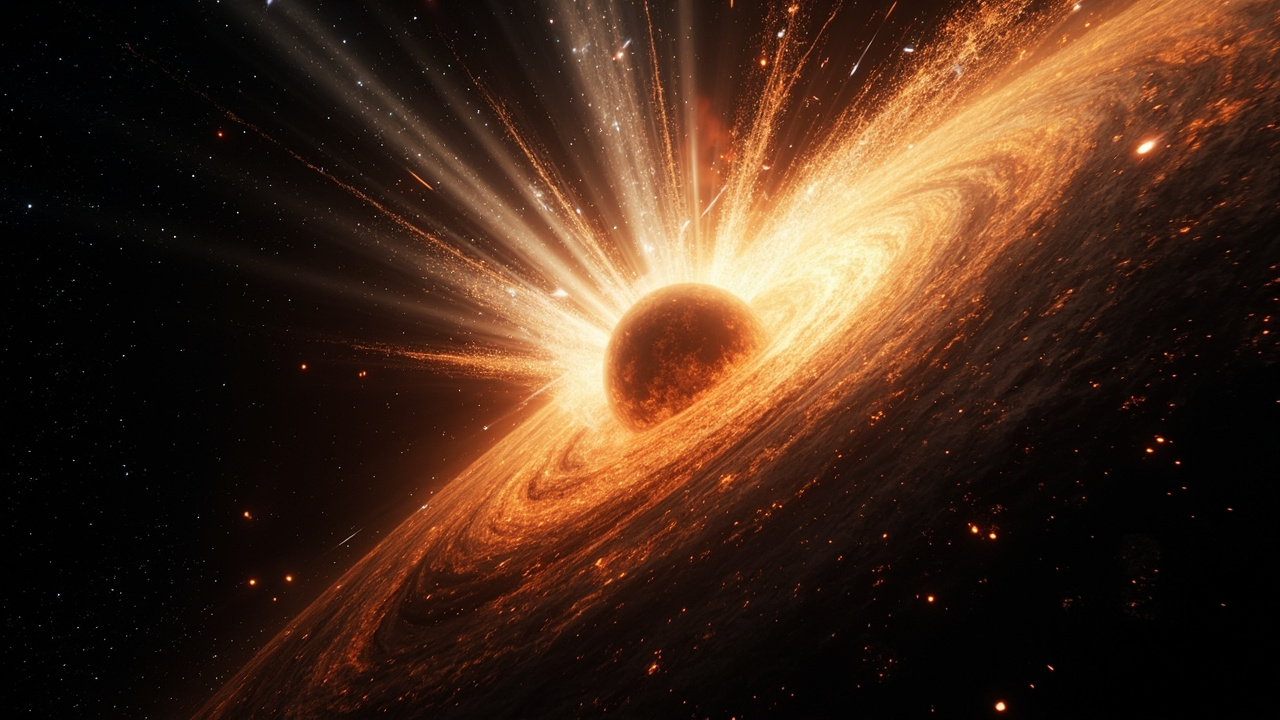
TL;DR: A Southwest Research Institute-led team found that adding temperature-dependent rock strength to Moon-forming impact models can produce either an intact Moon in about five hours or a debris disk that later builds the Moon.
New computer models of the collision that built the Earth-Moon system show two sharply different birth paths for the Moon, depending on heat and rock strength inside the colliding worlds. The work was conducted by the Southwest Research Institute (SwRI) in collaboration with scientists at the University of Arizona and was published in The Astrophysical Journal Letters, according to Southwest Research Institute.
The central change is the treatment of the colliding planets as solid, geologic bodies rather than largely fluid masses. The simulations add temperature-dependent geologic strength, a property earlier giant-impact calculations left out as unimportant at such high energy. With that physics included, the same broad impact setup can leave a coherent Moon or destroy the impactor into orbiting debris, according to the Boulder SWRI research summary.
The paper is titled “Collisional Capture of an Intact Moon Depends on Strength” and lists C. Adeene Denton, Erik Asphaug, Namya Baijal and Robert E. Melikyan as authors, with access through DOI: 10.3847/2041-8213/ae91e9. The journal record identifies Denton with Southwest Research Institute and Asphaug, Baijal and Melikyan with the University of Arizona, according to the journal publication record for Collisional Capture of an Intact Moon Depends on Strength.
What the new models tested
The study revisits the giant-impact idea in which a Mars-sized body called Theia struck the early Earth and created the Earth-Moon system. That scenario traces in part to a foundational 2001 paper by Robin Canup and Erik Asphaug, described by SwRI as a basis for later work on Theia and Earth.
Denton led the new calculations. She was formerly a NASA Postdoctoral Program fellow at SwRI and is now a postdoctoral researcher in SwRI’s Solar System Science and Exploration Division. Asphaug, a professor at the University of Arizona, is a co-author of the current study. Canup is now vice president of SwRI’s Solar System Science and Exploration Division in Boulder, Colorado.
The team used smoothed-particle hydrodynamics simulations with realistic strength, drawing on giant-impact simulation methods developed at the University of Bern and the University of Arizona. For the first time in this canonical-impact context, the calculations included temperature-dependent geologic strength, allowing warmer rock to behave more weakly than colder rock.
That distinction had already become routine in modeling smaller collisions. Denton noted that strength-aware methods are important for asteroid collisions and were used in her prior work on formation of the Pluto-Charon system. The open question was whether the same effect would alter a planet-scale event. The new runs indicate that it does.
Why heat and strength change the outcome
In the models, heat controls stiffness. Hotter bodies are weaker than colder ones, so the starting temperatures of Earth and Theia affect how Theia deforms, how momentum moves between the bodies, and what remains in orbit after the strike.
The published abstract reports that strength in the outer hundreds of kilometers of Theia hinders its deformation. Although that strength is small compared with stresses deep inside the planet, the resistance near the surface is enough to alter momentum transfer and produce fundamental differences in Moon formation, according to the journal publication record.
The result is sensitivity to thermal state rather than a single inevitable outcome. A hotter but still solid Theia can survive the encounter in a form that becomes an intact Moon. A colder and therefore stronger Theia, representing a later impact after more cooling, can instead produce the classic protolunar disk of iron-poor debris that later accretes into the Moon.
SwRI explains the broader logic in terms of planetary aging. Protoplanets generally begin hot and cool with age, so a hotter collision points toward an earlier event and a colder collision points toward a later event. That link connects impact timing to the Moon’s initial state and style of assembly.
Two ways to make the Moon
One pathway yields a coherent satellite quickly. When Denton used the same impact parameters as the original impact modeling, including equal internal temperature structures in both bodies, an intact Moon emerged within around five hours, SwRI reported.
The other pathway destroys Theia and spreads debris around Earth. Depending on how hot Earth and Theia are before impact, the collision can generate a massive disk of debris that eventually forms the Moon over time.
Intact-Moon results had appeared in earlier calculations, but the authors identify a new controlling factor. The work is presented as the first to show that material strength and temperature play a central role in deciding whether the Moon starts intact or is assembled from material processed within a protolunar disk.
The distinction matters because the two histories imply different early conditions. An intact survivor would preserve more of its pre-impact structure through the event. A disk-built Moon would be assembled from dispersed, heated and mixed material before gathering into a single body.
A possible clock for the giant impact
Because cooling tracks age, the temperature dependence may give researchers a new way to narrow when the Moon-forming collision happened. A hotter, weaker Theia corresponds to one timing regime; a colder, stronger Theia corresponds to another.
Canup, who was not involved in the current study, said the findings imply a potential connection between present-day lunar properties, including perhaps volatile content, and the thermal state of Earth and Theia at impact. That connection, in turn, might help scientists better constrain when the Moon-forming event occurred, according to Southwest Research Institute.
The study does not claim to fix the date of the impact. It proposes that thermal and mechanical state should now be treated as relevant variables when comparing model outcomes with lunar characteristics. Future comparisons could examine whether an intact-start or disk-assembled history better matches preserved lunar features.
SwRI frames the timing question as one of the main reasons the simulations could change understanding of Moon formation. The models do not by themselves establish the event’s date, but they add a physical link between age, temperature, strength and outcome that earlier fluid-like treatments lacked.
The composition puzzle remains
Even with the new physics, the close compositional makeup of Earth and Moon remains an open scientific question, SwRI reported. The issue is why two bodies with such a violent shared history look so similar in composition.
One possible explanation discussed in the announcement is a shared source region. Theia and the proto-Earth may have formed from a common region of the protoplanetary disk, while Mars, which is compositionally distinct from Earth and Moon, formed farther away.
Denton compared Earth and Mars to siblings from the same neighborhood of the solar system, and Earth and Moon to fraternal twins. The analogy underscores the observational constraint: any formation model must account for lunar-Earth similarity alongside Martian difference.
The new study does not resolve that composition question. It focuses on dynamics and initial assembly, leaving the chemical similarity to be addressed through formation location, mixing during impact, later processing, or a combination of factors.
How the result fits earlier impact science
The 2001 Canup and Asphaug work helped establish Theia as a leading explanation for an iron-poor Moon and an Earth-Moon system with high angular momentum. Later giant-impact modeling explored different impact angles, speeds, masses and thermal assumptions, but continued to omit material strength.
The current paper returns to otherwise identical canonical impact parameters and changes mainly the mechanical treatment. That experimental design is central to its claim: the divergent outcomes arise from different mechanical responses tied to temperature, not from selecting an entirely different collision geometry.
The abstract describes the canonical hypothesis as a differentiated Mars-sized Theia colliding with the proto-Earth and producing an iron-poor debris disk that accretes to form the Moon. The new contribution is that the same class of event can instead capture an intact Moon when strength and temperature are handled more completely.
SwRI also points to simulation videos illustrating the alternative outcomes. The announcement links to Moon-formation simulations at https://youtu.be/QAIRqc9dFHg and identifies Deb Schmid of the SwRI Communications Department as a contact at 6220 Culebra Road, San Antonio, Texas. The Boulder division address is listed as 1301 Walnut St., Suite 400, Boulder, Colorado.
For U.S. lunar science, the practical implication is a revised set of starting conditions for studies of lunar interiors, volatiles, cratering history and sample analysis. Whether the Moon began largely whole or grew from a disk affects how researchers interpret its early thermal evolution and the record preserved in its rocks.