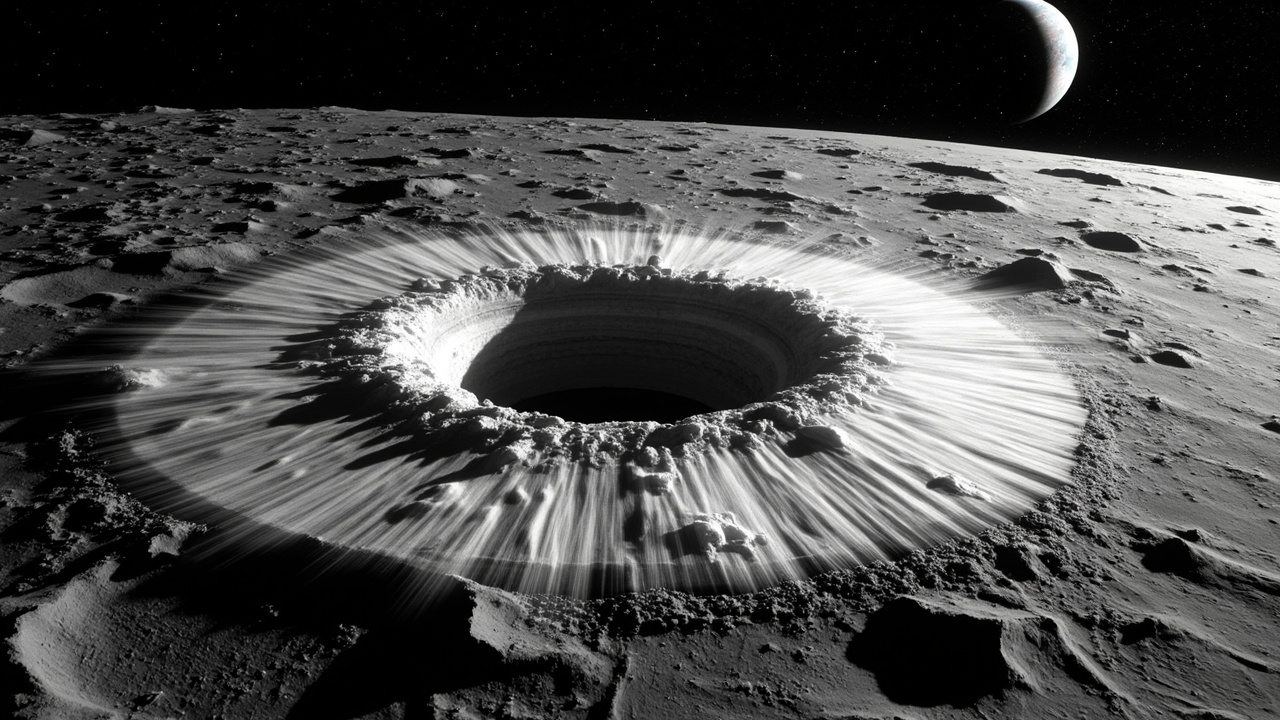
TL;DR: NASA's Lunar Reconnaissance Orbiter found a 222-meter-wide crater that formed on the Moon between April 11 and May 22, 2024, the largest fresh impact discovered during the mission.
A fresh crater twice as long as a football field
NASA's Lunar Reconnaissance Orbiter Camera team recently discovered a new crater on the Moon that is twice the length of an American football field, according to the Newsroom Universities Space Research Association report titled "NASA's Lunar Reconnaissance Orbiter Discovers a New 222-m Diameter Lunar Crater."
The study was published in Science Advances and was conducted by members of NASA's Lunar Reconnaissance Orbiter science team, including Principal Investigator and lead author Dr. Mark Robinson of Intuitive Machines and co-author Dr. Julie Stopar of USRA's Lunar and Planetary Institute.
The crater measures 222 meters in diameter, or 728 feet wide, and spans the length of two football fields. Its depth is about 43 meters on average, or 141 feet deep. NASA Science described the depth comparison in its report titled "NASA's Moon Orbiter Spots New, 'Once-in-Century' Moon Crater" by noting that the crater could fit three vertically stacked yellow school buses.
Scientists estimate that the impact occurred between April 11 and May 22, 2024, about 2.5 years before the September 2026 announcement. The impactor was a comet or asteroid fragment the size of a three- to six-story building that struck the Moon's eastern edge.
Largest fresh crater found in LRO's lifetime
The crater is scientifically important because it is the largest yet that was formed and discovered during LRO's lifetime at the Moon, according to the USRA newsroom account.
By comparing before and after images of the Moon, researchers realized they had discovered the largest, newly formed crater ever found in the solar system, as scientists reported Wednesday in Science Advances, according to NASA Science.
Scientists estimate that an impact of this magnitude happens on the Moon about once in a century or even longer. The USRA announcement described the frequency as a size estimated to form roughly once in a lifetime, or about 130 years.
Prior context from NASA Science states that for more than 17 years, LRO has been circling the Moon and using its seven instruments to map topography, surface composition, temperature, and radiation environment there. The spacecraft team has identified at least 1,000 new impact craters throughout the mission and flagged 100,000 more surface changes from an object smashing into the Moon or from debris flung out after.
NASA Science reported that this discovery highlights the value of NASA's Moon orbiter data in studying a dynamic landscape as the agency advances a sustained human presence and expanded scientific and commercial activity on the Moon.
A routine check turned into a discovery
It started as a routine data-quality check, according to NASA Science. Robert Wagner, a scientist with NASA's Lunar Reconnaissance Orbiter, scanned a giant Moon map on his computer screen when an unusually large bright spot circled by a dark halo caught his eye, as it implied that surface material in that area had been shaken up.
"I just stopped, dropped everything, and started looking into what that spot was," said Wagner, an image-processing specialist from Intuitive Machines who works with data from the Lunar Reconnaissance Orbiter Camera system.
In fall 2025, a routine temporal comparison of Wide Angle Camera image sets revealed the new crater, according to the underlying Science Advances research context summarized by NASA Science. The panel comparison used images captured by the Wide-Angle Camera in summer 2025 and images taken in spring 2011, covering an area 38 miles wide.
The white spot in that comparison is not the crater itself, but rather material flung out of the crater, according to NASA Science. Later, a series of Narrow Angle Camera images provided high-resolution, meter-scale photometric and topographic information.
The authors of the Science Advances paper on the crater were Mark S. Robinson, Aaron K. Boyd, Prasun Mahanti, Madeleine R. Manheim, Emerson J. Speyerer, Julie D. Stopar, and Robert V. Wagner, according to the USRA announcement.
Named for lunar scientist Thomas McGetchin
It is officially named McGetchin crater after Thomas McGetchin by the International Astronomical Union, according to the USRA newsroom report.
Dr. McGetchin served as Director of the Lunar and Planetary Institute, then known as the Lunar Science Institute, beginning in 1977, the same year that marked the inaugural summer of the LPI Internships in Planetary Science Program.
A renowned volcanologist and lunar scientist, McGetchin made lasting contributions to planetary science, according to the USRA account. The model of impact-crater ejecta developed by McGetchin and colleagues in 1973 remains an important framework for interpreting the formation and distribution of ejecta around impact craters and basins.
NASA Science described McGetchin as pioneering lunar scientist Tom McGetchin. Information on the planetary name is listed at the International Astronomical Union feature page referenced by USRA.
Straddling highlands and mare
The new crater seems to have formed on a boundary between the cratered and craggy lunar highlands and a wide, flat mare, according to USRA.
The crater is also surrounded by a bright blanket of ejecta — rock and dust that splashed out in all directions when the impact occurred — that extends hundreds of meters from the rim.
NASA Science reported the same ejecta pattern as material flung out of the crater. The crater shows the immediate effects of the impact cratering process before exposure to space and meteorite bombardment wears it down and hence is very useful for further studies, according to USRA.
With no atmosphere to slow them or burn them up, space rocks and other objects easily reach the lunar surface, according to NASA Science. Most are much smaller compared to the object that carved out McGetchin crater.
The smallest craters scientists can distinguish from LRO images are about 30 feet wide, the length of a three-story building laid on its side, made by rocks about 43 inches wide, the size of a monster-truck tire, according to NASA Science. Scientists estimate that impacts of this scale produce about 140 new craters across the Moon each year, while most new ones are made by microscopic projectiles that leave holes too small to identify in orbital images.
A 4-mile-wide cold spot
With its numerous instruments, the spacecraft can observe changes to the lunar surface that are not apparent in the LROC images alone, according to NASA Science. After the crater was discovered, scientists working with LRO's thermal instrument, Diviner, made follow-up observations of the site.
They found a 4-mile-wide area around the crater that is about 16 degrees Fahrenheit cooler at night than its surroundings. The post-impact image was constructed using data taken by Diviner between Nov. 15, 2025, and Feb. 18, 2026, after scientists discovered the crater in visible-light images taken by the Wide-Angle Camera.
Pre-impact temperatures are from the Diviner Global High-Resolution Mosaics, according to NASA Science. Scientists on the Diviner team reported this finding in a paper published on Sept. 16, 2026, in Science Advances.
Reporting in a second paper Wednesday in the same journal, researchers say that the cooling happens because the impact fluffs up the regolith around the crater, making it less dense and therefore less able to retain heat, according to NASA Science.
The large extent of this cold spot is striking, scientists say, because it shows that impacts can modify the Moon's surface far beyond the crater itself. These physical changes could affect how rover wheels interact with the surface, for instance, according to NASA Science.
Institutions behind the work
The study included co-author Dr. Julie Stopar of USRA's Lunar and Planetary Institute, according to USRA. The Lunar and Planetary Institute, an institute of Universities Space Research Association, was established during the Apollo program in 1968 to foster international collaboration and to serve as a repository for information gathered during the early years of the space program.
Today, the LPI is described by USRA as an intellectual leader in lunar and planetary science that serves as a scientific forum attracting visiting scientists, postdoctoral fellows, students, and resident experts. The research carried out at the LPI supports NASA's efforts to explore the solar system.
Founded in 1969, the Universities Space Research Association is an independent, nonprofit organization that advances space- and Earth-related science, engineering, and technology through research, education, and workforce development programs, according to USRA. USRA partners with government agencies, academic institutions, and industry to address scientific and technical challenges.
After the embargo lifts, USRA said anyone may view a copy of the manuscript at the Science Advances journal site, while reporters could access the paper through the EurekAlert press package.
Sources referenced
- NASA’s Moon Orbiter Spots New, ‘Once-in-Century’ Moon Crater - NASA Science (https://science.nasa.gov/solar-system/moon/nasas-moon-orbiter-spots-new-once-in-century-moon-crater/)