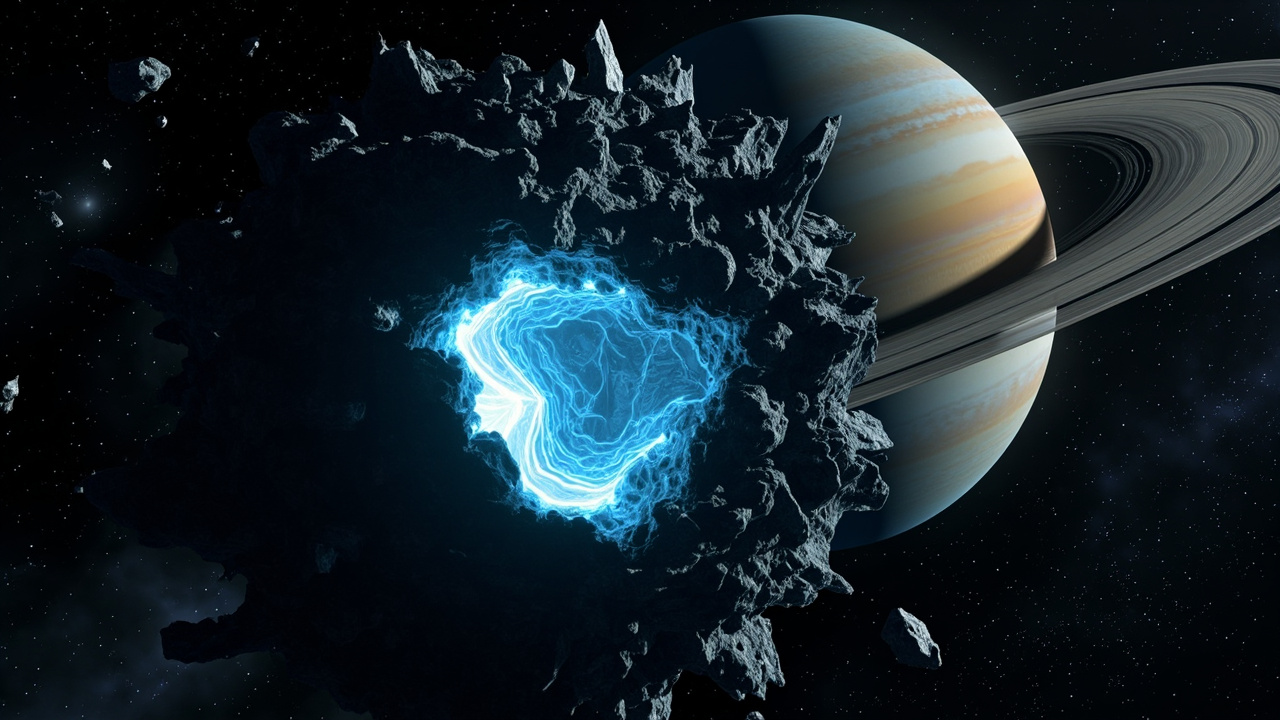
TL;DR: A University of Maryland-led simulation study found that shattering collisions do not create new subsurface oceans on icy moons, though larger moons can keep and temporarily thicken an existing ocean.
Shattering Crashes Do Not Decide Which Icy Moons Hold Oceans
A computer experiment that blew apart simulated moons and then tracked their interiors for billions of years found that catastrophic breakups leave the basic ocean verdict unchanged. Worlds that could sustain liquid water before disruption generally could do so afterward, while frozen worlds generally stayed frozen, according to the University of Maryland Department of Astronomy.
The work was led by Marc Neveu, an astronomy associate research scientist at the University of Maryland, with co-authors at the Southwest Research Institute in Colorado and the Weizmann Institute of Science in Israel. It was published on August 21, 2026, in the journal Nature Astronomy under the title “The Role of Disruptive Impacts on Ocean Generation and Longevity in Icy Moons,” according to the Southwest Research Institute.
The result addresses a direct habitability question for the outer solar system. Many moons around Saturn, Uranus and Neptune may conceal liquid water beneath miles of icy shell, and water is a central requirement for life as understood on Earth. At the same time, researchers suspect that some present-day moons are second-generation objects, broken apart and reassembled from debris after earlier moon-moon or moon-comet encounters.
Why researchers tested total disruption
The outer solar system has been described as a demolition zone where early moons may not have survived intact. Scientists have proposed that most or all smaller moons around Saturn and Uranus, defined in the study discussion as radius less than 1,000 kilometers, were disrupted in large collisions.
For Saturn’s system, disruptive collisions have even been proposed within the last 100 million years, raising the possibility that candidate ocean moons visible today reassembled relatively recently from older debris. That history prompted the central test: would a reassembled moon still develop an ocean?
Study co-author Alyssa Rhoden, a staff scientist in the Southwest Research Institute’s Solar System Science and Exploration Division in Boulder, Colorado, posed the question as whether striking a small, frozen and inactive moon could supply enough energy to start an ocean. The modeled answer was largely no. Most simulated small moons that experienced disruption either lost an ocean or never developed one.
What counted as a catastrophic impact
The team did not model ordinary cratering. It modeled events violent enough to disperse the target.
The researchers defined a disruptive impact as one in which the largest surviving fragment was less than half the size of the initial target. In practical terms, the object was broken up rather than dented.
Neveu said the runs represented approximately the largest collisions the team could devise. His interpretation was that if those extreme cases did not change the underlying ocean outcome, smaller impacts were unlikely to do so either.
That framing matters for mission planning. If giant breakups cannot easily switch a moon from frozen to ocean-bearing, then a moon’s present ocean is more likely tied to its size, composition, heat budget and long-term evolution than to a single dramatic strike.
How two kinds of models were linked
The study combined two simulation approaches that operate on very different timescales.
One component used a smoothed particle hydrodynamics model, often called SPH, to represent the collision itself. That method followed how millions of rock and ice fragments shattered, heated and then gravitationally clumped back together. The other component used a thermal-structural evolution model to follow the rebuilt moon’s interior as heat was produced, transported and lost, determining whether buried ice could melt or remain solid.
By linking impact physics to long-term thermal evolution, the scientists compared three histories for the same type of object: conditions before impact, conditions after reassembly, and evolution without any collision. They applied the comparison to moons of roughly 500 and 1,000 kilometers in radius, then projected interior development across 4.5 billion years.
That long projection allowed the team to separate brief impact heating from durable habitability. A crash can deposit substantial energy, but liquid-water persistence depends on whether heat is retained over geologic time.
Larger moons keep oceans; smaller moons lose insulation
Size emerged as a stronger control than collision violence.
In simulated moons around 1,000 kilometers in radius or larger, an existing ocean generally survived disruption. Impact energy converted into additional interior heat that could make an existing ocean thicker for a couple billion years. The ocean’s depth and lifetime were therefore affected, even though the impact did not determine whether an ocean was possible.
The outcome reversed for smaller moons near 500 kilometers in radius. Before impact, those objects could retain a mixed outer layer of ice and rock that functioned as insulation, trapping internal warmth and helping sustain liquid beneath the surface. Disruption destroyed that arrangement.
After reassembly, the materials sorted by density. Rock sank toward the center while ice rose toward the surface. The resulting body had a more distinct core and a thicker, cleaner ice shell, but it had lost the mixed insulating layer. Consequently, the rebuilt small moon had greater difficulty retaining enough heat for an ocean.
Critically, neither size regime produced an ocean that otherwise would have remained frozen. Collisions changed thickness and longevity, but the models did not show them generating entirely new oceans.
Why added energy cools too fast
The result may seem counterintuitive because more impact energy should mean more melting. The researchers found that breakup itself allows heat to escape rapidly.
SwRI co-author Raluca Rufu said the added energy dissipates very quickly, working against ocean formation rather than promoting it. Rhoden compared the process to cooking potatoes of different sizes, noting that smaller pieces heat and cool faster than a whole potato. When a small moon is dispersed into fragments, those pieces shed heat quickly.
Another post-impact change was ice-rock differentiation. During and shortly after the collision, ice could briefly melt; heavier rocky material then sank toward the core before water refroze. The consolidated object therefore ended with a more substantial core and a thicker ice layer surrounding it.
For larger moons with an ocean before impact, sufficient mass and heat retention allowed liquid to persist. For smaller moons, the combination of rapid cooling and structural reorganization tended to suppress ocean formation.
Which real moons are affected
The findings apply to a broad set of candidate ocean worlds and future exploration targets.
The study discussion included Saturn’s mid-sized moons Mimas, Enceladus, Tethys, Dione and Rhea; the Uranian moons Miranda, Ariel, Umbriel, Titania and Oberon; and Neptune’s large moon Triton. Those worlds differ in size, orbit, surface geology and suspected interior state, but all belong to the population NASA and other agencies consider when assessing where subsurface water may exist.
Rhea drew particular attention because its ancient craters appear unusually smooth and softened, as though warmed from below rather than altered by sunlight. Neveu compared the appearance to a snowman softening after warm weather, except that the relevant heat source would have been internal. A past collision that strengthened an existing interior ocean was offered as one possible explanation for that softened terrain.
On the other end, the results place limits on recent-disruption ideas for two of Saturn’s most closely studied ocean candidates. Rhoden said it now seems unlikely that Enceladus or Dione, both thought to harbor oceans today, were disrupted and reassembled during the past 100 million years. A smaller reassembled body would have faced difficulty forming or preserving such an ocean.
What this means for searching for life
The practical implication is not that collisions are irrelevant, but that they should not be treated as an easy way to make an icy moon habitable.
Knowing which moons most plausibly retain water can influence spacecraft destinations, flyby and orbiter measurements, and instrument requirements. The researchers pointed to several ocean indicators, including the gravitational signature of hidden liquid, salty surface deposits and icy cryovolcanoes.
Instrument sensitivity also depends on expected biology. Neveu said a mission designed to detect a sparse microbial population would differ fundamentally from one designed for a densely inhabited ocean. Collision history is only one variable; tidal heating from gravitational flexing remains at least as important.
Neveu described the present work as part of a broader effort to connect moon orbits, collision likelihood, tidal heat and interior evolution. A long-term goal is to model an entire moon system dynamically, watching moons move, collide and thermally evolve, potentially reconstructing events around Saturn, Uranus and Neptune.
The paper can be accessed through DOI https://doi.org/10.1038/s41550-026-02955-x, as listed by the Southwest Research Institute.