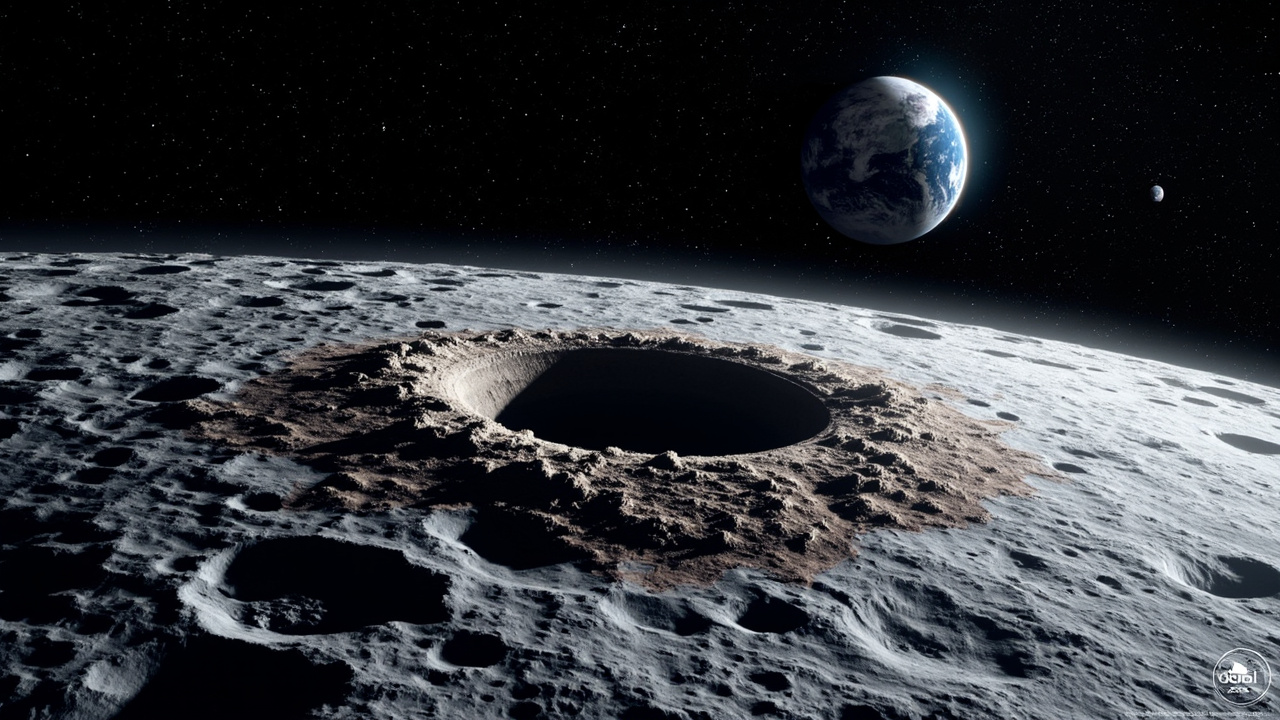
TL;DR: NASA's Lunar Reconnaissance Orbiter found a 222-meter-wide crater named McGetchin that formed in spring 2024, the largest fresh impact ever seen in the solar system and a roughly once-in-132-year event described in two papers on Sept. 15, 2026.
A routine check revealed an enormous fresh scar
It began as a standard quality review of lunar imagery. According to NASA Science, Robert Wagner, an image-processing specialist with the Lunar Reconnaissance Orbiter Camera system employed by Intuitive Machines, was examining a broad mosaic of the Moon when a bright patch ringed by shadowy terrain drew his attention. The pattern suggested ground that had been recently disturbed.
Wagner said in the agency account, "I just stopped, dropped everything, and started looking into what that spot was." Comparison of earlier and later coverage confirmed that the feature had not been present years before.
That follow-up work identified the largest newly formed crater yet documented anywhere in the solar system, detailed by researchers Wednesday in Science Advances. The result, according to NASA Science, underscores how long-term orbital records can capture a still-changing Moon at a time when the United States is preparing for extended crew activity and broader commercial and research operations on the surface.
The early view was striking because the conspicuous white marking was not the bowl itself. In a Wide-Angle Camera comparison covering a 38-mile-wide region, the pale zone represented debris thrown outward, set against pictures from spring 2011 and summer 2025.
When and where McGetchin formed
Scientists named the feature McGetchin for pioneering lunar researcher Tom McGetchin, as reported by NASA Science. A separate account from the Associated Press identifies him as the late Thomas McGetchin, a former director of Houston's Lunar and Planetary Institute.
The impact occurred on the Moon's eastern edge between April 11 and May 22, 2024. Investigators infer that a comet fragment or asteroid roughly the size of a three- to six-story building struck the airless surface during that interval.
The resulting depression is 728 feet, or 222 meters, across — described by NASA as spanning two football fields — and 141 feet, or 43 meters, deep. The agency illustrated the depth as room for three yellow school buses stacked vertically. The Associated Press noted that the hole is larger than the Roman Colosseum and is steep-sided.
Its coordinates were reported as 1.3536°N, 67.1765°E, near a highland-mare boundary just inside the outer ring of the Crisium basin. The Lunar and Planetary Institute account places the event about 2.5 years before publication and gives an average depth near 43 meters.
Why scientists call it a once-in-a-century impact
Crater-production calculations indicate that a lunar impact on this scale should occur only about once every 132 years on average, according to the Science Advances research summarized by NASA Science and the Associated Press. NASA's public summary phrases the recurrence as about once in a century or even longer.
The authors called the occurrence an effectively once-in-a-lifetime observation. It exceeds the prior largest contemporary lunar crater found during the orbiter mission, a 70-meter feature, by a factor of three. The new crater's formation energy was calculated at 6.5 x 10¹⁰ kilojoules in one of the studies, more than an order of magnitude above the earlier 70-meter event.
For perspective, the Moon preserves far older and vastly larger basins, including one more than 1,500 miles, or 2,400 kilometers, wide, according to the Associated Press. McGetchin is exceptional not for absolute size, but because researchers caught its creation and immediate aftermath.
The Lunar and Planetary Institute emphasized that the crater displays immediate impact effects before long exposure to space weathering and continued bombardment degrades the details, making it especially useful for testing formation models.
How the orbiter tracked it down
NASA's Lunar Reconnaissance Orbiter has circled the Moon for more than 17 years, since its 2009 launch, using seven instruments to map topography, composition, temperature and radiation, according to NASA Science. The mission team has cataloged at least 1,000 new impact craters and marked about 100,000 additional surface alterations caused by direct strikes or flying debris.
The new feature first emerged through month-to-month comparison of Wide-Angle Camera images, which have covered the entire Moon since 2010. The Lunar Reconnaissance Orbiter Camera project account says the temporal ratio — a comparison of views taken months apart under matching illumination — revealed the anomaly in late summer 2025. At that point the archive contained several earlier Narrow Angle Camera frames of the site but no later high-resolution coverage.
Over the following six months, the narrow-angle imagers collected views whenever the monthly geometry allowed, an opportunity lasting only a few days each month. High-sun images emphasized brightness differences, low-sun pictures highlighted boulders and small relief, and mid-morning or mid-afternoon illumination near 45 degrees supported stereo processing into terrain models.
The Associated Press reported a similar sequence: wide-angle data collected soon after formation were not recognized in the data volume until August 2025, followed by closer imaging last fall and confirmation early this year. Neither ground- nor space-based telescopes caught the 2024 strike as it happened.
A surprisingly wide zone of churned ground
High-resolution topography shows an average diameter of 222 meters, a depth of 43 meters, wall slopes averaging 24 degrees and approaching 40 degrees locally, and a rim standing about 8 meters above the former surface, according to the Lunar Reconnaissance Orbiter Camera team. Those proportions closely match expectations from lunar observations, terrestrial craters and laboratory experiments.
More surprising was the geographic reach of subtle disturbance. Researchers detected surface changes more than 100 kilometers from McGetchin, or more than 1,000 crater radii. The Associated Press placed the extensively churned area at more than 66 miles, or 100 kilometers.
Mark Robinson, chief scientist for the orbiter cameras now with Intuitive Machines and lead author of one study, said ejected dust and soil left at a steeper angle than anticipated, according to the Associated Press account. The camera team described initial high-speed ejection above 10 degrees, rather than the roughly 2 degrees often assumed, alongside evidence for at least two stages of continuous ejecta near the rim.
Because there is no atmosphere to slow or consume incoming bodies, even modest objects reach the ground. NASA Science says the smallest craters distinguishable in orbiter imagery are about 30 feet wide — comparable to a three-story building on its side — created by rocks about 43 inches across, likened to a monster-truck tire. Impacts at that modest scale are thought to create roughly 140 fresh craters annually, while countless microscopic particles make pits too small for orbital detection.
A four-mile-wide cold spot
A second investigation used Diviner, the orbiter's thermal radiometer, to examine nighttime temperatures. The instrument team found a roughly 4-mile-wide, or 7-kilometer-wide, zone around McGetchin that is about 16 degrees Fahrenheit cooler at night, equivalent to 8 to 9 kelvins, according to NASA Science and the Associated Press.
The researchers concluded that the strike fluffed the upper regolith, lowering its density and ability to store daytime heat. Diviner observations used for the after-impact assessment spanned Nov. 15, 2025, to Feb. 18, 2026, compared with earlier global high-resolution temperature mosaics.
David Paige of the University of California, Los Angeles, a co-author on the thermal study, compared the process to cultivation. The Associated Press quoted Paige saying in a statement, "We're now thinking of impacts as a way to garden the regolith."
The broader survey found that every newly identified crater larger than about 30 meters produced a measurable cold feature, with larger craters showing stronger cooling. The authors suggested that repeated loosening around fresh impacts may rework shallow lunar soil at a rate comparable to direct excavation, making it an important driver of surface evolution on airless bodies.
What a fresh crater means for astronauts
A pristine crater of this dimension provides a natural test of ejection, rim uplift, boulder distribution and distant alteration. Because McGetchin sits across volcanic mare basalt and ancient highland crust, excavated material from 20 or more meters down offers a glimpse beneath a surface blurred by billions of years of mixing, according to the camera team.
The findings also carry practical consequences. NASA Science noted that broad physical loosening could influence how rover wheels grip the ground. Robinson told the Associated Press that the next task is to estimate hazards from high-velocity particles thrown by distant impacts, information that could guide engineers strengthening habitats and equipment.
Long-term resurfacing may be faster than commonly assumed. Robinson said the orbiter's catalog implies that the top inch, or 2 centimeters, of lunar soil is overturned by ejected material about every 80,000 years. Contrary to the idea that Apollo bootprints will survive indefinitely, he said in an email quoted by the Associated Press that they will definitely disappear on that timescale.
The formal name honors McGetchin's work on ejecta. The Lunar and Planetary Institute noted that he led the institute beginning in 1977 and that a 1973 ejecta framework developed with colleagues remains influential. The International Astronomical Union approved the McGetchin designation, linking an Apollo-era volcanologist and crater-mechanics researcher to a feature now clarifying those same processes.
Sources referenced
- NASA's Moon Orbiter Spots New, 'Once-in-Century' Moon Crater - NASA Science (https://science.nasa.gov/solar-system/moon/nasas-moon-orbiter-spots-new-once-in-century-moon-crater/)
- NASA spacecraft discovers a huge new crater on the moon | KSL.com (https://www.ksl.com/article/51624873/nasa-spacecraft-discovers-a-huge-new-crater-on-the-moon)