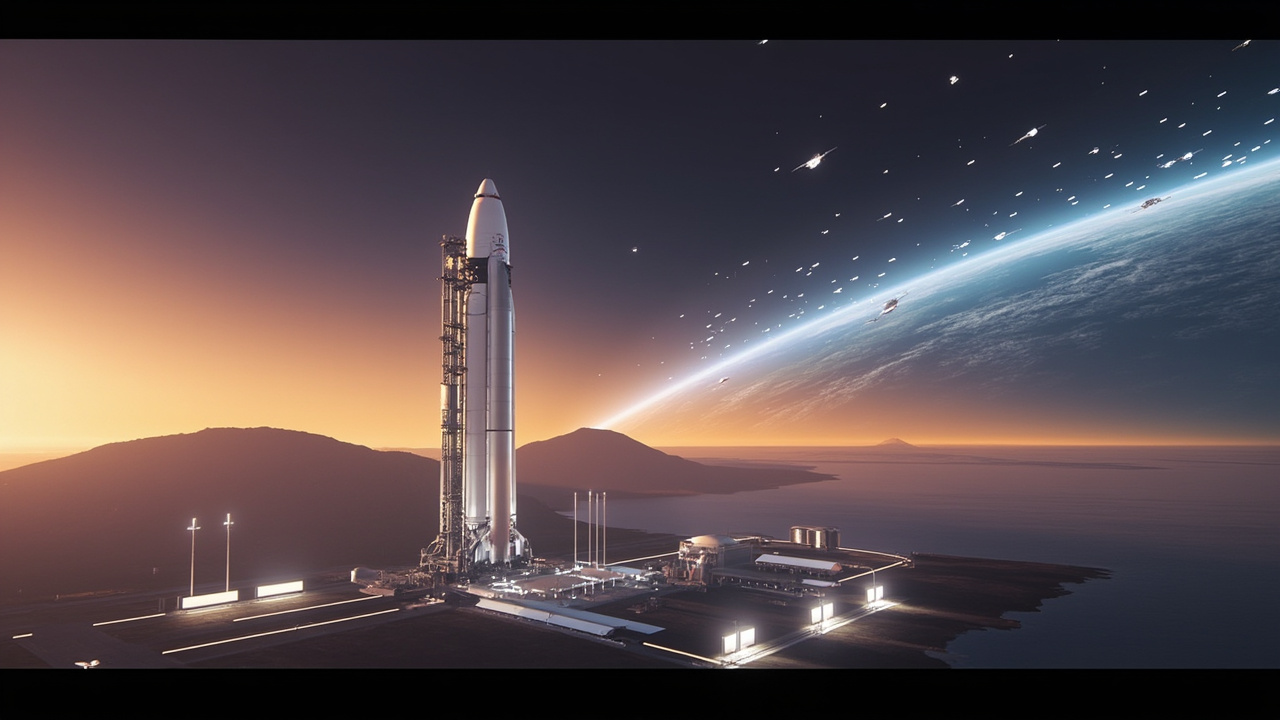
TL;DR: Starship Flight 14 Will Carry Paying Payloads
SpaceX plans to fly production Version 3 Starlink satellites on Starship Flight 14 later in September 2026, making it the program's first revenue-generating mission, Chief Financial Officer Bret Johnsen said Sept. 10 at the Goldman Sachs Communacopia and Technology Conference.
A Commercial Turn For Starship
According to Aviation Week, Johnsen told investors that Flight 14 remained due this month and would move Starship beyond demonstration runs. As reported by Aviation Week, his message was direct: “It is going to be a revenue-generating flight.”
The distinction matters because earlier Starship missions centered on vehicle testing. According to the transcript of the Goldman Sachs session published by Investing.com, Johnsen said he valued demonstration flights but was now focused on production cadence.
That production cadence means flying operational hardware that can enter commercial service. According to TeslaNorth.com, Johnsen described Flight 14 as carrying production Version 3 Starlink satellites into operational orbit.
SpaceX had positioned Flight 14 as an orbital insertion attempt. According to TeslaNorth.com, the company had already filed Flight 14 as the program's first genuine orbital insertion attempt after earlier suborbital tests.
The timing places the flight in the second half of September 2026. According to Aviation Week, Johnsen confirmed on Sept. 10 that the mission was still due this month.
SpaceX also highlighted Flight 14 hardware in advance. According to Aviation Week, the company released an image of testing of the booster assigned to Flight 14.
The conference appearance itself drew industry attention. According to TeslaNorth.com, SpaceX promoted Johnsen's fireside chat live from its investor-relations events page.
Goldman Sachs analyst Eric Sheridan moderated the discussion. According to the transcript published by Investing.com, Sheridan framed the session as a fireside chat covering launch, connectivity and artificial intelligence infrastructure.
What Flight 13 Proved
Flight 13 supplied the technical foundation for the revenue attempt. That mission launched as Starship 40 and Booster 20 from the company's facility in Cameron County, Texas, on July 24, 2026, according to Stocktwits.
According to the transcript published by Investing.com, Johnsen called Flight 13 a huge milestone event with extensive learning for engineers.
One result involved payloads. According to the transcript published by Investing.com, Flight 13 delivered demonstration payloads of V3 satellites.
A second result involved propulsion. According to the transcript published by Investing.com, the mission included a relight of the Raptor engine in space.
A third result involved recovery of the upper stage. According to the transcript published by Investing.com, the second stage achieved a soft precision splashdown over the ocean.
Johnsen emphasized the softness of the ocean touchdown. According to the transcript published by Investing.com, he described it as the softest splashdown of the second stage to date.
Recovery crews then retrieved the vehicle. According to the transcript published by Investing.com, a SpaceX recovery team towed the stage back to shore.
The vehicle attracted attention because of its size. According to the transcript published by Investing.com, Johnsen compared its appearance during towing to a big whale.
Engineers then gained direct access to flight hardware. According to the transcript published by Investing.com, engineers were able to climb over the returned vehicle to examine the heat-shield environment.
Heat-shield performance was a central lesson. According to the transcript published by Investing.com, Johnsen said data on how the heat shield performed would carry into Flight 14 and beyond.
The review period was compressed. According to the transcript published by Investing.com, Johnsen said substantial learning occurred in the weeks after Flight 13.
Why Production V3 Starlinks Matter
The payload shift from demonstration units to production units defines Flight 14. According to TeslaNorth.com, Flight 14 will use production Version 3 Starlink satellites as the commercial payload.
That change links launch testing to communications revenue. According to TeslaNorth.com, Johnsen presented the V3 satellites as the payload that turns the mission into a revenue flight.
The broader goal is steadier operations. According to TeslaNorth.com, Johnsen framed the mission as part of a shift from demonstration flights toward a steadier production cadence.
According to Stocktwits, Flight 14 will carry production Starlink satellites into orbit and mark a shift from test flights to commercial operations.
The development effort behind that shift has spanned years. According to Stocktwits, Starship reflects years of development efforts worth billions of dollars.
Lower launch cost is the economic rationale. According to Stocktwits, management has said Starship is meant to cut the cost of putting mass into orbit by 99 percent or more versus historical averages.
Reusing hardware is central to that cost case. According to Stocktwits, Johnsen said information from test flights will inform efforts to reuse both stages of the two-stage vehicle.
Future recovery attempts will build on Flight 14. According to the transcript published by Investing.com, getting a chance at bringing back both the first and second stage will be a major milestone later this year.
Falcon 9 provides the reusability precedent. According to the transcript published by Investing.com, SpaceX has reflown more than 500 Falcon 9 boosters since December 2015.
Johnsen linked those lessons to Starship. According to the transcript published by Investing.com, he said the same reusability lessons are now being applied to Starship.
Space Business Still In Investment Phase
The commercial step follows heavy spending. For the period ended June 30, SpaceX's Space segment posted a $542 million operating loss on $962 million of revenue, according to Stocktwits.
Research spending rose sharply. According to Stocktwits, research and development in the segment rose to $1.08 billion in the quarter, up 55% from a year earlier.
Hardware, engines and test flights drove the increase. According to Stocktwits, the company poured money into Starship hardware, engines and test flights during the quarter.
The first-half result was also negative on an operating basis. According to Stocktwits, the Space segment lost $1.2 billion from operations for the first half of 2026.
The quarterly report provides context for the revenue milestone. According to Stocktwits, the commercial flight follows a costly development year for the Space segment.
Investor interest remains tied to launch cadence. On Stocktwits, retail sentiment around SPCX fell from neutral to bearish over the 24 hours surrounding the announcement, while message volume remained low.
The stock context reflects a public listing. According to Stocktwits, SPCX stock closed that Thursday at around $148, above its $135 IPO price but below its all-time high of around $220.
AI Compute And Connectivity Plans
Starship underpins projects beyond broadband. According to the transcript published by Investing.com, Johnsen described Starship as core to the rest of the business across segments.
Vertical integration was the management theme. According to the transcript published by Investing.com, Johnsen said vertical integration is core to the company.
Johnsen traced that approach to early rocket work. According to the transcript published by Investing.com, he said the company adopted vertical integration because suppliers could not match its pace or quality needs.
The same approach extended to communications. According to the transcript published by Investing.com, SpaceX owns launch, satellite manufacturing and the customer relationship for its communications business.
SpaceX is now applying that model to artificial intelligence infrastructure. According to the transcript published by Investing.com, the company is building its own buildings, power systems and models for AI customers.
Orbital compute is the longer-term element. According to TeslaNorth.com, the company described orbital compute satellites as targeted for first launches next year with scale into 2028.
Terrestrial compute is the nearer-term element. According to TeslaNorth.com, terrestrial AI compute remains on a path toward a $100 billion annualized revenue run rate by year-end.
A new hosting agreement supports that target. According to Stocktwits, a newly closed hosting deal with an unnamed customer will add about $13 billion in annual recurring revenue starting Dec. 1.
The monthly equivalent is about $1.11 billion. According to the transcript published by Investing.com, the hosting deal adds about $1.11 billion in monthly recurring revenue.
Connectivity expansion continues in parallel. According to the transcript published by Investing.com, Starlink operates in more than 170 countries.
Enterprise and mobility markets are growing. According to Stocktwits, Starlink has moved beyond its early phase into enterprise and mobility markets, including a large aircraft backlog.
Awareness remains a constraint abroad. According to Stocktwits, Johnsen said awareness remains the main limiter outside the United States.
Next-generation satellites are planned for 2027. According to Stocktwits, SpaceX will fly next-generation satellites in 2027.
Direct-to-phone service is targeted later. According to Stocktwits, the company plans to turn on a full 5G-quality direct-to-phone service in the first half of 2028 using spectrum acquired from EchoStar.
Johnsen tied those services to the same launch system. According to the transcript published by Investing.com, he presented Starship as the backbone supporting broadband, mobile direct-to-device service and future AI satellite deployment.
Sources referenced
- SpaceX's Next Starship Flight To Generate Revenue | Aviation Week (https://aviationweek.com/space/launch-vehicles-propulsion/spacexs-next-starship-flight-generate-revenue)
- SpaceX Says Starship Flight 14 Will Generate Revenue With Starlink V3 | TeslaNorth.com (https://teslanorth.com/2026/09/10/spacex-flight-14-starlink-v3-revenue/)