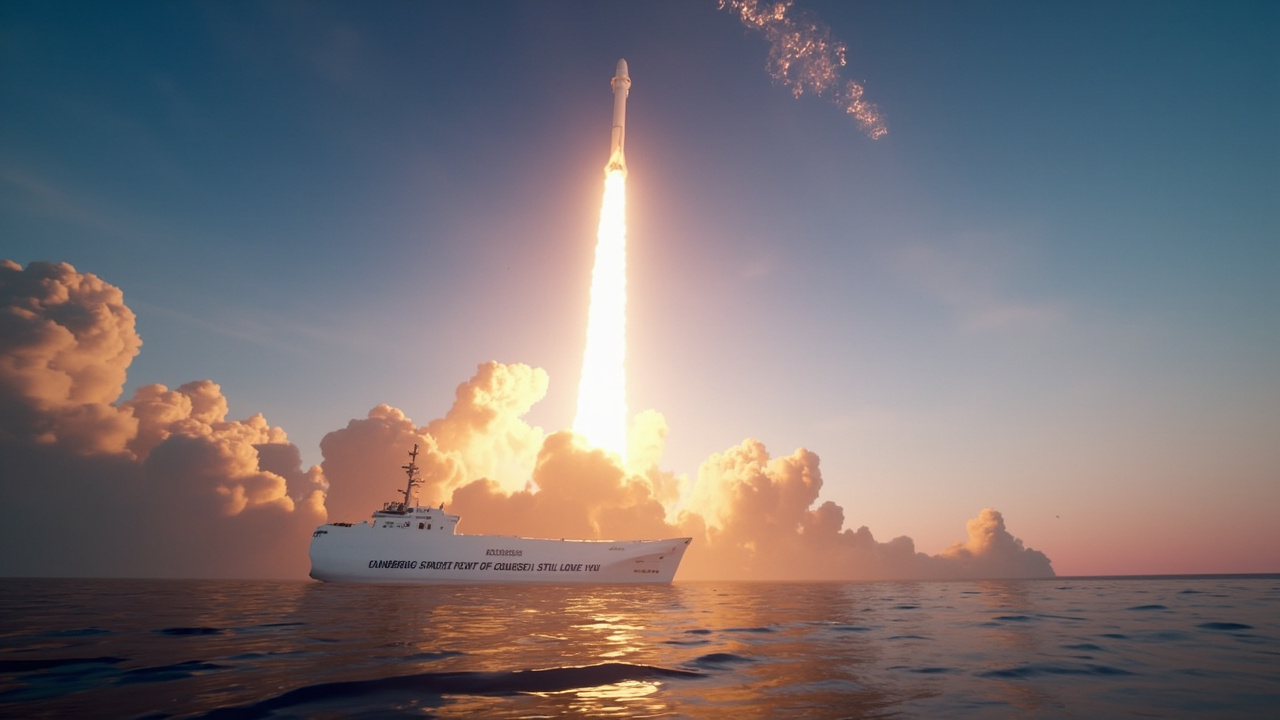
TL;DR: SpaceX targeted its 80th Starlink flight of 2026, the Starlink 15-24 mission from Vandenberg Space Force Base, as part of a shift of Falcon 9 Starlink launches to California while Florida pads are prepared for Starship.
A Labor Day weekend Starlink flight
SpaceX lined up the Starlink 15-24 mission to lift off from Space Launch Complex 4 East at Vandenberg Space Force Base in California, according to Spaceflight Now.
That report lists liftoff at 7:26 a.m. PDT, or 10:26 a.m. EDT and 1426 UTC, and describes a southeasterly trajectory after leaving the pad. A separate pre-launch schedule published by Astronomy Magazine listed Starlink Group 15-24 from Vandenberg at 6:59 a.m. EDT on Sunday, Sept. 6, with the booster again targeting the droneship Of Course I Still Love You.
The mission was identified as the 80th Starlink mission of the year. It was also described as the third Starlink mission since SpaceX announced that it would no longer launch its broadband internet satellites on Falcon 9 rockets from Florida.
Spaceflight Now quoted Kiko Dontchev, Vice President for Launch at SpaceX:
“From here on, Starlink missions out of Florida will fly on Starship,”
Booster B1088 and Pacific recovery plan
The mission was assigned to Falcon 9 first-stage booster tail number B1088, according to Spaceflight Now.
The booster was slated for its 19th flight. Its prior assignments were listed as three national security missions, Transporter-12, NASA’s SPHEREx mission, and 13 batches of Starlink satellites.
The recovery plan called for landing nearly 8.5 minutes after liftoff on the droneship Of Course I Still Love You, positioned in the Pacific Ocean. Spaceflight Now reported that landing as the 223rd landing on that vessel and the 659th Falcon booster landing to date.
Astronomy Magazine, in its schedule for the launch week of Aug. 31 to Sept. 6, also associated both Group 15-23 and Group 15-24 with Pacific recovery on Of Course I Still Love You. For Group 15-23, targeted for Sept. 2 at 3:46 a.m. EDT from Vandenberg, the magazine said the Falcon 9 booster was expected to land on that droneship.
A 27-satellite V2 Mini payload
The payload was described as 27 Starlink satellites, with detailed pre-launch coverage by Tech Times identifying them as Starlink V2 Mini satellites.
In that Sept. 3 report, Tech Times described a Friday, Sept. 4, four-hour window opening at 11:28 UTC, or 7:28 a.m. ET, and remaining open through 15:28 UTC, or 11:28 a.m. ET. That preview said the rocket would fly southeast to low Earth orbit, with coverage available through spacex.com and streaming typically beginning approximately five minutes before liftoff. Booster recovery was expected on one of SpaceX’s Atlantic drone ships.
The same Tech Times preview characterized the Friday mission as the company’s 103rd orbital flight of 2026 and its 686th overall. It said the flight arrived eleven days before SpaceX’s Federal Communications Commission-filed target of Sept. 15 for Starship Flight 14, described as the first Starship mission licensed for orbital V3 satellite deployment.
Tech Times reported that the V2 Mini era had produced every Starlink satellite launched on Falcon 9 since February 2023, and described Friday’s batch as one of its remaining entries.
Why the V2 Mini mattered
The V2 Mini platform first flew in February 2023, according to Tech Times. The publication said it was not a scaled-up version of the original Starlink design, but a substantially different satellite.
Each unit weighed approximately 740 kilograms, or 1,631 pounds, for initial production versions, with the current Optimized variant closer to 525 kilograms, or 1,157 pounds. Tech Times said that mass change explained why the same Falcon 9 that originally carried 22 V2 Minis per launch now carries 27 to 29 satellites.
Each V2 Mini delivers approximately four times the broadband throughput of the first-generation V1.5 satellites it is replacing, according to Tech Times.
E-band, lasers and argon thrusters
Tech Times attributed that throughput gain to three engineering upgrades.
First, the satellites use E-band frequencies, the 71 to 86 GHz millimeter-wave band, for backhaul connections between satellite and ground.
Second, they carry optical inter-satellite links. Tech Times explained that this means they route data through the constellation via laser rather than relying on a ground station at every hop, a capability that extends coverage into areas far from any SpaceX gateway.
Third, they use argon Hall-effect thrusters for orbital maneuvering. The report listed 170 millinewtons of thrust at 2,500 seconds specific impulse, drawing 4.2 kilowatts of power. That represents 2.4 times the thrust and 1.5 times the fuel efficiency of the krypton thrusters used on V1.5 satellites, according to Tech Times. The report added that argon’s higher mass availability and lower cost compared with krypton reduce operating expenses while improving the constellation’s ability to maintain precise orbital slots.
Direct-to-Cell and ordinary phones
A subset of the V2 Mini fleet — the Direct-to-Cell variant, developed jointly with T-Mobile and now deployed as Starlink Mobile — was designed to connect a standard, unmodified LTE phone directly to a satellite without additional hardware or software, according to Tech Times.
The technical answer described in that report is the eNodeB modem. In a standard 4G LTE network, an eNodeB, short for evolved Node B, is the base station at the top of a cell tower. It handles the radio link with devices in range, manages radio resource allocation and scheduling, applies encryption, facilitates handoffs between towers, and connects to the carrier’s core network via the S1 interface.
What SpaceX did, according to Tech Times, was install a complete eNodeB modem inside each Direct-to-Cell satellite. From a T-Mobile phone’s perspective, the report said, there is no difference between the satellite passing overhead and a cell tower on a building. The phone receives downlink beacon channels as it would from a terrestrial tower, responds through the standard LTE random-access procedure, and completes a connection that registers on T-Mobile’s network as a standard roaming event.
The central engineering challenge is Doppler compensation. Tech Times said a Starlink satellite orbits at approximately 340 to 355 kilometers, or 211 to 221 miles, in altitude at roughly 7.8 kilometers per second, or 4.85 miles per second — about 28,080 kilometers per hour, or 17,446 miles per hour. That velocity produces a substantial Doppler shift. SpaceX’s custom silicon processes that shift in real time, keeping the link stable as the satellite moves across the sky, according to Tech Times.
The practical result described was that any 4G LTE phone — a two-year-old Android, an iPhone or a budget handset — can access Starlink Mobile coverage where no ground tower reaches, without downloading an app or changing a setting.
As of March 2026, Starlink Mobile was active across 32 countries on six continents, serving approximately 10 million active users per month, with a target of 25 million by year’s end, according to Tech Times. The Direct-to-Cell constellation was approaching 650 launched spacecraft.
Flight three days earlier
Friday’s planned mission followed a Sept. 1 launch — the 102nd SpaceX orbital mission of 2026 — which also carried 27 Starlink V2 Mini satellites and lifted off from Vandenberg Space Force Base at 1:18 a.m. PDT, or 4:18 a.m. EDT, according to Tech Times.
Astronomy Magazine also tracked a rapid Starlink cadence from Vandenberg that week, including two Group 15 flights. Its schedule listed Group 15-23 on Sept. 2 and Group 15-24 on Sept. 6.
Florida towers and Starship Flight 14
The broader context for moving Falcon 9 Starlink missions west was Starship work in Florida, according to Spaceflight Now.
SpaceX is working on three Starship launch towers in Florida: one at Launch Complex 39A at NASA’s Kennedy Space Center and two at Space Launch Complex 37 at Cape Canaveral Space Force Station.
The company has said it aims to launch its first Starship mission from Florida before the end of the year. SpaceX is working toward its first orbital launch of the more than 400-foot-tall rocket, which will fly from Starbase, Texas, according to Spaceflight Now.
For the forthcoming Starship Flight 14, SpaceX completed single-engine and six-engine static fire tests for Ship 41 and a 33-engine static fire test for Booster 21. Both vehicles will fly on that mission, according to Spaceflight Now. A launch date had not been announced, but hazard warnings for aviators and mariners suggested that the mission may fly no earlier than Sept. 15.
That Sept. 15 date also appeared in Tech Times as the Federal Communications Commission-filed target for Starship Flight 14 and the first licensed orbital V3 deployment.
What to watch next
For U.S. readers, the near-term signal was cadence and location: continued Falcon 9 Starlink launches from Vandenberg, Pacific droneship recoveries, and Florida infrastructure being reserved for Starship.
The payload signal was generational change. Tech Times framed the late V2 Mini flights as the twilight of a design that had carried Falcon 9 Starlink launches since February 2023, with larger V3 satellites and Starship deployment as the next step.
Sources referenced
- SpaceX launches 80th Starlink mission of 2026 – Spaceflight Now (https://spaceflightnow.com/2026/09/05/live-coverage-spacex-to-launch-80th-starlink-mission-of-2026/)
- Starlink V2 Mini Twilight: Falcon 9 Launches Friday as Starship V3 Nears – Tech Times (https://www.techtimes.com/articles/326555/20260903/starlink-v2-mini-twilight-falcon-9-launches-friday-starship-v3-nears.htm)