TL;DR: SpaceX flew Starship into Earth orbit for the first time on Sept. 28, 2026, deploying 26 Starlink V3 satellites before cutting a planned 10-hour mission to about three hours after an engine problem.
Starship finally reaches orbit on Flight 14
SpaceX launched its giant Starship system from the company's Starbase facility at Boca Chica Beach in Texas on Monday morning, sending the upper-stage vehicle to orbital velocity for the first time in the program's history, according to NPR.
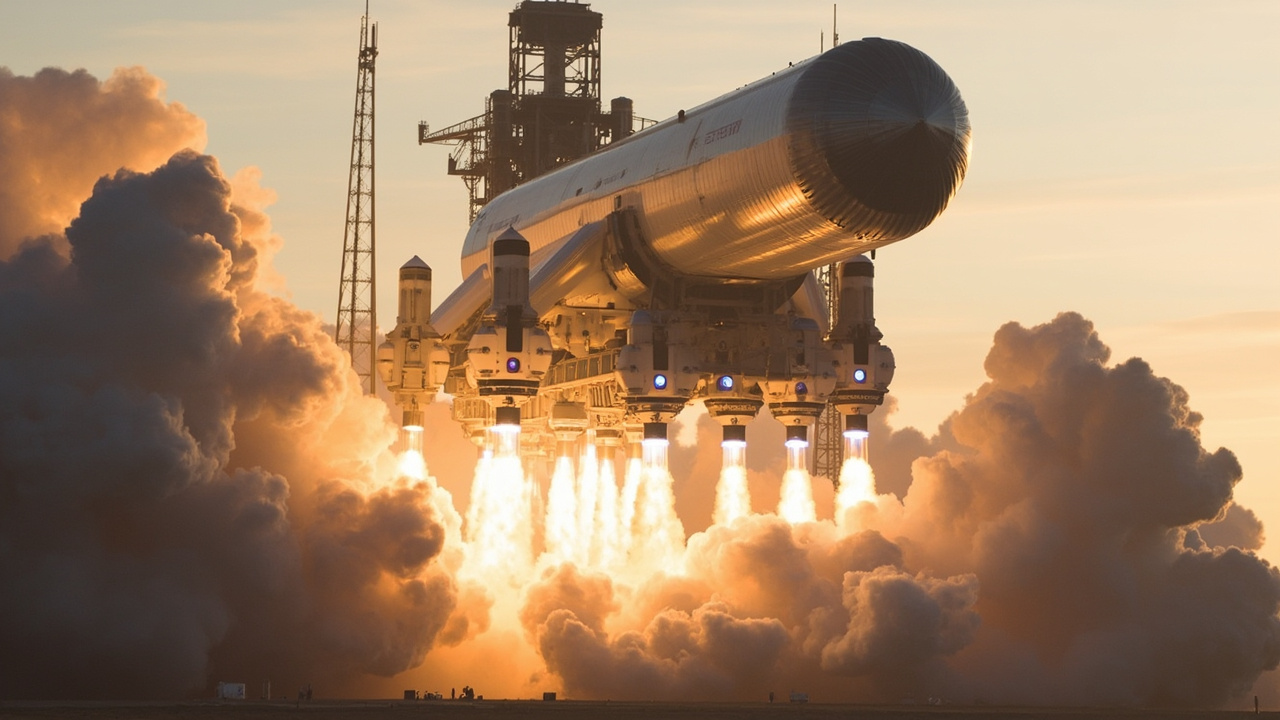
Liftoff occurred at 7:48 a.m. CT, when the Super Heavy booster lit its 33 rocket engines and climbed away from South Texas, according to NPR. About two-and-a-half minutes after launch, the upper stage known as Starship separated from the booster and continued toward space.
The flight was the 14th integrated launch of Starship and Super Heavy. Each of the 13 previous flights had flown on suborbital trajectories, according to Spaceflight Now preview coverage. This time, controllers committed to an orbit insertion after reviewing the vehicle's health during ascent and an initial coast period.
Spaceflight Now reported that the mission used Super Heavy booster tail number B21 and Starship upper stage tail number S41, flying from Pad 2 at Starbase during a 75-minute window that opened at 7:15 a.m. CDT. The company did not plan to recover either stage on this test.
At 171 feet tall, the Ship upper stage is itself larger than many orbital rockets. Stacked with Super Heavy, the full vehicle stands 407 feet, or 124 meters, tall, according to Space.com. Both stages are intended to become fully and rapidly reusable, a goal SpaceX has described as central to lowering launch costs and enabling Moon and Mars missions.
No people were aboard Monday's mission. The booster simulated a landing offshore in the Gulf of Mexico while engineers tested software and hardware upgrades, according to NPR. SpaceX has previously caught Super Heavy boosters with the launch tower's arms, but no catch attempt was planned for this flight.
One engine failed, then a call to proceed
Shortly after stage separation, one engine on Starship shut down earlier than planned, forcing a real-time decision about whether to continue toward orbit, according to NPR and Reuters.
According to NPR, the vehicle carries six engines on the upper stage. Reuters described the event as a premature shutdown of one of the ship's main engines after separation from Super Heavy. About 22 minutes into the flight, after assessing performance, the flight team decided it was safe to proceed to orbit, according to NPR.
Reaching orbit requires roughly 17,500 mph, a major step beyond the speeds seen on earlier suborbital tests, according to NPR. SpaceX said the launch profile included segments that would have allowed Starship to abort its orbital path and return safely if conditions required it.
The engine issue did not prevent orbit insertion and payload deployment, but it changed the rest of the day. SpaceX had planned a flight of about 10 hours, including six orbits around Earth at an altitude of about 170 miles, according to NPR. Mission managers instead shortened the mission to about three hours.
In a company blog post quoted by NPR, SpaceX said: "Out of an abundance of caution given the engine issue experienced during ascent, the flight control team decided to limit the duration spent on orbit."
Reuters similarly reported that the uncrewed mission was reduced from 10 hours to three hours after the engine shutdown. Early mission outlines tracked by Space.com had called for roughly six circuits followed by a controlled splashdown in the Pacific Ocean off the western coast of South America nearly 10 hours after liftoff.
Instead, Starship splashed down north of Hawaii after the shortened flight, according to NPR. Live coverage tracked by the BBC said the vehicle completed about two laps of Earth rather than the six originally planned and ended with a fiery splashdown in the Pacific. The BBC also reported that the booster came down in the Gulf of Mexico as planned.
First Starlink V3s ride Starship
The main payload on Flight 14 was a batch of 26 Starlink Version 3 next-generation internet satellites, the first Starlinks ever deployed from Starship, according to NPR, Reuters and Spaceflight Now.
According to Spaceflight Now, deployment was expected to begin about 34 minutes after liftoff and continue for about 30 minutes, with satellites released in roughly one-minute increments. The mission was designated Starlink 31-1.
The satellites join a constellation of thousands of spacecraft providing broadband service worldwide. SpaceX routinely launches Starlink satellites from Florida and California aboard its Falcon 9 rocket, but the larger V3 spacecraft need Starship's greater volume and lift, according to NPR.
SpaceX has said future Starship missions could carry up to 60 Starlink V3 satellites at once, but chose to fly 26 on this first orbital attempt, according to Spaceflight Now. Three of the satellites flown Monday carried extra imaging equipment to record video of the Ship's heat-shield tiles during flight, according to NPR and Spaceflight Now.
Heat-shield survival is one of the central technical challenges for Starship. The vehicle must endure fiery reentry heating to become reusable. Data from onboard cameras and ground tracking will help engineers assess tile performance, especially after the shortened orbital stay and early return.
NPR noted that SpaceX regularly launches operational Starlinks from Florida and California with Falcon 9, and that the company announced the final Florida Falcon mission last month while planning future Starship launches from Florida's Space Coast. That shift would move large Starlink deployments to the new heavy vehicle once test flights and ground systems allow it.
Business stakes: IPO filing, Louisiana expansion and the Moon
Monday's flight carried weight beyond engineering because Starship is central to SpaceX's commercial plans and to NASA's plan to return astronauts to the lunar surface, according to NPR.
In filings related to its initial public offering in June, SpaceX told investors that Starship development was critical to its growth strategy, according to NPR. The filing warned: "Any failure or delay in the development of Starship at scale or in achieving the required launch cadence, reusability and capabilities thereafter would delay or limit our ability to execute our growth strategy."
The company also announced plans for a large manufacturing and launch expansion in Louisiana, described by NPR as a $100 billion investment involving dozens of launch pads, with a goal of flying Starship from a Louisiana Starbase beginning in 2029.
For NASA, Starship's upper stage has been selected as the first crewed lunar lander for the Artemis program, which aims to land people on the Moon for the first time on the Artemis IV mission in 2028, according to Space.com. Before operational lunar missions, SpaceX still must demonstrate milestones including in-space propellant transfer using tanker versions of Starship, outfitting for crew life support, and reliable return and reuse of the Ship stage.
Spaceflight Now reported that depending on the outcome of Flight 14, SpaceX could attempt to catch a Starship upper stage with the launch tower on its 15th test flight. Operational flights envision both Super Heavy and Ship returning to the launch site for capture, refurbishment and rapid reflight.
NASA gives Boeing's Starliner more time and money
In a separate Sept. 28 announcement, NASA said it will provide additional support and funding to Boeing as the company reworks its CST-100 Starliner crew capsule after its troubled 2024 test flight, according to the Associated Press.
That 2024 mission left test pilots Butch Wilmore and Suni Williams aboard the International Space Station for nearly a year. NASA later classified the episode as a crew-endangering Type A mishap, its most severe ranking, according to the Associated Press.
NASA Administrator Jared Isaacman said Monday that Boeing should be ready to fly a revised Starliner to the station with cargo but no crew by December, according to the Associated Press. Astronauts would not fly aboard again until 2028 because additional safety redesigns will take months or longer.
According to NASASpaceFlight.com, the uncrewed mission is designated Starliner-1 and is targeted for no earlier than December 2026, with January 2027 also in the window. NASA described it as an engineering evaluation flight to verify improved thermal conditions on the service module, collect qualification data and identify remaining risk before crew flies again.
Isaacman framed the effort as part of preserving more than one American crew transportation option as activity in low Earth orbit grows, according to NASASpaceFlight.com. NASA also plans to add a fifth and sixth Starliner station flight to its options and to work with Boeing and United Launch Alliance to certify ULA's Vulcan rocket for crew transport after the remaining Atlas V flights are used, since Atlas V has carried Starliner on every flight so far.
Program Investigation Team findings released in February traced the 2024 problems to reaction-control thrusters operating outside qualification and loss of control authority during approach, leading to 61 recommendations, according to NASASpaceFlight.com. Ground testing pointed to a combination of heat around the service-module "doghouses" and design features of thruster valves. Boeing has made thermal changes for Starliner-1 and plans a valve redesign, new crew-module thrusters, new batteries and parachute changes before crewed certification.
NASA astronaut Woody Hoburg has been assigned to command the first crewed return, Starliner-2, according to NASASpaceFlight.com. "Bottom line: We're on the right path," Hoburg said, according to the Associated Press. Hoburg also paid tribute to Wilmore and Williams, both now retired, calling them American heroes.
Low Earth Orbit Program manager Dana Weigel emphasized that NASA must be confident all Starliner problems are resolved before astronauts board again, according to the Associated Press and NASASpaceFlight.com.
Small satellite tests single-tank propulsion
NASA engineers in Huntsville, Alabama, also completed ground testing of a shoebox-size satellite designed to demonstrate a safer, more compact propulsion system, according to Phys.org.
The ASCENT Propulsion Dual Mode mission will test a single integrated system that feeds both a high-thrust chemical engine and low-thrust electrospray thrusters from one central tank, according to Phys.org. The spacecraft uses a nontoxic propellant called ASCENT. The design could save mass and volume, leaving more room for instruments and allowing launches on smaller rockets.
The 6-U CubeSat relies on electrospray thrusters developed by the Massachusetts Institute of Technology, a chemical propulsion module built by Plasma Processes and a spacecraft bus integrated by the Georgia Institute of Technology, according to Phys.org. NASA's Marshall Space Flight Center manages the mission.
Over recent months, engineers in Marshall's Small Spacecraft Servicing and Integration Lab ran a pressurized helium leak test in a vacuum chamber, thermal-vacuum testing to simulate airless temperature extremes, and a spin test to measure mass properties and balance for stable flight, according to Phys.org.
Project manager Nehemiah Williams said coordinating propulsion work across teams was central to success, according to Phys.org.
The mission is scheduled to launch no earlier than Oct. 1 aboard a SpaceX Falcon 9 from Vandenberg Space Force Base in California, according to Phys.org. After deployment about 325 miles, or 520 kilometers, above Earth, the spacecraft will begin a nine-month mission featuring short chemical and electric test burns followed by alternating orbit-raising and lowering maneuvers.
Sources referenced
- SpaceX's Starship launches on first orbital mission from Texas : NPR (https://www.npr.org/2026/09/28/nx-s1-5983418/spacex-starship-first-orbital-flight-14-nasa)
- SpaceX's Starship makes orbital debut deploying Starlinks before early ending | Reuters (https://www.reuters.com/business/media-telecom/spacexs-starship-launches-14th-flight-first-headed-orbit-2026-09-28/)