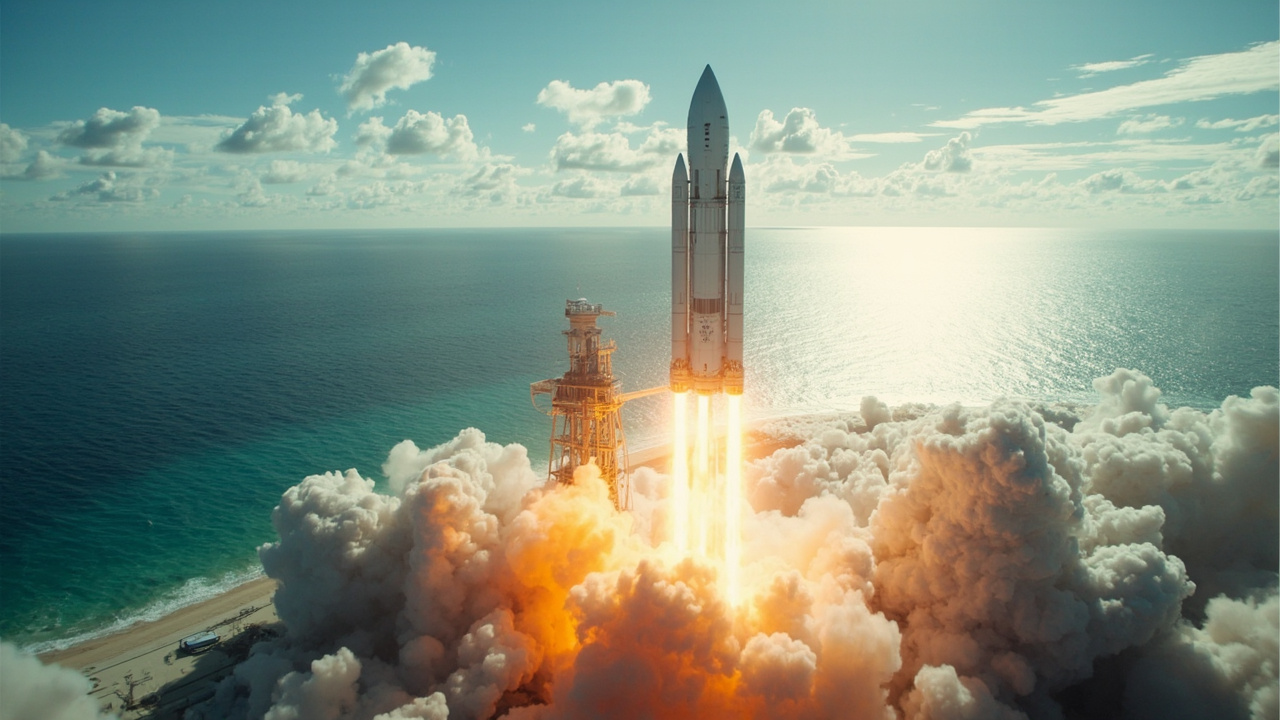
TL;DR: SpaceX's Starship reached Earth orbit for the first time on Sept. 28, 2026, and the program must now demonstrate full reuse, orbital refueling and crew readiness.
Orbital debut opens a new test phase
SpaceX's Starship became an orbital vehicle on Monday, Sept. 28, 2026, during its 14th test flight from Starbase in South Texas. The uncrewed mission lifted off at 7:48 a.m. Central Time and placed the Ship upper stage into orbit after an engine problem during ascent, according to NPR. Once there, it released 26 Starlink V3 broadband satellites before returning early to a Pacific splashdown, according to Reuters.
That outcome answered the central question behind the flight: could Starship finally reach orbital speed and do useful work there? The answer was yes, but with qualifications. Flight controllers shortened a planned 10-hour, six-orbit mission to about three hours as a precaution after the engine shutdown, according to NPR. The result leaves three major demonstrations still ahead — recovering the upper stage, moving propellant between vehicles in orbit, and preparing a crew-capable system for NASA's Artemis program, according to Space.com's Sept. 29 assessment of what comes next.
Starship is the largest and most powerful launch vehicle ever built. In its present configuration it stands 407 feet, or 124 meters, tall and is designed to carry more than 110 tons, or 100 metric tons, to low Earth orbit, according to Space.com's Flight 14 launch report. Both stages — the Super Heavy booster and the Ship upper stage — are intended to be fully and rapidly reusable.
What happened on Flight 14
Liftoff, engine loss and a revised call
Super Heavy ignited its 33 engines for the morning launch from Boca Chica Beach, Texas. About two-and-a-half minutes later, Ship separated from the booster and continued upward, according to NPR.
One of Ship's six engines failed during ascent. SpaceX spokesperson Dan Huot initially told viewers that the team would not proceed to orbit, then reversed course after engineers reviewed the vehicle's condition, according to Reuters. About 22 minutes into the flight, controllers concluded it was safe to continue, according to NPR. Roughly 25 minutes after liftoff, Ship fired a Raptor engine briefly to enter orbit, according to Space.com's launch report.
The episode recalled earlier Starship development problems. Engine issues had appeared on some prior suborbital flights, an area Reuters described as important for maneuvering in space. For low-orbit satellite delivery the effect was manageable; for future lunar assignments, reliable in-space engine performance will matter more.
Payload and early return
Starting about 34 minutes after launch, Ship released its 26 next-generation Starlink V3 satellites over about 30 minutes into an operational orbit, according to Space.com's launch report. Reuters reported the deployment altitude as roughly 269 km, or 161 miles, with all 26 spacecraft deployed one by one.
Three of those satellites carried cameras to scan Ship in flight. Engineers plan to study that imagery alongside heat-shield condition to improve protection for atmospheric reentry, according to Space.com's launch report. NPR similarly reported that three satellites carried cameras to collect heat-shield data, calling survival of reentry central to reuse plans.
Ship did not remain in orbit for the originally discussed six circuits. Mission managers instead directed reentry after a much shorter coast. The vehicle reentered about two hours and 40 minutes after launch, passed back through supersonic speeds 26 minutes later, and splashed down intact in the northern Pacific Ocean three hours and eight minutes after liftoff, according to Space.com's launch report. NPR placed the splashdown north of Hawaii and quoted SpaceX's explanation that caution after the ascent engine issue led controllers to limit orbital time.
Super Heavy, meanwhile, returned for a controlled splashdown in the Gulf of Mexico about seven minutes after liftoff, according to Space.com's launch report. Reuters reported that some booster engines stopped working during descent, while still allowing the water landing. The booster was not recovered for reuse on this flight.
Notably, Flight 14 was described as both a test and an operational mission because it carried commercial payloads. Reuters called it Starship's first revenue-generating mission, even though the final vehicle design remains under development.
Next test: catching Ship
Why recovery matters
Operational Starship flights are supposed to return both Super Heavy and Ship to the launch pad for capture by the tower's "chopstick" arms, according to Space.com's Sept. 29 assessment. SpaceX considers that approach essential to rapid turnaround and high flight rates. Company founder Elon Musk has discussed a target of 10,000 Starship liftoffs per year by 2030, according to the same assessment.
To date, SpaceX has completed chopstick catches with Super Heavy on three test flights, but has not attempted one with Ship, according to Space.com's Sept. 29 assessment. The 171-foot-tall, or 52-meter, upper stage has instead ended each mission with an ocean splashdown.
Flight 15 could attempt it
Musk said during a Sept. 14 appearance at the All-In Summit that SpaceX might attempt to catch Ship on Flight 15 if Flight 14 performed well, according to Space.com's Sept. 29 assessment. The company had not released a Flight 15 mission profile by Sept. 29, and no official launch date had been announced. Provisional planning documents listed Oct. 19 as the earliest possible target, according to the same assessment.
A Ship catch would require precise reentry, controlled descent and a return to the tower rather than the ocean. It has not been demonstrated. For now, the assessment frames Monday's orbital success as keeping that option available rather than confirming it.
More launch pads
Higher cadence also depends on infrastructure. Starship has flown from two pads at Starbase in South Texas, according to Space.com's Sept. 29 assessment. SpaceX is now building three Starship pads on Florida's Space Coast and plans to begin work on a $100 billion, 12-pad Starship Louisiana complex in 2027, according to the same assessment.
NPR separately reported that SpaceX routinely launches Starlink satellites from Florida and California with Falcon 9, ended its final Florida Falcon mission last month in that context, and intends to use Starship from Florida's Space Coast in the future. The expansion work is therefore proceeding alongside flight testing rather than waiting for it to finish.
Next technology: moving fuel in orbit
Why deep-space Starship needs a depot
Most near-term Starship missions are expected to remain in Earth orbit, deploying Starlink V3 satellites and a larger proposed "Starmind" data-center network of about one million satellites, if current plans hold, according to Space.com's Sept. 29 assessment. Lunar and Mars missions face a different constraint.
Ship cannot lift off with a full deep-space fuel load because the added mass would be too great, according to the same assessment. The architecture therefore calls for a Moon- or Mars-bound Ship to meet an off-Earth propellant depot, itself a Ship variant, and take on fuel delivered by specialized tanker vehicles.
The number of tanker flights needed for each deep-space mission remains uncertain. Estimates cited for a lunar-landing campaign range from eight missions at the low end to 15 or 20 at the high end, according to Space.com's Sept. 29 assessment.
What has been shown so far
SpaceX transferred propellant from one internal tank to another aboard Ship during Flight 3 in March 2024, according to Space.com's Sept. 29 assessment. It has not yet transferred propellant from one vehicle to another in space.
Whether such a vehicle-to-vehicle demonstration could occur on Flight 15 was characterized as speculation in that assessment, pending an official mission description. In other words, orbital refueling remains a required milestone, but its date and flight assignment were not established by Sept. 29.
NASA's interest sharpens the stakes. The agency selected Starship's upper stage as the first crewed lander for Artemis, a program intended to establish a base near the moon's south pole over the next decade, according to Space.com's Sept. 29 assessment. Reuters likewise described Starship as one of two vehicles competing to conduct a crewed lunar landing, last accomplished in 1972.
Next qualification: carrying people
From cargo and satellites to life support
Starship was introduced by Musk in September 2016 as the Interplanetary Transport System, presented as the development that could make Mars settlement economically feasible, according to Space.com's Sept. 29 assessment. Transforming that concept into a crew vehicle will require adding and extensively testing life-support systems before anyone flies aboard.
The schedule pressure comes partly from NASA. The agency intends to launch the crewed Artemis III mission in mid-2027, sending its Orion capsule to dock with Ship in Earth orbit, according to Space.com's Sept. 29 assessment. It was unclear by Sept. 29 whether Ship must already be crew-capable for that flight, since the Artemis III astronauts may not enter Ship.
The requirement becomes explicit for the next mission. Artemis IV in 2028 is intended to place astronauts near the lunar south pole, the first crewed moon landing since Apollo 17 in 1972, according to the same assessment. By that point Ship must be suitable for people.
A competitive lunar path
SpaceX is not the only provider. NASA also selected Blue Origin to supply crewed landers, and the agency has said it could fly Blue Origin's Blue Moon lander on Artemis III or Artemis IV if Ship is not ready, according to Space.com's Sept. 29 assessment.
That competitive structure, combined with the Flight 14 engine issue, frames the work ahead. Reaching orbit and deploying 26 operational satellites showed that Starship can perform useful orbital missions, according to Reuters. Catching Ship, refueling it in space and certifying it for astronauts will determine when the megarocket moves from test milestones to routine lunar service.
Sources referenced
- Starship just reached orbit for the 1st time. What's next for the SpaceX megarocket? | Space (https://www.space.com/space-exploration/launches-spacecraft/starship-just-reached-orbit-for-the-1st-time-whats-next-for-the-spacex-megarocket)
- SpaceX's Starship makes orbital debut deploying Starlinks before early ending | Reuters (https://www.reuters.com/business/media-telecom/spacexs-starship-launches-14th-flight-first-headed-orbit-2026-09-28/)