TL;DR: As of Oct. 8, 2026, SpaceX had not yet launched 21 Northrop Grumman-built data satellites for the Space Development Agency after an Oct. 5 auto-abort, with the next attempt targeted no earlier than Oct. 10 from Vandenberg.
Delayed fourth Tranche 1 flight waits on the pad
The mission awaiting liftoff is known as Tranche 1 Transport Layer A, or T1TL-A, and it would be the fourth operational launch for the Space Development Agency's low-Earth-orbit network, according to Spaceflight Now.
The payload consists of 21 transport satellites constructed by Northrop Grumman. Those spacecraft arrived at Vandenberg Space Force Base in California on Sept. 28 for final processing, according to Spaceflight Now.
T1TL-A forms part of the Proliferated Warfighter Space Architecture, a Defense Department mesh intended to move battlefield data, track advanced missiles, and provide secure links for U.S. forces and allies, according to Spaceflight Now. Agency leaders have described continuous, near-instant delivery of information to deployed personnel as the central purpose of the network.
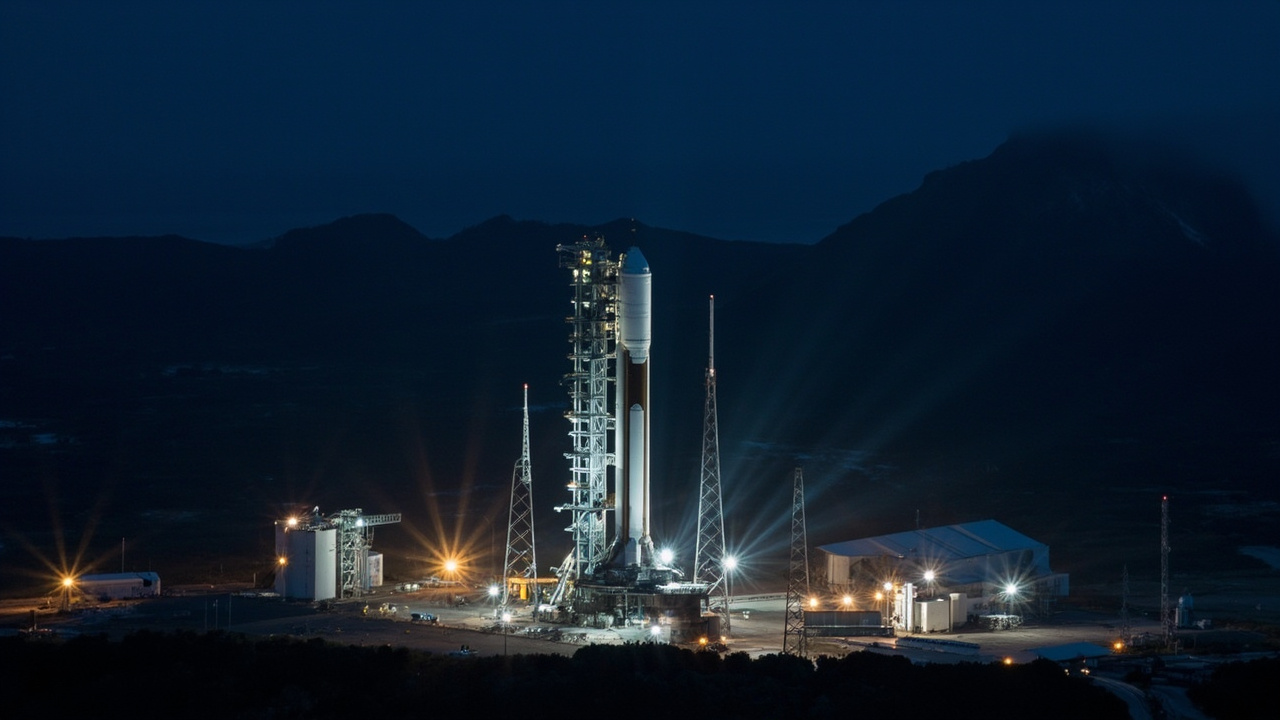
If it flies as planned, the Falcon 9 will depart southward from Space Launch Complex 4 East. That pad is presently SpaceX's sole active orbital launch site on the West Coast, according to Spaceflight Now.
Oct. 5 countdown stopped with 58 seconds left
The first countdown reached its final minute early on Oct. 5 before onboard software stopped the sequence, according to Spaceflight Now.
The halt came with 58 seconds remaining, shortly after flight computers assumed authority for the count. SpaceX later attributed the call to unusual readings associated with the rocket's second stage, according to Spaceflight Now.
The company described the hardware and the 21 satellites as healthy after the scrub. Ground teams then lowered the Falcon 9 to a horizontal attitude at the complex to inspect the vehicle, according to Spaceflight Now.
The Oct. 5 try had been aimed at about 1:15 a.m. local time, according to Air & Space Forces Magazine. That publication noted that SpaceX characterized the event as an auto-abort in a social-media update.
New target points to Oct. 10 after day-by-day slips
SpaceX did not immediately roll to the next morning. After first eyeing Oct. 6, the company set aside that chance and then successive daily chances, according to Spaceflight Now.
An update posted Oct. 7 said the team was working toward no earlier than Saturday, Oct. 10, according to Spaceflight Now. The archive date for this report is Oct. 8, so that target remained a plan rather than an outcome at the time of writing.
SpaceX commentator Atticus Vadera said extra days during the week permitted added reviews of rocket systems and work to resolve scheduling pressure on the Western Range, according to Spaceflight Now.
The range issue was thought to involve a missile test conducted from Vandenberg on Friday, according to Spaceflight Now. Range availability controls when rockets and tests can use shared tracking, safety, and airspace resources.
Reused booster and planned California landing
The assigned first stage is Falcon 9 booster B1103, making its sixth mission, according to Spaceflight Now.
Its prior assignments included the SDA's T1TL-E flight, a mission designated NROL-179, and three Starlink delivery flights, according to Spaceflight Now.
SpaceX intended to return the stage to land about seven and one-half minutes after departure at Landing Zone 4, adjacent to the launch complex, according to Spaceflight Now.
Had that recovery succeeded on the next try, the company said it would have marked the 37th touchdown at that landing pad and the 668th Falcon booster recovery overall, according to Spaceflight Now. Both figures were projections tied to a future flight, not completed results as of Oct. 8.
Why Northrop Grumman's first batch matters
This flight is the first Tranche 1 launch to carry Northrop Grumman satellites, according to Air & Space Forces Magazine.
The contractor is responsible for an additional group of 21 transport satellites plus 14 missile-warning and tracking spacecraft, according to Air & Space Forces Magazine. The Oct. 8 mission therefore represents less than half of the company's current Tranche 1 transport commitment.
After liftoff, the 21 spacecraft were expected to join 63 Tranche 1 satellites already in orbit that were supplied by York Space Systems and Lockheed Martin, according to Air & Space Forces Magazine.
SDA Director Gurpartap Sandhoo told journalists during an Oct. 1 prelaunch briefing that handling 21 satellites through initial operations is fundamentally harder than handling one or a few, according to Air & Space Forces Magazine. He said he anticipated some difficulties while expressing confidence that Northrop teams were prepared to issue software fixes and updates.
Scaling problems slowed earlier constellation work
The Space Development Agency was established in 2019 to field large numbers of relatively small data-relay and missile-warning satellites, according to Air & Space Forces Magazine.
Officials had hoped to place all 154 Tranche 1 satellites in orbit by summer 2026, but component shortages and ground and on-orbit technical trouble changed that schedule, according to Air & Space Forces Magazine.
Sandhoo said the basic capability was not the central problem. Instead, he pointed to construction, testing, launch, and early operations at high volume, according to Air & Space Forces Magazine.
Checkout of the first York and Lockheed satellites took substantially longer than the four to six months planners had anticipated. The agency then paused for nine months to diagnose orbital behavior and adjust ground procedures before resuming launches, according to Air & Space Forces Magazine.
A July launch carrying York's final 21 transport satellites went more smoothly during early checkout, Sandhoo said, according to Air & Space Forces Magazine. Control of those York satellites has since moved into the agency operations center for limited trials.
Transfer of Lockheed spacecraft has proved slower. Only four had moved to agency control by early October while engineers studied the cause, according to Air & Space Forces Magazine. A Lockheed spokesperson said the firm was working closely with the agency to complete the transition and apply experience from each orbital plane to later work, according to Air & Space Forces Magazine.
What Tranche 1 is supposed to become
Tranche 1 is the first operational layer of the wider architecture and is expected to start supporting Defense Department users in 2027, according to Spaceflight Now.
When finished, that layer is envisioned with 126 Transport Layer satellites, 28 Tracking Layer satellites, and four missile-defense demonstration vehicles, according to Spaceflight Now. Earlier flights had placed 63 satellites in orbit before T1TL-A.
The broader Transport Layer could eventually contain 300 to 500 satellites circling 750 to 1,200 kilometers above Earth, according to Spaceflight Now. At full strength, agency planners say 95 percent of the planet would remain within view of at least two transport satellites at any moment.
The spacecraft are designed to connect through optical links between satellites, which the agency says offer major gains over conventional radio crosslinks, according to Spaceflight Now. Combined with low orbits, those laser links are intended to cut signal loss and delay when pursuing time-critical targets.
The satellites are also intended to work with Link-16 terminals and the Integrated Broadcast System to distribute warning and situational-awareness data, according to Spaceflight Now.
Contract and management backdrop
T1TL-A is one of 23 SpaceX assignments under the National Security Space Launch Phase 2 agreement awarded in August 2020, according to Spaceflight Now. The U.S. Space Force's Space Systems Command oversees that launch procurement framework.
Earlier Tranche 1 transport launches took place on Sept. 10, 2025, Oct. 15, 2025, and July 16, 2026, designated T1TL-B, T1TL-C, and T1TL-E respectively, according to Spaceflight Now.
York Space Systems supplied the satellites for the first and third of those flights, while Lockheed Martin supplied the second, according to Spaceflight Now. Space Force Col. Ryan Hiserote, an assured-access launch official, said in September 2025 that the initial transport missions could fly in any sequence.
Day-to-day launch execution is handled through System Delta 80 and the portfolio executive for assured access to space, according to Spaceflight Now.
Looking beyond T1TL-A, the agency was considering December or early the following year for its first Tranche 1 tracking-layer launch, with remaining Tranche 1 flights potentially continuing into late spring 2027, according to Air & Space Forces Magazine.
Sources referenced
- SpaceX launches 21 data satellites for the Space Development Agency – Spaceflight Now (https://spaceflightnow.com/2026/10/09/spacex-to-make-another-attempt-to-launch-21-data-satellites-for-space-development-agency/)
- SpaceX scrubs launch attempt for 21 data transport satellites for the Space Development Agency – Spaceflight Now (https://spaceflightnow.com/2026/10/04/live-coverage-spacex-to-launch-21-data-transport-satellites-for-the-space-development-agency/)