Spaceflight Status for Oct. 5: ISS Crew Swap, Starship's First Orbital Delivery, and Artemis Honors
TL;DR: The International Space Station is mid-handover with Crew-13 aboard and Crew-12 set to undock Oct. 7, SpaceX's Starship reached orbit Sept. 28 and deployed 26 Starlink satellites, and NASA's Artemis II crew was honored Sept. 30 for a 252,756-mile lunar flyby.
Eleven people were living aboard the International Space Station on Oct. 5 as NASA managed overlapping Dragon operations, Starship test planning, and post-lunar mission recognition, according to NASA.
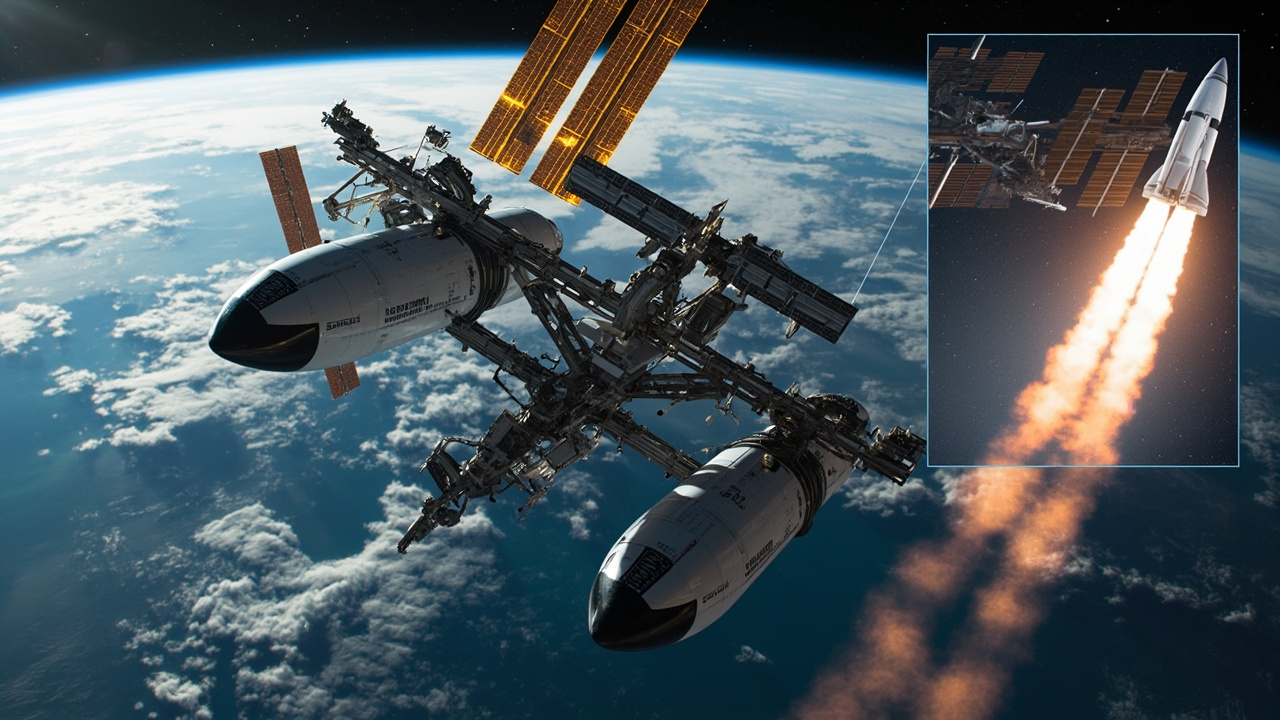
ISS at 11: Two Dragons Docked to Harmony
Expedition 75 was in the middle of a crew swap, with four new arrivals adjusting to microgravity while four long-duration residents packed for return, according to NASA's Expedition 75 Welcomes Crew-13 and Preps for Crew-12 Departure blog.
Two SpaceX Dragon spacecraft were docked to the station's Harmony module. The 11 crew members were busy packing and unpacking those vehicles and preparing for cargo activities, according to NASA.
The new arrivals — NASA astronauts Jessica Watkins and Luke Delaney, Canadian Space Agency astronaut Josh Kutryk, and Roscosmos cosmonaut Sergey Teteryatnikov — have been living and working on the station since Thursday, Oct. 1, according to NASA.
They launched as NASA's SpaceX Crew-13 aboard a SpaceX Dragon and docked to Harmony's forward port the same day. The quartet has been unpacking Dragon and familiarizing itself with station systems at the start of a six-month space research mission, according to NASA.
Their ride to orbit set a speed mark. Docking occurred at 7:05 p.m. EDT, 7 hours and 55 minutes after launch, which marked the fastest launch-to-docking of a U.S. spacecraft in station history, according to NASA's Dragon Docks Bringing SpaceX Crew-13 to Station blog.
That flight also made organizational history. Watkins made history as the first Black woman to lead a crew into orbit, according to BBC Newsround in its report titled Super speedy ISS space trip sets new record.
The same report notes the station orbits around 250 miles above Earth and that Crew-13 launched from Cape Canaveral in Florida aboard a SpaceX Falcon 9 rocket. Getting to the station usually takes much longer, and the previous U.S.-launched crew took more than 30 hours to reach the outpost, according to BBC Newsround.
Crew-12 Packed for Oct. 7 Undocking and Oct. 8 Splashdown
The SpaceX Crew-12 quartet has been aboard the outpost since Feb. 14 and is now preparing to come home, according to NASA.
NASA astronauts Jessica Meir and Jack Hathaway will respectively command and pilot Dragon alongside mission specialists Sophie Adenot of the European Space Agency and Andrey Fedyaev of Roscosmos, according to NASA.
The foursome will undock from Harmony's space-facing port and then orbit Earth for just over a day inside Dragon. Crew-12 will reenter the atmosphere and then parachute inside the spacecraft to a splashdown in the Pacific Ocean at 11:34 a.m. on Thursday, Oct. 8, ending a nearly eight-month stay in space, according to NASA.
NASA and SpaceX are targeting no earlier than 8:05 a.m. EDT, Wednesday, Oct. 7, for undocking, pending weather conditions, according to NASA's NASA to Stream SpaceX Crew-12 Return, Splashdown Live release.
An Oct. 7 undock puts Meir, Hathaway, Adenot and Fedyaev on schedule to splash down off the coast of California at approximately 11:34 a.m. on Thursday, Oct. 8, according to NASA.
Mission managers continue monitoring conditions in the recovery area, as undocking depends on spacecraft readiness, recovery team readiness, and weather conditions in the Pacific off the coast of California, according to NASA.
How to watch the return
NASA's live return coverage will stream through online platforms listed at https://www.nasa.gov/live, according to NASA.
NASA's coverage schedule, with all times Eastern and subject to change based on real-time operations, is:
Wednesday, Oct. 7
- 6 a.m.: Hatch closure coverage begins
- 6:20 a.m.: Hatch closing
- 7:45 a.m.: Undocking coverage begins
- 8:05 a.m.: Undocking
Following undocking coverage, NASA will provide audio-only communications between Crew-12, the space station and flight controllers during Dragon's transit away from the complex, according to NASA.
Thursday, Oct. 8
- 10:20 a.m.: Return coverage begins
- 10:46 a.m.: Deorbit burn
- 11:34 a.m.: Splashdown
- 1:15 p.m.: International Space Station briefing for Crew-12 return and SpaceX Commercial Resupply Services-35 launch
Briefing participants are Bill Spetch, deputy manager of Commercial, NASA's Low Earth Orbit Program; Dr. Liz Warren, deputy chief scientist, NASA's Low Earth Orbit Program; Lee Echerd, senior mission manager, Customer Operations and Integration, SpaceX; and Andreas Mogensen, leader, Human Exploration Group, ESA, according to NASA.
Command Changes Hands Aboard Station
Roscosmos cosmonaut Pyotr Dubrov accepted command of the International Space Station from Meir on Sunday, Oct. 4, during a traditional change-of-command ceremony, according to NASA.
Dubrov will stay in space with flight engineers Anna Kikina of Roscosmos and Anil Menon of NASA until spring 2027, according to NASA.
The ceremony marked the formal transfer of mission responsibilities from the departing crew to the new complement before Crew-12's farewell and return preparations, according to NASA and CGTN reporting.
Cargo Traffic Next: Cygnus XL Out, Resupply Dragon In
The next spacecraft scheduled to depart is Northrop Grumman's uncrewed Cygnus XL resupply ship, which has been attached to the Unity module since April 13, according to NASA.
NASA flight engineers Menon and Hathaway loaded trash and discarded gear inside Cygnus XL on Monday. The cargo spacecraft is scheduled to be released into Earth orbit with the Canadarm2 robotic arm at the end of the week, according to NASA.
Soon after that, SpaceX will launch Dragon on its 35th commercial resupply mission to deliver science and supplies to the Expedition 75 crew, according to NASA.
Kutryk on Monday studied tools and procedures to monitor Dragon's approach and rendezvous following its upcoming launch from Florida. Meir reorganized the Kibo laboratory module where some of Dragon's cargo will be stowed after arrival, according to NASA.
Starship Reaches Orbit and Delivers 26 Satellites
SpaceX's Starship reached orbit for the first time on Monday, Sept. 28, during its 14th test flight to date, according to Space.com in its report Starship just reached orbit for the 1st time. What's next for the SpaceX megarocket?
The megarocket — described as the biggest and most powerful launch vehicle ever built — also deployed 26 of SpaceX's Starlink V3 broadband satellites on Flight 14, kicking off construction of a constellation that will eventually harbor 100,000 spacecraft if all goes to plan, according to Space.com.
SpaceX and outside analysts appear largely satisfied with the first orbital flight despite some technical issues during the mission, according to SpaceNews in its report SpaceX, analysts satisfied with latest Starship flight.
Images showed Starship S41 as it fired its engines to enter Earth orbit, 25 minutes after launch from Starbase on Sept. 28, according to EL PAÍS English in its report The dark side of Starship’s success: Musk sidelines NASA in his bid to dominate space.
The company has already received approval from the U.S. federal government to accelerate the current testing phase and launch twice more in October if it wishes, according to EL PAÍS English.
Musk declared last week on X that Starship is two to three years away from hourly flights, according to EL PAÍS English.
What Starship must still prove
Both of Starship's stages — the Super Heavy booster and Ship upper-stage spacecraft — are designed to be fully and rapidly reusable. During operational flights, SpaceX plans to bring both vehicles back to the launch pad, where they will be caught by the tower's chopstick arms, according to Space.com.
SpaceX has already pulled off chopstick catches with Super Heavy, doing so on three Starship test flights to date. The company has yet to attempt one with the 171-foot-tall Ship, which has always targeted an ocean splashdown to wrap up its missions, according to Space.com.
During an appearance at the All-In Summit on Sept. 14, Musk said SpaceX may try to catch Ship on Flight 15, provided Flight 14 went well, according to Space.com.
The company has not laid out a mission profile for Flight 15, but provisional planning documents peg Oct. 19 as the earliest possible target, according to Space.com.
Another hurdle is off-Earth propellant transfer. Ship cannot launch with much fuel onboard because doing so would make it too heavy, so each Ship bound for the Moon or Mars will need to visit an off-Earth fuel depot, itself a Ship variant, according to Space.com.
That depot will need to be fueled by special Ship tanker vehicles. Estimates for a Ship lunar-landing campaign range from eight tanker missions on the low end to 15 or 20 on the high end, according to Space.com.
SpaceX successfully transferred propellant from one internal tank to another on Ship during Flight 3 in March 2024. The company has not yet moved propellant from one vehicle to another in space, according to Space.com.
Falcon tempo underscores the transition
Of 325 space launches worldwide in 2025, SpaceX carried out more than 50%, all using Falcon 9 rockets including the Falcon Heavy variant designed for heavier payloads, according to EL PAÍS English.
On Thursday, Oct. 1, the company conducted three launches in just 13 hours. First, a crew of four astronauts departed from Cape Canaveral, Florida, bound for the station. Next, another Falcon 9 lifted off in California carrying Google's first orbital AI data center and, on the same flight, delivered 129 smaller payloads. Then, back in Florida just before midnight, SpaceX launched a Falcon Heavy carrying a U.S. government spy satellite, according to EL PAÍS English.
SpaceX is already planning to retire Falcon 9 rockets in 2028, despite their use for the vast majority of launches, according to EL PAÍS English.
To support higher Starship cadence, SpaceX is currently building three Starship pads on Florida's Space Coast, and it plans to break ground on the $100 billion, 12-pad Starship Louisiana complex in 2027, according to Space.com.
Artemis II Crew Honored After Record Lunar Flyby
The University of Houston hosted the Artemis II crew and staff after they broke the record for farthest distance traveled from Earth during their mission: 252,756 miles, according to The Cougar in its report From space to UH: Artemis II crew speaks at Fertitta Center after record-breaking mission.
The event was held Sept. 30 at the Fertitta Center, according to The Cougar.
Johnson Space Center Director Vanessa Wyche presented astronauts Reid Wiseman, Victor Glover, Christina Koch and Jeremy Hansen and staff with NASA's Honor Award medals, according to The Cougar.
The National Aeronautic Association and its international partner Fédération Aéronautique Internationale also presented two records: one for highest altitude above Earth's surface, as well as another for distance from Earth, a feat that had not been broken for 58 years, according to The Cougar.
In their first public event in Space City, the four astronauts who flew around the Moon and back were celebrated as hometown heroes, according to Houston Public Media in its report Artemis II crew members close out their historic chapter with celebration in Houston.
Commander Reid Wiseman said, We've been back for six months, but today, we are home, according to Houston Public Media. Wiseman also called the celebration bittersweet, with the Houston ceremony as the final stop on a publicity tour across the country, according to Houston Public Media.
NASA's goal for the mission was to initiate its long-term return to the Moon and to set a precedent for future missions to Mars, according to The Cougar.
The crew was selected in April 2023. They spent three years training for the mission in the Vehicle Assembly Building in Florida, but despite preparation for the April 1 launch day, the crew said they were still shocked by the scale of launch, according to The Cougar.
One highlight was witnessing a solar eclipse, Glover said, noting that if launch had occurred 48 hours later they would not have seen it, according to The Cougar.
Viewing Earth from farther distance reinforced that humans have power to protect and change the planet, Koch said, describing Earth as an incredible, beautiful, glorious lifeboat that could be covered with a thumb at that distance, according to The Cougar.
Wyche said the pride, excitement and resilient support from Houston reminded the team how deeply the mission resonated, adding that the golden age of space exploration is here, and America is back in the business of sending astronauts to the Moon and bringing them home safely, according to The Cougar.
For NASA's lunar program, crewed operations remain tied to Starship readiness. The agency plans to launch the crewed Artemis III mission in mid-2027, sending its Orion capsule to dock with Ship in Earth orbit, according to Space.com.
That mission will be followed by Artemis IV in 2028, which will land astronauts near the lunar south pole in the first crewed Moon touchdown since Apollo 17 in 1972, according to Space.com. NASA has said it may fly Blue Origin's Blue Moon lander on Artemis III and/or Artemis IV if Ship isn't ready, according to Space.com.
Sources referenced
- Expedition 75 Welcomes Crew-13 and Preps for Crew-12 Departure - NASA (https://www.nasa.gov/blogs/spacestation/2026/10/05/expedition-75-welcomes-crew-13-and-preps-for-crew-12-departure/)
- NASA to Stream SpaceX Crew-12 Return, Splashdown Live - NASA (https://www.nasa.gov/news-release/nasa-to-stream-spacex-crew-12-return-splashdown-live/)