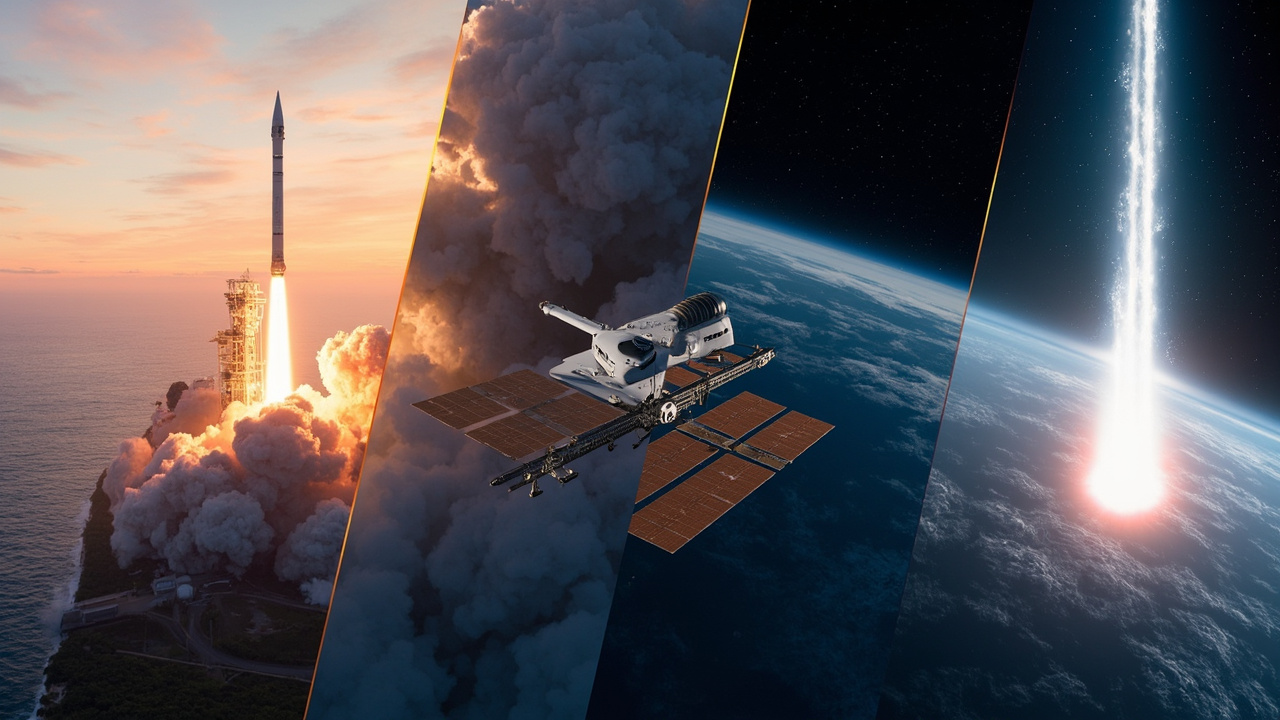
TL;DR: NASA's SpaceX Dragon cargo ship docked to the International Space Station on Oct. 15, 2026, closing out a packed two-week run of U.S. launches that also carried a NASA crew, military satellites and a classified Space Force payload.
The newest verified milestone came at 10:27 a.m. EDT on Oct. 15, when the SpaceX Dragon spacecraft docked to the space-facing port of the International Space Station's Harmony module, according to NASA. The docking delivered more than 6,300 pounds of food, supplies and equipment for the Expedition 75 crew on SpaceX's 35th commercial resupply services mission for NASA.
That arrival capped a rapid sequence of Florida and California launches between Oct. 1 and Oct. 15 that touched every major corner of U.S. spaceflight — station resupply, crew rotation, Pentagon communications and classified national security space — with another NASA-supported planetary mission now counting down to launch.
Dragon cargo flight delivers final solar arrays
The resupply mission, known as CRS-35, lifted off at 6:33 a.m. EDT Tuesday, Oct. 13, aboard a Falcon 9 rocket from Space Launch Complex 40 at Cape Canaveral Space Force Station in Florida, according to NASA. About nine minutes after launch, Dragon separated from the rocket's second stage, opened its nosecone and began thruster firings to reach the station.
The flight carried more than 6,300 pounds of scientific investigations and cargo, according to NASA's space station blog. NASA said live rendezvous and docking coverage began at 9:15 a.m. on Oct. 15 ahead of the 10:27 a.m. docking, later updated to approximately 11 a.m. in pre-arrival forecasts.
Aboard Dragon was the final set of International Space Station Roll-Out Solar Arrays, or iROSAs. NASA said the arrays will complete the station's power system augmentation, boosting available electricity for research, operations and the station's safe, controlled deorbit. Astronauts will install the arrays during spacewalks planned for later this fall, according to NASA.
The spacecraft is scheduled to remain at the station until mid-November, when it will depart and return to Earth with time-critical research and cargo, splashing down off the coast of California, according to NASA.
According to SpaceX, CRS-35 is the fourth flight for this Dragon spacecraft, which previously flew CRS-26, CRS-29 and CRS-33. The company said this was the eighth flight of the supporting first-stage booster, which previously launched KF-01, IMAP, NROL-77, GPS III-9, CRS-34, NROL-95 and one Starlink mission. Following stage separation, the first stage landed on Landing Zone 40 at Cape Canaveral Space Force Station.
New science: retinas, heart tissue, glass and brain organoids
Dragon's research manifest spans biology, biotechnology, physical sciences and Earth and space science, with hundreds of investigations conducted aboard the orbiting laboratory, according to NASA.
The new experiments include hardware to manufacture artificial retinas in microgravity that could help restore vision for patients on Earth, according to NASA. Another payload carries 3D heart tissue models to advance large-scale drug testing on future space missions.
Dragon also carried materials to study how a new type of glass is formed in microgravity, according to NASA. A separate investigation involves brain organoids that could uncover potential treatment targets for neurodegenerative diseases like Alzheimer's, Parkinson's and multiple sclerosis.
NASA said research and technology investigations aboard the station benefit people on Earth and lay groundwork for deep-space missions. As part of NASA's Artemis program, the agency will send astronauts to the Moon to prepare for future human exploration of Mars, according to NASA.
While awaiting Dragon's arrival, the seven-member Expedition 75 crew continued biomedical research and technology work, according to NASA. Flight engineers Anil Menon of NASA and Joshua Kutryk of the Canadian Space Agency inspected and cleaned a science freezer in the Kibo laboratory module. Menon later joined NASA astronauts Jessica Watkins and Luke Delaney for eye checks using a medical imaging device to study effects on the retina, cornea and lens.
Watkins also serviced 3D cell-printing hardware in the Destiny laboratory module and swapped batteries on an Astrobee free-flying robotic assistant, according to NASA. Delaney set up the Echo tele-operated ultrasound scanner system for remote maintenance and removed a battery adapter from a spacesuit emergency jetpack.
Crew-13 sets fastest U.S. trip to station
Two weeks earlier, NASA and SpaceX opened October's surge with a crewed launch. SpaceX successfully launched its Crew-13 astronaut crew for NASA at 11:10 a.m. EDT on Thursday, Oct. 1, 2026, on a mission to the International Space Station, according to Space.com.
Docking occurred at 7:05 p.m. EDT while the spacecraft flew 263 miles, or 423 kilometers, over the northeastern Pacific Ocean, according to Space.com. The crew entered the station at 9:43 p.m. EDT, about 25 minutes after hatches opened between the Harmony module and their Crew Dragon capsule, named Grace.
The flight lasted 7 hours and 55 minutes from launch to docking, the fastest-ever trip to the station by an American spacecraft, breaking the old record by about five hours, according to Space.com. NASA and SpaceX had forecast a 7-hour, 50-minute profile before docking. Julianna Scheiman, SpaceX's director of NASA Science and Dragon programs, attributed the timing to orbital mechanics and the station's position, according to Space.com.
Crew-13 carries commander Jessica Watkins and pilot Luke Delaney of NASA, along with mission specialists Joshua Kutryk of Canada and Sergey Teteryatnikov of Russia, according to Space.com. The four will spend roughly six months aboard the station before returning around February or March 2027. Their arrival raised the station population to 11, joining the three Expedition 75 core crew members and four Crew-12 astronauts.
The mission launched on the 68th anniversary of NASA, according to Space.com. The overall crewed speed record remains with a Russian Soyuz, which reached the station in 3 hours and 3 minutes in May 2020.
Military mesh network grows with 21-satellite launch
National security launches anchored the middle of the month from Vandenberg Space Force Base in California.
A SpaceX Falcon 9 lifted off from Vandenberg at 3:39 a.m. EDT on Oct. 10, or 12:39 a.m. local time, hauling 21 data transport satellites to orbit for the U.S. Space Force's Space Development Agency, according to Space.com. The launch was five days later than planned after an Oct. 5 attempt ended in an automated abort in the countdown's final minute.
The payloads were built by Northrop Grumman for the Space Development Agency, bringing the total number of on-orbit Tranche 1 space vehicles to 84, according to the Space Development Agency. The agency described the flight as the fourth orbital plane of Tranche 1 Transport satellites and the first Tranche 1 launch carrying Northrop Grumman-built spacecraft.
According to the Space Development Agency, the satellites will provide secure, low-latency, beyond-line-of-sight resilient data transport in support of tracking advanced missile threats. Tranche 1 will provide initial warfighting capability beginning in 2027, including persistent regional tactical data links, enhanced missile tracking and warning, beyond-line-of-sight targeting and user connectivity enabled by tactical optical and Ka-Band links.
Tranche 1 will eventually consist of 154 operational satellites in low Earth orbit — 126 data-transport spacecraft and 28 missile-tracking vehicles — plus four missile-defense test satellites with higher-fidelity infrared sensors, according to Space.com. Launches are provided through the National Security Space Launch program and overseen by Space Systems Command's System Delta 80 and the Space Force portfolio acquisition executive for space access.
The Falcon 9 first stage returned to Vandenberg for landing a little over seven minutes after liftoff, according to Space.com. It was the sixth mission for booster 1103, whose most recent flight was the July Tranche 1 mission. SpaceX ended its webcast shortly after touchdown at the request of the agency.
Classified Space Force flight closes busy week
On Oct. 15, SpaceX launched a classified mission for the U.S. Space Force from California, according to Space.com and Spaceflight Now.
A Falcon 9 lifted off from Space Launch Complex 4 East at Vandenberg Space Force Base at 5:01 p.m. PDT, or 8:01 p.m. EDT and 0001 GMT on Oct. 16, rising into clear skies above the central coast, according to Space.com and Spaceflight Now. The mission is designated USSF-481 and referenced as TH-2 in public notices, the second TH mission in two months after USSF-259, or TH-1, on Sept. 16, according to Spaceflight Now.
The rocket took a southerly trajectory, with hazard warnings suggesting a low Earth orbit inclined about 80 degrees from the equator, according to Spaceflight Now. SpaceX did not disclose the payload or destination, ending its webcast after first-stage landing.
The flight used first-stage booster B1081 on its 28th launch, following four missions for NASA, three national security missions, two Transporter rideshare missions, two missions for Europe and 16 Starlink missions, according to Spaceflight Now. About eight and a half minutes after liftoff, B1081 landed on the droneship Of Course I Still Love You in the Pacific Ocean. It was the 228th landing on that vessel and the 671st Falcon booster landing to date, according to Spaceflight Now.
USSF-481 was the 114th Falcon 9 mission of the year, according to Space.com. More than 70 percent of Falcon 9 flights in 2026 have built out SpaceX's Starlink broadband megaconstellation, which now exceeds 11,000 satellites. SpaceX has also launched Falcon Heavy and Starship three times each this year, with Starship reaching orbit for the first time on Sept. 28, according to Space.com.
Next up: moon mission preview and rideshare
NASA will hold a media teleconference at 4 p.m. EDT on Thursday, Oct. 15, to preview U.S. contributions to the Japan Aerospace Exploration Agency's Martian Moons eXploration mission, according to NASA. The MMX spacecraft is scheduled to launch from Tanegashima Space Center in Japan on Monday, Oct. 19 EDT, or Tuesday, Oct. 20 Japan time.
Participants include Lindsay Hays, acting director of NASA's Planetary Science Division; Tom Statler, MMX program executive and scientist; David Lawrence of Johns Hopkins Applied Physics Laboratory; and Kris Zacny of Blue Origin's Honeybee Robotics, according to NASA.
The spacecraft will arrive at Mars in August 2027 to survey Phobos and Deimos, collect a sample from Phobos no earlier than December 2028 and deliver it to Earth in 2031, according to NASA. U.S. contributions include the MEGANE gamma-ray and neutron spectrometer, the pneumatic sampler mechanism, Deep Space Network communications and navigation support, and funding for U.S. scientists. The work was funded through NASA's Discovery Program, managed by Marshall Space Flight Center in Huntsville, Alabama.
Commercial launches continue immediately after. SpaceX lists Bandwagon-5 from Cape Canaveral on Oct. 19, followed by Starlink missions from Vandenberg on Oct. 20 and Oct. 24, according to SpaceX.
Sources referenced
- NASA Science, Cargo Launch on 35th SpaceX Resupply Mission to Station - NASA (https://www.nasa.gov/news-release/nasa-science-cargo-launch-on-35th-spacex-resupply-mission-to-station/)
- SpaceX Dragon Docks with Science, Supplies, and Roll-Out Solar Arrays - NASA (https://www.nasa.gov/blogs/spacestation/2026/10/15/spacex-dragon-docks-with-science-supplies-and-roll-out-solar-arrays/)