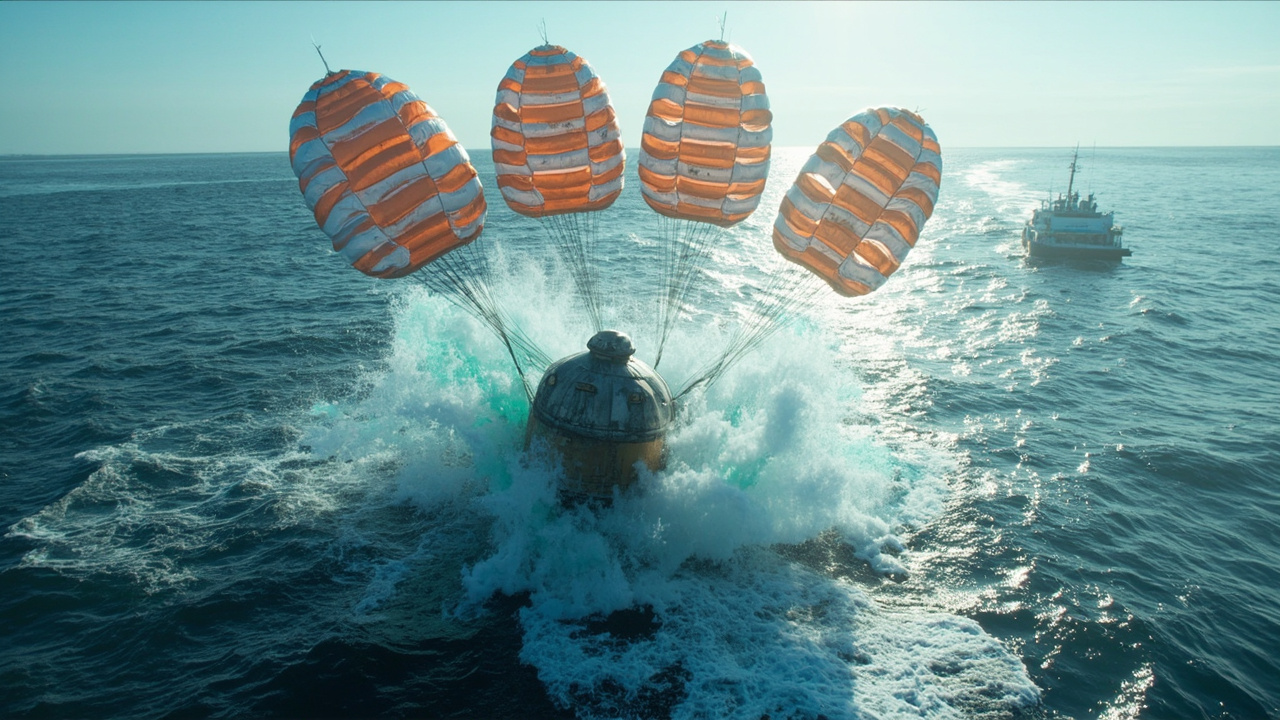
TL;DR: NASA's SpaceX Crew-12 splashed down safely in the Pacific Ocean off Los Angeles on Oct. 8, 2026, ending a 237-day station mission for four crew members.
After more than seven months aboard the International Space Station, NASA's SpaceX Crew-12 mission safely splashed down Thursday in the Pacific Ocean off the coast of Los Angeles, according to NASA's SpaceX Crew-12 Splashes Down release.
Splashdown off Los Angeles ends long mission
The SpaceX Dragon spacecraft touched down at 11:34 a.m. EDT, which was 8:34 a.m. PDT, off the coast of Los Angeles, California. The spacecraft was identified as the SpaceX Crew Dragon Freedom spacecraft.
Aboard were NASA astronauts Jessica Meir and Jack Hathaway, ESA astronaut Sophie Adenot, and Roscosmos cosmonaut Andrey Fedyaev. Adenot represents the European Space Agency, and Fedyaev represents Roscosmos.
Teams aboard SpaceX recovery vessels retrieved the spacecraft and its crew shortly after splashdown. Teams aboard the recovery ship, including two fast boats, secured the SpaceX Dragon and ensured the spacecraft was safe for the recovery effort.
As the fast boat teams completed their work, the recovery ship moved into position to hoist Dragon onto the main deck with the astronauts inside. Once on the main deck, the crew exited the spacecraft.
Following standard postflight medical screenings, the crew was to fly to shore before returning to NASA's Johnson Space Center in Houston. The splashdown completed 237 days at the International Space Station for the four-person crew.
Who flew on Crew-12
The crew was commanded by NASA's Jessica Meir and included pilot Jack Hathaway with mission specialists Sophie Adenot of the European Space Agency and Andrey Fedyaev of Russia's Roscosmos, according to NPR's Crew-12 returns to Earth report.
The mission was the second for Meir and Fedyaev and the first for Hathaway and Adenot. NASA's station blog also recorded that it was the first time Hathaway and Adenot had been to space, while it was the second time for Fedyaev.
Meir has logged 440 total days in space, placing her in NASA's Top 10 for cumulative days in space. That cumulative total was reported after the completion of the 237-day station stay.
NASA Administrator Jared Isaacman said, "Jessica, Jack, Sophie, and Andrey spent 237 days living and working in orbit, traveled more than 100 million miles, advanced important science, and returned safely home because of the extraordinary expertise and competence of thousands across NASA, SpaceX, and our international partners."
Dana Weigel, manager of NASA's Low Earth Orbit Program at the agency's Johnson Space Center, said, "NASA's activities supporting the International Space Station — transporting crew, conducting impactful research, and maintaining critical national assets — enable the science, engineering, and risk-reduction needed for future missions across the solar system."
Weigel also said the agency was grateful for the dedication across the human spaceflight team that makes the work possible. She said the team was thrilled to welcome Jessica, Jack, Sophie, and Andrey home.
A 237-day flight covering millions of miles
During their 237-day mission, the four crew members traveled more than 100 million miles and completed more than 3,792 orbits around Earth. Isaacman also cited the 237 days in orbit and more than 100 million miles traveled in his statement on the return.
The mission duration was described as more than seven months aboard the International Space Station. Other NASA updates described the stay as nearly eight months aboard the orbiting laboratory.
The crew logged hundreds of hours of scientific research to support human exploration beyond low Earth orbit and advance benefits for people on Earth. During the eight months in space, NASA said the crew completed dozens of science experiments and research, including studies of stem cells, how crystals grow in space and bone loss in microgravity.
That research portfolio was intended to support human exploration beyond low Earth orbit and to benefit humanity on Earth. The same research theme was emphasized in SpaceX's mission summary, which said the crew conducted new research to prepare for human exploration beyond low-Earth orbit and to benefit humanity on Earth.
NASA's Low Earth Orbit Program provides reliable access to space, maximizing the use of the International Space Station for research and development by partnering with private U.S. companies, including SpaceX, to transport astronauts to and from the space station.
Launch, docking and undocking timeline
On Friday, February 13 at 5:15 a.m. ET, Falcon 9 launched Dragon's 12th operational human spaceflight mission to the International Space Station from Launch Complex 39A at NASA's Kennedy Space Center in Florida, according to SpaceX's Crew-12 Mission page.
Crew-12 lifted off at 5:15 a.m. EST on Feb. 13 and docked to the orbiting laboratory a day later. Dragon autonomously docked with the space station on Saturday, February 14 at 3:15 p.m. ET.
The February launch was the 20th time SpaceX had sent humans into orbit. The launch used a Falcon 9 rocket from Cape Canaveral in Florida, and the spacecraft docked with the space station the next day.
After 234 days docked to the orbiting laboratory, Dragon autonomously undocked at 8:00 a.m. ET on Wednesday, October 7 and successfully returned to Earth. Splashdown off the coast of California followed on Thursday, October 8 at 8:34 a.m. PT.
The crew's trip home started about 45 minutes before splashdown, at an orbital speed of 17,500 mph. The spacecraft lit its thrusters to nudge it out of orbit, causing the capsule to plunge into the atmosphere.
How the Dragon came home
The SpaceX Dragon spacecraft completed its deorbit burn as expected ahead of splashdown. Live NASA coverage noted the deorbit burn was scheduled to begin around 10:46 a.m. EDT, with splashdown targeted for approximately 11:34 a.m. EDT.
During reentry, the capsule's ablative heat shield faced extreme temperatures up to 3,500 degrees Fahrenheit during the fiery reentry. Over the course of about half an hour, the capsule slowed to a few hundred miles per hour.
Four minutes before splashdown, the drogue parachutes were to deploy at about 18,000 feet in altitude while Dragon was moving approximately 350 mph. Less than a minute later, four orange-and-white parachutes took over, easing the spacecraft to just 16 mph above the ocean.
The Dragon spacecraft supporting the mission previously flew the Crew-4, Ax-2, Ax-3, and Crew-9 missions to and from the space station. This was the second flight for the first stage supporting the mission, which previously launched a Starlink mission.
Following stage separation, Falcon 9's first stage landed on Landing Zone 40 at Cape Canaveral Space Force Station. The Dragon then spent the mission docked to the station before the October return sequence.
Science left aboard and returned to Earth
Crew-12 logged hundreds of hours of scientific research to support human exploration beyond low Earth orbit. The crew members' work included testing stem cell production for cell-based therapies and demonstrating on-demand IV fluid generation for future missions.
The crew also studied how the bacteria that causes pneumonia can lead to long-term heart damage. The crew also conducted nutrition-focused research and examined how physical characteristics may affect blood flow during spaceflight to help keep astronauts safe and healthy on future missions.
Research conducted aboard the space station advances knowledge and demonstrates new technologies that enable preparation for human exploration of the Moon and Mars. NASA said research and technology investigations taking place aboard the space station benefit people on Earth and lay the groundwork for other agency deep space missions.
NASA's post-splashdown briefing plan included Bill Spetch, deputy manager of Commercial, NASA's Low Earth Orbit Program, and Dr. Liz Warren, deputy chief scientist, NASA's Low Earth Orbit Program. The briefing plan also listed Lee Echerd, senior mission manager, Customer Operations and Integration, SpaceX, and Andreas Mogensen, leader, Human Exploration Group, ESA.
NASA set a post-splashdown media teleconference at 1:15 p.m. EDT to cover the return. The teleconference was also intended to cover the launch of the agency's next cargo resupply mission for the microgravity laboratory.
Spacewalks set milestones for Meir and Adenot
Meir completed four spacewalks, bringing her career total to seven. That places her third all-time in total spacewalks among women at NASA, behind former agency astronauts Peggy Whitson and Suni Williams.
Meir conducted four spacewalks totaling just over 27 hours to perform maintenance and upgrade the aging orbital outpost. NASA's station blog reported that the crew also conducted four spacewalks during their nearly eight-month mission.
Adenot completed three spacewalks, becoming the first French woman to venture outside the orbital outpost. NPR's account also reported that Adenot performed three spacewalks during the mission.
Not all of the crew's work happened inside the space station. The spacewalks supported maintenance and upgrades to the orbital outpost during the long-duration stay.
What happens next in Houston
The crew members were scheduled to discuss their science mission during a news conference at 3:30 p.m. EDT, Thursday, Oct. 15, at the agency's Johnson Space Center in Houston.
United States-based media interested in attending the crew news conference in person with Meir, Hathaway, and Fedyaev were required to contact the NASA Johnson newsroom no later than 5 p.m. EDT, Tuesday, Oct. 13. Media joining by phone were required to request dial-in details by 9:30 a.m., Oct. 15.
To ask a question, media were required to join no later than 15 minutes before the start of the news conference. Adenot was scheduled to return to Europe and not be available during the news conference.
Learn more about NASA's SpaceX Crew-12 at the agency's commercial crew page at https://www.nasa.gov/commercialcrew. NASA's live coverage was streamed through agency platforms, with viewing information available at www.nasa.gov/live.
Sources referenced
- NASA's SpaceX Crew-12 Splashes Down, Sets Briefing to Discuss Mission - NASA (https://www.nasa.gov/news-release/nasas-spacex-crew-12-splashes-down-sets-briefing-to-discuss-mission/)
- NASA's SpaceX Crew-12 Dragon Splashes Down at 11:34 a.m. EDT - NASA (https://www.nasa.gov/blogs/spacestation/2026/10/08/nasas-spacex-crew-12-dragon-splashes-down-at-1134-a-m-edt/)