TL;DR: NASA’s Psyche spacecraft began near-continuous ion thrusting on Sept. 28 after its Mars gravity assist to stay on course for a summer 2029 rendezvous with the metal-rich asteroid Psyche.
NASA’s Psyche spacecraft has shifted into its long push toward the main asteroid belt after clearing a key Mars encounter, now running its electric thrusters almost without pause.
According to the NASA Science blog Pedal to the Metal: NASA’s Psyche Heads Toward Asteroid Belt, the spacecraft began using its propulsion system nearly continuously on Sept. 28, stopping just once each week to contact mission controllers on Earth. That operating pattern keeps the mission aligned for rendezvous with the asteroid Psyche in the main asteroid belt by the summer of 2029.
Navigation lead Don Han, of NASA’s Jet Propulsion Laboratory in Southern California, said the team will run the propulsion system at every available opportunity, with operation expected nearly 90% of the time until arrival at the asteroid. JPL is managed for NASA by Caltech.
The change follows an October 2023 launch and an initial cruise phase in which the mission used electric propulsion intermittently. During that first leg, intermittent thrusting placed the spacecraft where it could use the gravity of Mars for a propellant-saving speed increase and a slight change in trajectory.
Mars flyby set the course
The Mars gravity assist is now behind the spacecraft. According to JPL reporting in NASA’s Psyche Mission Aces Mars Flyby, Targets Metal-Rich Asteroid, Psyche completed its close approach on May 15, passing within 2,864 miles (4,609 kilometers) of the surface.
That encounter used Martian gravity to add speed and adjust the spacecraft’s orbital plane without consuming onboard propellant. The flight team then examined radio links with NASA’s Deep Space Network, the agency’s global system for communicating with interplanetary spacecraft, to verify the new trajectory.
Han said Mars supplied a 1,000 mile-per-hour boost and moved the orbital plane by about 1 degree relative to the Sun. The team confirmed the spacecraft was on course for arrival at the asteroid Psyche in summer 2029.
The asteroid target lies in the main asteroid belt between Mars and Jupiter. After the flyby, controllers found the spacecraft headed directly toward that destination.
Why thrust is now almost constant
The mission no longer needs to save its major trajectory work for Mars. With the assist completed, steady acceleration is the way to close the remaining distance on schedule.
The Sept. 28 transition moved Psyche from occasional maneuvers to routine thrusting broken only by weekly Earth check-ins and necessary engineering work. Mission planners describe the present period as full use of every thrusting opportunity.
That approach matters because solar electric propulsion produces only a small force at any moment. Continuous operation lets the small push accumulate into a large velocity change across interplanetary distances.
At maximum cruise speed, Psyche will travel more than 100,000 mph (160,900 kph) relative to an observer on Earth. The nearly constant thrusting profile is intended to build and maintain progress toward that performance while preserving the planned 2029 arrival period.
How the Hall thrusters produce thrust
Psyche does not rely on brief, powerful chemical burns. Its solar-powered system uses electromagnetic fields to deliver up to 250 millinewtons of steady force, approximately the force felt from the weight of holding one AA battery.
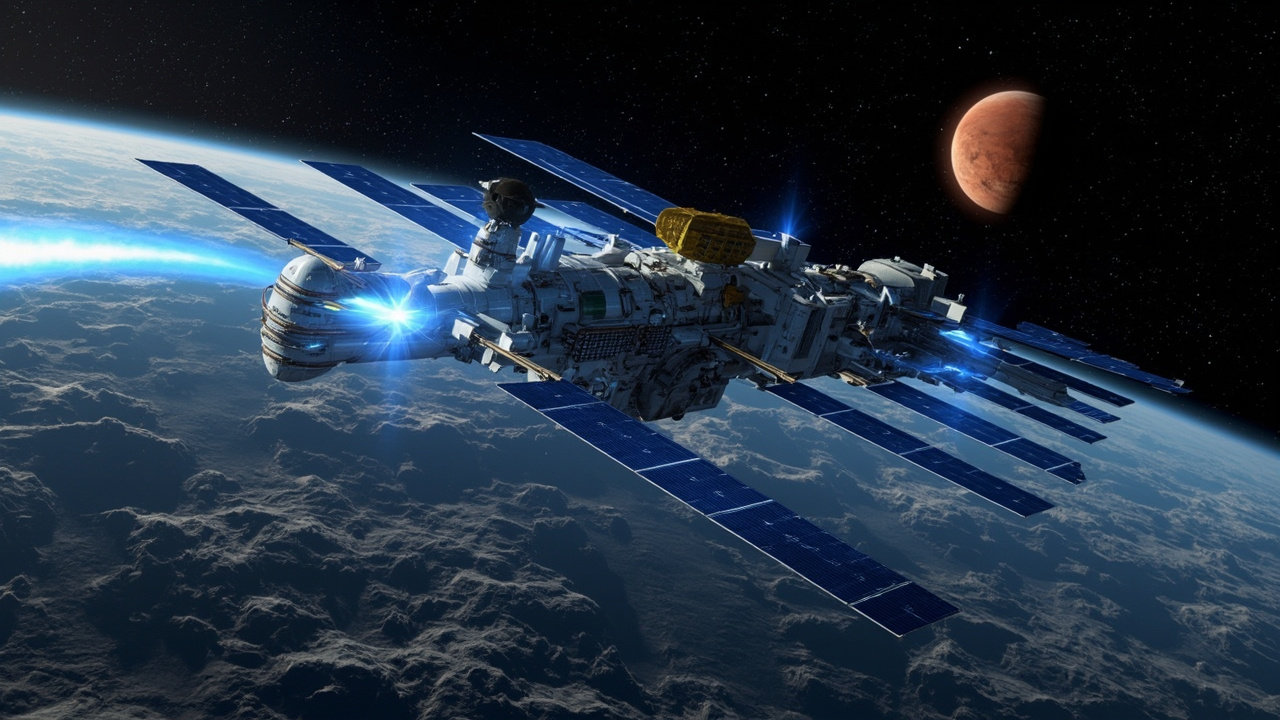
The design uses a process known as the Hall effect. Charged atoms, or ions, of the inert gas xenon are expelled to generate thrust, producing a bright blue glow.
The spacecraft carries four thrusters, operated one at a time. Although each thruster’s output is small, the effect accumulates over the long cruise and allows the spacecraft to gain speed through interplanetary space.
Conventional spacecraft thrusters use large amounts of fuel for short, strong bursts. By contrast, Psyche’s method applies a gentle, continuing push that becomes effective when maintained for months and years.
Power, sunlight and xenon supply
Electricity for the system comes from two five-panel, cross-shaped solar arrays. Their sunlight-collecting area totals 800 square feet (75 square meters) and supplies power for battery charging and spacecraft systems, including propulsion.
Sunlight availability will shape operating power over the next phase. Propulsion operations lead engineer Steve Snyder, at JPL, said the spacecraft will thrust at full power for the next three months, then slowly reduce to approximately half power as greater distance from the Sun reduces light on the arrays and lowers generated power.
Fuel margin remains substantial. The spacecraft launched with nearly 2,400 pounds (1,090 kilograms) of xenon in seven fuel tanks. In three years since launch, it has consumed about one third of that supply.
The remaining xenon is expected to be sufficient to reach the target and support operations while orbiting the asteroid Psyche during a two-year prime science mission. The mission therefore does not face an immediate propellant constraint despite the move to nearly continuous thrusting.
Controlling a subtle twisting force
Operating the thrusters continuously requires careful attitude management. As xenon ions leave the engine, the generated magnetic field causes the ions to swirl.
Those swirling ions can impose a slight torque, or twisting force. Left uncorrected, that twist could disturb the spacecraft’s pointing.
Psyche compensates with reaction wheels that alter their spin rate to absorb excess angular momentum. After several hours of thrusting, engineers instruct the spacecraft to stop the active thruster, rotate, and fire a different thruster at low power in another direction for several minutes. That sequence removes momentum accumulated in the reaction wheels.
Snyder said the torque is so small that it can only be measured in space and not on Earth. He said this is the first time the effect has been measured on a Hall thruster across power level and operating time over such an extended period in space, making the spacecraft an excellent laboratory for the measurement.
Instruments rehearsed at Mars
The Mars encounter also served as an operational rehearsal. In the days before and during closest approach, all Psyche instruments were switched on for calibration, including imagers, magnetometers and the gamma-ray and neutron spectrometer.
Because Psyche approached Mars from a high phase angle, the planet looked like a thin crescent during the approach, illuminated by sunlight reflected from its surface. Observations with the multispectral imager showed the crescent brighter and stretching farther around the disk than expected because sunlight scattered strongly through the planet’s dusty atmosphere.
As the spacecraft moved from Martian night to day, it recorded a rapid series of surface pictures around closest approach. Imager instrument lead Jim Bell, at Arizona State University in Tempe, said the team captured thousands of images of the approach, surface and atmosphere for camera calibration and testing of early image-processing tools being prepared for the asteroid.
Several other missions supplied complementary surface, atmospheric and navigation data for calibration. Those participants included NASA’s Perseverance rover team, Mars Reconnaissance Orbiter, 2001 Mars Odyssey orbiter and Curiosity rover, plus ESA’s Mars Express and ExoMars Trace Gas Orbiter. Bell also leads the Mastcam-Z imaging investigation on the Perseverance team.
Additional calibration work involved the magnetometers, whose early measurements may have detected Mars’ bow shock during the passage. The gamma-ray and neutron spectrometer team compared its Mars measurements with the extensive existing Mars dataset to calibrate that instrument.
What arrival in 2029 will begin
Upon arrival in 2029, the spacecraft will place itself into orbit around the asteroid Psyche. Scientists consider the body a possible partial core of a planetesimal, a building block of an early planet.
The asteroid measures about 173 miles (280 kilometers) across at its widest point. The spacecraft will map it and collect science data through orbits that move lower and then higher in altitude.
If the body proves to be the metallic core of an ancient planetesimal, researchers say it could provide a rare look inside the interior processes that form rocky planets like Earth. Principal investigator Lindy Elkins-Tanton, at the University of California, Berkeley, said the Mars flyby let the team calibrate instruments and rehearse planetary-encounter procedures before the asteroid arrival.
The present cruise phase connects that rehearsal to the destination. With Mars behind it and thrusters firing most of the time, Psyche is using sunlight and xenon to maintain the trajectory that leads to the planned summer 2029 orbit insertion and subsequent science campaign.