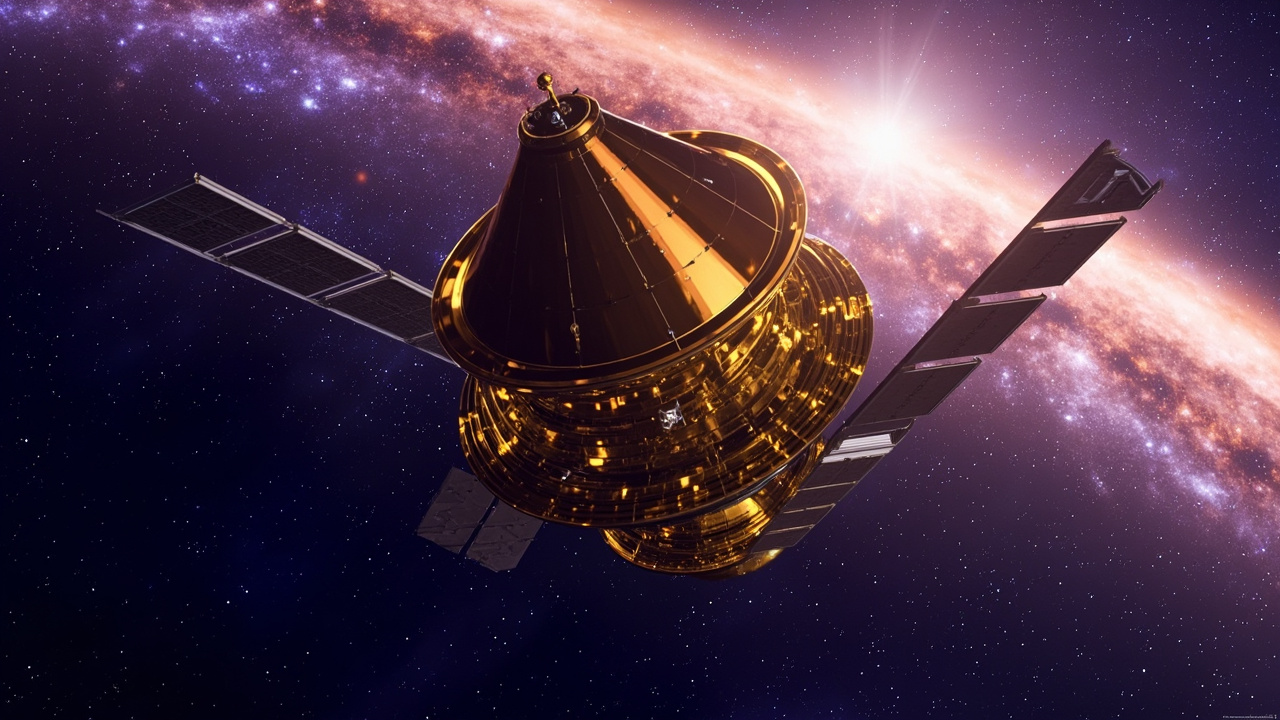
TL;DR: NASA's SPHEREx is recording an infrared spectrum for every point in the sky to test cosmic inflation, track water and other life-related ices, and measure faint background light from early galaxies.
As of early October 2026, the mission launched in March 2025 is already carrying out that all-sky survey, taking about 3,600 images per day and building maps in 102 infrared colors, according to News | SPHEREx.
A census telescope, not a portrait camera
Most famous space telescopes stare deeply at small patches of sky. SPHEREx does the opposite.
The observatory was built to record an infrared spectrum for every direction across the entire sky, according to SPHEREx: The Niftiest Space Telescope You May Not Have Heard Of - AAS Nova. That means for each point, astronomers do not just get a brightness in visible light. They get a measurement of how brightness changes with wavelength in the infrared.
That wavelength dependence is the scientific payoff. Different molecules, different distances and different physical processes leave distinct fingerprints in infrared light. By collecting those fingerprints everywhere, SPHEREx creates a dataset that can be reused for cosmology, planetary formation, galaxy evolution, asteroids, exoplanet host stars and even studies of Earth's upper atmosphere through which the spacecraft orbits.
The effort is led by principal investigator James J. Bock and colleagues at the California Institute of Technology and NASA's Jet Propulsion Laboratory, with results described in a mission paper published in The Astrophysical Journal, according to SPHEREx: The Niftiest Space Telescope You May Not Have Heard Of - AAS Nova.
SPHEREx is short for Spectro-Photometer for the History of the Universe, Epoch of Reionization, and Ices Explorer, according to News | SPHEREx. The long name is essentially its research agenda.
How it makes a spectrum everywhere
A normal sky image is two-dimensional. A spectrum adds a third dimension: brightness versus wavelength.
Some observatories make spectra by dividing a small field into tiny regions and passing the light through a prism or grating. Another approach is to take many separate images through many narrow filters. SPHEREx uses a different implementation based on filters whose transmitted wavelength varies across the detector, so repeated pointings build up 102 spectral measurements for each sky position.
The operational rhythm is steady rather than spectacular. After weeks of preparation, the observatory began its science mission and started taking about 3,600 unique images per day, according to News | SPHEREx. It is operating in low-Earth orbit and delivering survey data to a public archive on a weekly basis.
The first major milestone followed quickly. Launched in March, the telescope completed its first infrared map of the entire sky in 102 colors, an achievement reported on Dec. 18, 2025, according to News | SPHEREx. The 102 wavelengths are not visible to the human eye, but they are widespread in the cosmos.
Science operations began capturing the entire sky on May 1, 2025, according to News | SPHEREx. The plan was for repeated full-sky coverage, allowing later maps to be combined for greater sensitivity.
Goal 1: Testing what inflated the early universe
The first major science goal concerns cosmic inflation, the rapid burst of accelerating expansion in the very early universe posited by current cosmological models.
In that picture, tiny regions with slightly higher energy density than their surroundings, arising from quantum fluctuations, were stretched to enormous scales. Because those regions exerted stronger gravity, they later attracted matter and became the seeds where galaxies formed, according to SPHEREx: The Niftiest Space Telescope You May Not Have Heard Of - AAS Nova.
If that framework is correct, the present-day distribution of galaxies preserves information about inflation. The statistical pattern of galaxy separations can therefore be used to test different inflation theories, including whether inflation was driven by multiple fields.
SPHEREx is designed to assemble the largest atlas of galaxies yet, recording three-dimensional positions for hundreds of millions of galaxies across the entire sky, according to SPHEREx: The Niftiest Space Telescope You May Not Have Heard Of - AAS Nova. Distance is estimated from redshift, the stretching of light by cosmic expansion. Its low-resolution infrared spectroscopy provides moderately precise redshift measurements.
No single galaxy distance needs to be perfect for this test. The strength comes from numbers. With hundreds of millions of positions measured uniformly over the whole sky, small statistical departures from randomness become detectable. Those subtle clustering signals are the observable link back to the properties of quantum fluctuations and how inflation enlarged them.
Goal 2: Following frozen ingredients for planets and life
The second goal looks much closer to home in cosmic terms: how water and other molecules useful for biology reach planets.
Astronomers are actively searching exoplanet atmospheres for signs of habitability through transmission spectroscopy. But a basic supply question remains unresolved: how molecules that could participate in biological processes arrive on planets in the first place.
The candidate molecules include water, carbon dioxide, carbon monoxide and methanol, described as biogenic molecules in SPHEREx: The Niftiest Space Telescope You May Not Have Heard Of - AAS Nova. Researchers think a large fraction of these species spend part of their history frozen onto dust grains in the interstellar medium.
When new stars form, that surrounding dusty, icy material can become part of a protoplanetary disk. Ice can then help build planetesimals that may grow into planets, or it can later deliver biogenic molecules to planetary surfaces. Earth's oceans likely came at least in part from collisions with icy asteroids, according to SPHEREx: The Niftiest Space Telescope You May Not Have Heard Of - AAS Nova.
SPHEREx is designed to measure the abundance of ice species in settings that trace that sequence, from dense interstellar clouds that may soon form stars to regions around newborn stars and evolving protoplanetary disks. Each type of ice leaves a distinct fingerprint in an infrared spectrum, making the different stages comparable with the same instrument.
The mission had already demonstrated that ice-mapping ability before the October 2026 review. It mapped interstellar ice on a scale covering regions more than 600 light-years across inside giant molecular clouds, vast collections of gas and dust where dense clumps collapse under gravity and form stars, according to News | SPHEREx. That result was reported on April 15, 2026.
Goal 3: Turning background glow into signal
The third goal treats something most telescopes try to remove: diffuse extragalactic background light.
Even where SPHEREx sees no individually resolvable star or galaxy, every sky position still contains faint infrared light. That glow combines contributions from many sources, including stars, dust and quasars, from the early universe to the present, added together incoherently, according to SPHEREx: The Niftiest Space Telescope You May Not Have Heard Of - AAS Nova.
For most observatories, that mixture is noise. For SPHEREx, it is data. By measuring both the spectrum of the background and how it fluctuates across the sky, scientists can compare observations with theoretical predictions and look for missing components.
Broad wavelength coverage and complete sky coverage are central to that comparison because they capture redshifted light from very early times. One specific objective is to isolate emission associated with the first stars and galaxies that ionized most of the gas in the universe during the epoch of reionization. Understanding that contribution, alongside later stars, dust and quasars, tests ideas about how galaxies form and evolve.
Why infrared, and why the whole sky
Infrared light is essential because many of the mission's targets are either cold, dust-obscured or shifted to longer wavelengths by cosmic expansion. Dense star- and planet-forming clouds, distant galaxies and diffuse background emission all carry information in infrared wavelengths that visible-light images miss.
Wide area matters for a different reason. Inflation tests need enormous galaxy samples. Ice studies need comparisons across many environments. Background-light studies need fluctuations measured over large scales. An all-sky spectrum serves all three without requiring separate pointed campaigns for each object.
That generality also creates bonus science. The same all-sky infrared spectra are expected to be useful for studying asteroids, characterizing stars that host exoplanets, and studying Earth's upper atmosphere along the spacecraft's orbital path, according to SPHEREx: The Niftiest Space Telescope You May Not Have Heard Of - AAS Nova.
The mission has also shown it can pivot to targets of opportunity. SPHEREx observed interstellar comet 3I/ATLAS in December 2025, only the third such object discovered passing through the solar system, according to News | SPHEREx. Earlier multi-spectral observations between Aug. 7 and Aug. 15 had detected carbon dioxide gas in its extended coma and water ice associated with its nucleus when it was about 290 million miles from the Sun, according to News | SPHEREx.
Recognition followed the technical progress. The SPHEREx team received the Sylvia A. Earle Award for Exploration Excellence, reported Feb. 2, 2026, and the Rotary National Award for Space Achievement 2026 Stellar Award to the JPL team, reported April 30, 2026, according to News | SPHEREx.
The central point for U.S. researchers, students and the public is access. Because SPHEREx data flow to a public archive weekly, professional astronomers and anyone else can probe the same 102-color sky. The mission that began mapping in May 2025 is therefore less a single experiment than a shared infrared reference for the next decade of astronomy.