TL;DR: NASA's Pandora SmallSat has started science operations to separate true exoplanet atmosphere signals from starlight distortion, while Arizona State University researchers have modeled how its year-long survey of 20 worlds will sharpen measurements, especially with NASA's James Webb Space Telescope.
Pandora begins its exoplanet atmosphere survey
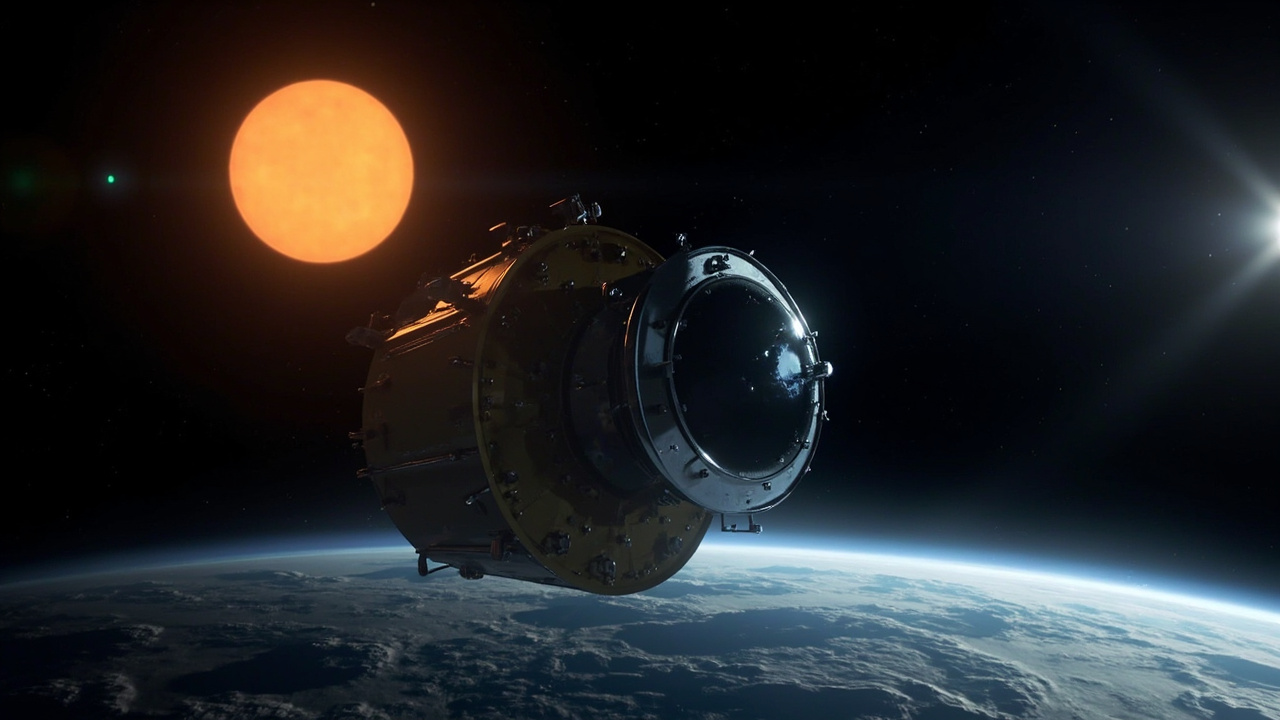
Pandora, NASA's newest exoplanet mission and the first satellite to launch through the agency's Astrophysics Pioneers program, is now making observations of worlds beyond our solar system and the stars they orbit, according to NASA Science.
The spacecraft launched into low Earth orbit on Jan. 11, according to NASA Science. The mission will determine the atmospheric make-up of at least 20 exoplanets, including the presence of hazes, clouds and water.
"Pandora's data will help close a major gap in our knowledge about planets and their host stars because, right now, we can't be entirely sure how the star's light affects measurements of what makes up exoplanet atmospheres," said Elisa Quintana, Pandora's principal investigator at NASA's Goddard Space Flight Center in Greenbelt, Maryland.
"We designed the Pandora spacecraft and its in-depth observing program to better understand this vexing issue," Quintana said.
The results will lay a firm foundation for interpreting measurements by NASA's James Webb Space Telescope, as well as future observatories focused on finding habitable worlds, according to NASA Science. Pandora's near-infrared detector is a spare originally developed for Webb.
"The spacecraft is healthy and all of the instruments are performing as well as we could have hoped," said Jordan Karburn, Pandora's deputy project manager at Lawrence Livermore National Laboratory in California. "Our team's hard work throughout the commissioning process has paid off, and we can now confidently start science."
The starlight problem Pandora was built to solve
NASA's January launch of the Pandora SmallSat mission is set to explore one of exoplanet science's greatest challenges: distinguishing the true atmospheric signals of distant worlds from the ever-changing surfaces of their host stars, according to ASU News.
Traditional observations have struggled due to stellar variability, which introduces spectral signals from the star to what otherwise would be planetary, complicating the detection of key atmospheric components such as water and methane, according to ASU News.
Telescopes can sample a planet's atmosphere in systems where the planet passes in front of its star as seen from Earth. During this event, called a transit, some starlight skims the planet's atmosphere before reaching observers, according to NASA Science. As this light interacts with atmospheric molecules, their chemical fingerprints become embedded in it. For each molecule, astronomers see brightness dips at characteristic wavelengths.
But instruments also see light from the whole star, not just what grazes the planet. Stellar surfaces are not uniform. They have hotter, brighter areas called faculae and cooler, darker regions similar to sunspots. Both can grow, shrink and change position as the star rotates, according to NASA Science.
"Water is one of the most important molecules we can measure to understand the composition and physical conditions of an exoplanet atmosphere," said Benjamin Rackham, a team member at the Massachusetts Institute of Technology in Cambridge.
"But features on the star can distort the water signal we're searching for. Pandora is designed to disentangle the signals from the planet and the star, helping us to understand the planets more accurately and laying the groundwork for the eventual study of planets that could harbor life," Rackham said.
How a small satellite stares longer
Three factors make Pandora unique. It carries a novel all-aluminum telescope about 18 inches (45 centimeters) in diameter, it will study planets and their host stars simultaneously in both visible and infrared light, and it will observe targets for a much longer time than flagship observatories like Webb are able to, according to NASA Science.
The mission is designed to study both exoplanets and their host stars simultaneously. Pandora SmallSat will observe 20 exoplanet targets over the coming year using near-infrared and optical spectrometry, according to ASU News. By dedicating dozens of hours per visit to each planet, the small satellite will characterize both planetary and stellar properties, reducing the chances of false positives.
Pandora's telescope, jointly developed by Livermore and Corning Incorporated, and its detectors make up the mission's heart. The detectors will capture the star's brightness in visible light and its near-infrared spectrum at the same time, while also obtaining a near-infrared spectrum from the planet when it transits the star, according to NASA Science.
Over the course of its year-long primary mission, Pandora will observe at least 20 exoplanets 10 times with a long-duration stare covering 24 hours, with a transit included in each observation, according to NASA Science.
"Pandora's advantage is its ability to observe targets for extended periods at multiple wavelengths, something high-demand flagship missions like Webb cannot regularly do," said Knicole Colón, the mission's project scientist at NASA Goddard. "Combining Pandora and Webb data will uniquely enable scientists to determine the properties of stellar surfaces and cleanly separate star and planetary signals."
Pandora is an ambitious small satellite funded by NASA's Astrophysics Pioneers program. Pioneers missions are designed to explore compelling questions about the universe with fast-paced, low-cost missions that require a higher-than-usual tolerance for failure, according to NASA Science.
ASU team modeled what Pandora can measure
The first science paper of the mission, which modeled the expected observational capabilities of Pandora ahead of the mission's launch, was recently published in The Astronomical Journal, according to ASU News.
The paper was led by Yoav Rotman, a PhD student in Arizona State University's School of Earth and Space Exploration, during his time as a Pandora science intern at the Lawrence Livermore National Laboratory's Space Science Institute. The paper includes ASU co-authors Luis Welbanks and Michael Line, according to ASU News.
"Pandora will unlock a new level of understanding of how these planets and their stars interact and evolve," said Rotman, a current Pandora science team contributor.
Rotman modeled the mission's expected observations to assess its scientific potential, leading a team to predict what the Pandora mission will be able to measure in the atmospheres of these distant worlds. The models showed that, when combined with data from NASA's James Webb Space Telescope, Pandora's observations will yield even stronger results than either instrument alone, according to ASU News.
The transit method for transmission spectroscopy, used by telescopes such as Webb, measures the combined light from a star and planet during a transit and compares it with observations of the star alone. The difference reveals the spectrum of the planet's atmosphere. However, variability in the host star can contaminate these measurements, making planetary signals more difficult to interpret. Pandora is designed to correct for this effect by observing both the star and planet simultaneously, according to ASU News.
Combining Pandora and Webb nearly doubles precision
A graph in the ASU-led study shows the expected precision from 1-20 transits observed with Pandora, a single transit observation with Webb, and a combination of the two. A lower value indicates a more precise estimate of the atmosphere's water abundance, according to ASU News.
By combining Pandora and Webb observations, the team can nearly double the precision compared with data collected from a single transit of Webb, according to ASU News.
Rotman and Welbanks also contributed to a companion paper recently published in the Astronomical Journal that evaluated how well the Pandora SmallSat mission will measure the properties of the host stars and correct contamination from stellar activity in exoplanet transmission spectroscopy, according to ASU News.
Together, these studies highlight how Pandora will help researchers more accurately characterize distant worlds while complementing observations from other major observatories, according to ASU News.
"Reliably measuring the properties and compositions of these distant worlds, and the stars they orbit, will require joint efforts that leverage multiple space- and ground-based telescopes," said Welbanks, leader of the Exoteric Lab at ASU.
"Our exoplanet groups at ASU are hard at work developing the methods to bring these tools together, and Pandora will be a key player in this new landscape," Welbanks said.
Who built and runs Pandora
Pandora is a small satellite that was selected as part of NASA's inaugural call for Pioneer mission concepts in 2021. It is designed to study the atmospheres of exoplanets, or worlds beyond our solar system, and the activity of their host stars with long-duration multiwavelength observations, according to ASU News.
The project is a collaboration between NASA's Goddard Space Flight Center, Lawrence Livermore National Laboratory, NASA's Ames Research Center and a host of other institutions, according to ASU News.
Pandora is led by NASA's Goddard Space Flight Center. Lawrence Livermore National Laboratory provides the mission's project management and engineering. Pandora's telescope was manufactured by Corning and developed collaboratively with Livermore, which also developed the imaging detector assemblies, according to ASU News.
NASA Science reports that Livermore also developed the mission's control electronics and all supporting thermal and mechanical subsystems. The infrared sensor was provided by NASA Goddard. Blue Canyon Technologies provided the bus, performed spacecraft assembly, integration and environmental testing, and is providing mission operations support. NASA's Ames Research Center in California's Silicon Valley performs the mission's data processing.
Pandora's science data is available at the NASA Exoplanet Archive, which is operated by IPAC at the California Institute of Technology in Pasadena, according to NASA Science.
What comes next in the year-long campaign
Over the coming year, the repeated 24-hour stares will build a dataset that pairs visible-light brightness measurements with near-infrared spectra for each target system, allowing astronomers to track stellar rotation and surface changes across visits, according to NASA Science and ASU News.
For the 20-planet sample, the planned 10 visits per planet mean stellar contamination can be studied visit by visit rather than inferred from a single snapshot, a strategy designed to improve interpretation of both Pandora and Webb transmission spectra, according to NASA Science.
The two Astronomical Journal papers provide pre-launch predictions for that campaign: one forecasts atmospheric constraints achievable with Pandora alone and with Pandora plus Webb, and the companion assesses recovery of stellar properties and correction of stellar contamination, according to ASU News.
If the spacecraft and instruments continue performing as described by mission managers, the team can now test those predictions against on-orbit light curves and spectra as the primary mission proceeds through its target list.