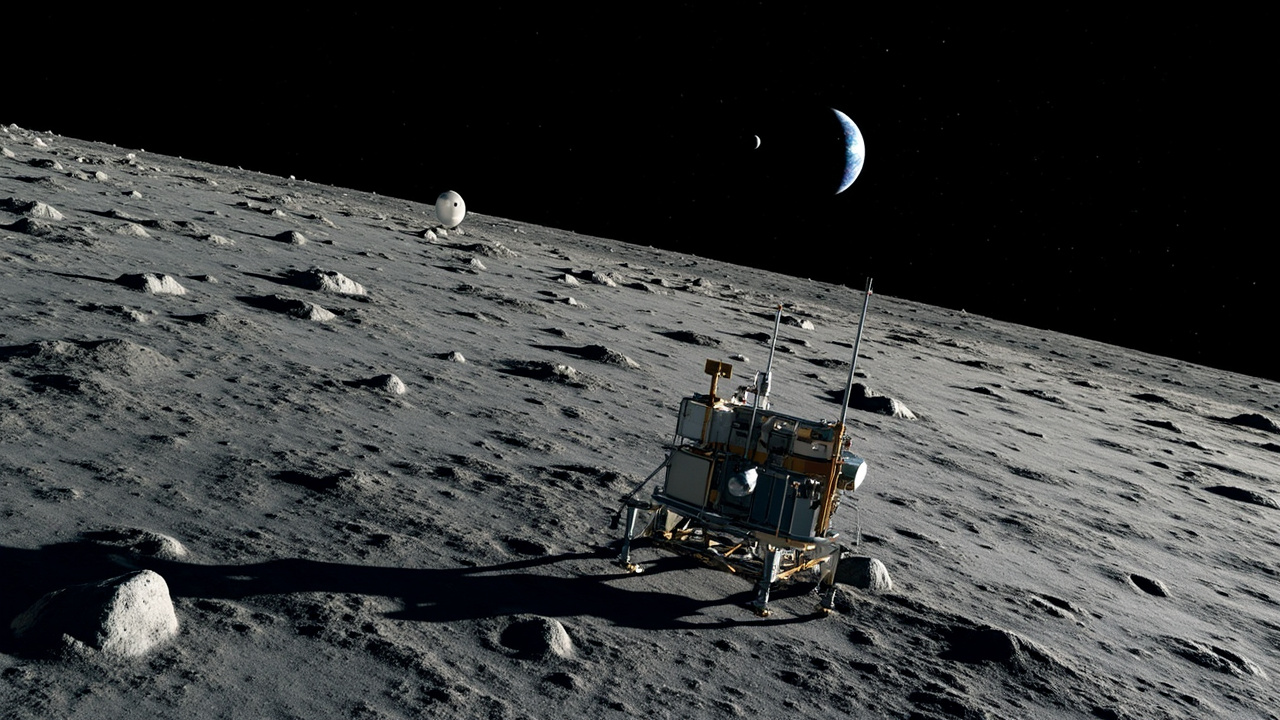
TL;DR: NASA convened the SPARX Science Definition Team to define science objectives, measurements, architectures and a design reference mission for a South Pole-Aitken basin sample return, a mission prioritized across three Planetary Science Decadal Surveys.
NASA has a detailed science blueprint for returning samples from the oldest, largest and deepest recognized impact basin on the Moon.
The blueprint is the South Pole-Aitken basin sample Return and eXploration (SPARX) Science Definition Team Report, according to the SPARX Science Definition Team Report abstract archived on arXiv. The abstract states that NASA convened the team in response to recommendations in the 2023-2032 Origins, Worlds, and Life Decadal Survey, and that the report provides analysis on prioritized science objectives, measurement requirements, implementation architectures, and a design reference mission for a South Pole-Aitken basin sample return mission.
The report does not announce a flight mission. It defines what a future mission would need to measure, where it would need to go, and how it could be implemented using current capabilities.
Why the South Pole-Aitken basin
The South Pole–Aitken basin, often abbreviated SPA, is the largest, deepest, and oldest recognized impact basin on the Moon, according to the South Pole–Aitken basin — Edgepedia summary published Sept. 17, 2026.
That summary describes SPA as an ancient impact structure spanning the lunar far side from the small Aitken crater to the Moon's south pole. From Earth, only a mountain chain on the Moon's southern edge is visible because the depression itself faces away from Earth.
The scale is global. The summary gives a diameter of more than 1,550 miles, or 2,500 kilometers, covering nearly a quarter of the lunar surface. It identifies SPA as the largest impact crater known in the solar system.
Depth is also exceptional. The summary gives an average depth of about 6 miles, or 10 kilometers. It notes that early global topography from the Clementine mission, sponsored by the Ballistic Missile Defense Organization with NASA participation, first established SPA as the largest basin of the solar system, with a diameter of about 2,600 kilometers and a maximum depth of almost 12 kilometers.
Later laser altimetry, including the Lunar Orbiter Laser Altimeter, known as LOLA, on the Lunar Reconnaissance Orbiter, filled a polar gap in the Clementine data and refined the basin's rim structure, according to the same summary.
The SPARX abstract places that physical setting in scientific context. It states that the South Pole-Aitken basin presents the ideal target destination to test nearly 60 years of lunar science hypotheses owing to a unique combination of its size, antiquity, and location on the lunar farside.
A priority across three decadal surveys
Sample return from the South Pole-Aitken basin has been recognized as the highest priority lunar science mission for well over two decades, according to the SPARX Science Definition Team Report abstract archived on arXiv.
The abstract traces that priority through three National Academies Planetary Science Decadal Survey cycles. It states that SPA sample return appeared as a recommended New Frontiers class mission in the two previous Planetary Science Decadal Survey documents, identified as 2003-2012 New Frontiers and 2013-2022 Visions and Voyages.
It then states that SPA sample return appeared as a prioritized mission for the Lunar Discovery and Exploration Program, abbreviated LDEP, in the 2023-2032 Origins, Worlds, and Life Decadal Survey, often called the OWL survey.
That history is consistent with NASA mission competition history described in the New Frontiers program — Edgepedia summary published Sept. 17, 2026. That summary states that the New Frontiers program is a NASA series of medium-class Solar System exploration missions, each proposed and led by a principal investigator and selected through competitive peer review.
The program occupies a middle tier between the smaller Discovery program and NASA's Large Strategic Science Missions, or Flagship missions, according to the same summary. It states that missions must address priority goals identified by the planetary science community in the National Academies' decadal surveys.
The first Announcement of Opportunity restricted proposals to four decadal survey concepts, according to that summary. The four were Venus In Situ Explorer, Jupiter Polar Orbiter with Probes, Lunar South Pole-Aitken Basin Sample Return, and Comet Surface Sample Return, with launch required no later than June 30, 2010.
A later competition again included the Moon. The summary states that the competition begun in January 2017 was limited to six mission themes, including Lunar South Pole Sample Return. NASA received 12 proposals, according to the summary, including MoonRise, a lunar South Pole-Aitken basin sample return.
Two finalists, CAESAR and Dragonfly, each received $4 million through the end of 2018 for concept studies, according to the same summary. On June 27, 2019, NASA selected Dragonfly, a rotorcraft for Saturn's moon Titan.
That program context helps explain the SPARX approach. Rather than repeating a principal-investigator-led New Frontiers competition structure immediately, NASA asked a Science Definition Team to define objectives, measurements, architectures and a reference design.
What the SPARX report defines
The SPARX abstract lists four products: prioritized science objectives, measurement requirements, implementation architectures, and a design reference mission.
Prioritized science objectives mean the lunar science questions ranked highest for an SPA sample return. Measurement requirements mean the observations and laboratory analyses needed to answer those questions. Implementation architectures mean the different ways spacecraft, landers, mobility systems and Earth-return systems could be combined. A design reference mission means a concrete example mission that shows one workable combination.
The abstract states that the science objectives and measurements outlined in the report would transform lunar science. It also states that the mission would address multiple high-level Decadal science questions at the only place in the Solar System where they can be credibly addressed.
The language is conditional. The abstract describes what the mission would do, not what a selected mission is doing. It presents a plan for decision-makers and engineers, not a launch manifest.
The abstract also states that the proposed mission profiles would pioneer a new paradigm for planetary surface exploration in the 21st century. It states that the approach would unite robotic exploration with human exploration in a model for a future sustained lunar enterprise.
How SPARX would use commercial and polar infrastructure
The mission profiles presented in the report leverage three developments, according to the SPARX Science Definition Team Report abstract archived on arXiv.
First, the abstract cites key advancements in remote surface exploration technology. Second, it cites the U.S. commercial space industry. Third, it cites the programmatic focus on sustained human presence and exploration at the lunar south polar region.
The abstract states that leveraging the burgeoning space economy would allow ground-breaking science on a more cost-efficient basis. It does not name specific commercial providers, landers or contracts in the abstract.
The south polar connection matters because NASA's current lunar program emphasizes sustained presence near the south pole. SPA stretches from Aitken crater to the south pole, according to the South Pole–Aitken basin — Edgepedia summary. That geography creates overlap between a far-side basin science target and near-polar exploration infrastructure.
NASA's Lunar Reconnaissance Orbiter continues to provide data relevant to that planning. NASA Science reported Sept. 16, 2026, that the Lunar Reconnaissance Orbiter has circled the Moon for more than 17 years and used seven instruments to map topography, surface composition, temperature and radiation environment.
That NASA Science article described discovery of McGetchin crater, a 222-meter-diameter crater that formed between April 11 and May 22, 2024, and was reported in Science Advances. The agency said the discovery highlights the value of orbiter data as it advances sustained human presence and expanded scientific and commercial activity on the Moon.
SPARX builds on that type of orbital reconnaissance by defining surface measurements and returned samples that orbiters cannot provide.
What makes SPA scientifically distinct
SPA materials are enriched in mafic minerals relative to much of the lunar highlands, and the basin interior exposes deep crust and possibly mantle-derived material, concepts summarized in recent basin literature reflected in the South Pole–Aitken basin — Edgepedia compilation.
The summary states that simulations suggest the impact broke through the Moon's crust to its mantle. It states that melting of the upper mantle produced a large, compositionally zoned body of melt that makes up the basin's interior.
Because basin formation melts material kilometers to tens of kilometers deep, a substantial amount of melt remains in the basin, according to the same summary. For SPA, the solidified impact melt sheet is thought to be about 31 miles, or 50 kilometers, thick.
The summary also states that simulations show significant quantities of upper mantle material were folded into the ejecta curtain, where they mixed with pre-impact crust to form part of the post-impact floor.
Gravity data add another layer. Gravity data from NASA's GRAIL mission revealed a giant mass beneath the basin, probably enriched with metal, that drags the basin floor down by more than half a mile, or 0.8 kilometers, according to the same summary.
A geophysical analysis found this mantle mass excess has a minimum mass of 2 x 10^18 kilograms and likely extends to depths of at least 300 kilometers, according to the summary. Two explanations are considered plausible in the compiled literature: metallic core material from the basin-forming impactor still suspended in the Moon's mantle, or oxide-rich dregs from the last stage of magma ocean crystallization.
Crustal thickness models imply that the crust in the center-most region of the basin interior is 13 to 22 kilometers thick, according to the summary. The interior contains a relatively uniform-thickness crust of at least 16 kilometers in undisturbed regions, thicker than earlier estimates.
Unlike many smaller lunar basins, SPA did not develop into a mascon basin, a basin with a large positive gravity anomaly at its center, according to the same summary. Modeling indicates the crust was not entirely removed and mantle flow toward the basin center uplifted topography closer to isostatic equilibrium.
Those interior properties are why returned samples matter. Orbiters can map composition and gravity, but dating impact melt and analyzing mantle candidates in Earth laboratories would test formation models directly.
Age and the Chang'e-6 context
Age is central to SPA science. The basin is thought to have formed approximately 4 billion years ago, around the time of the Late Heavy Bombardment, according to the South Pole–Aitken basin — Edgepedia summary.
In-situ dating of samples returned by Chang'e-6 places the impact at 4.25 billion years ago, according to the same summary. That date places the impact after solidification of the lunar magma ocean and the start of mantle overturn, which the summary states rules out earlier models in which impact melt inherited pre-overturn magma-ocean compositions.
China's Chang'e-6 returned 1,935.3 grams of soil from Apollo crater inside the basin in June 2024, the first samples from the lunar far side, according to the same summary. A Chinese report published Sept. 17, 2026, described the same 1,935.3-gram sample as humanity's first far-side collection and said it was collected in the South Pole-Aitken basin.
That mission sampled one location inside a vast basin. The SPARX concept addresses broader basin-wide objectives through site selection, mobility, sample diversity and measurement requirements defined by a NASA science team.
The distinction matters for U.S. readers. Chang'e-6 demonstrated far-side sampling and return. SPARX defines U.S. science priorities, architectures and a reference mission that would use U.S. commercial capabilities and south polar exploration planning to address decadal-level questions.
What happens next
The SPARX report is a science definition input, not a selection. NASA convened the team, the team defined objectives and a reference mission, and program officials can use that work to shape future calls, partnerships or directed missions.
The abstract frames the stakes in broad terms. It states that the mission would transform lunar science, pursue ground-breaking science on a more cost-efficient basis through the space economy, and unite robotic and human exploration.
For now, the verified step is the completion of the definition work itself: objectives prioritized, measurements specified, architectures compared, and a design reference mission presented for a future South Pole-Aitken basin sample return.