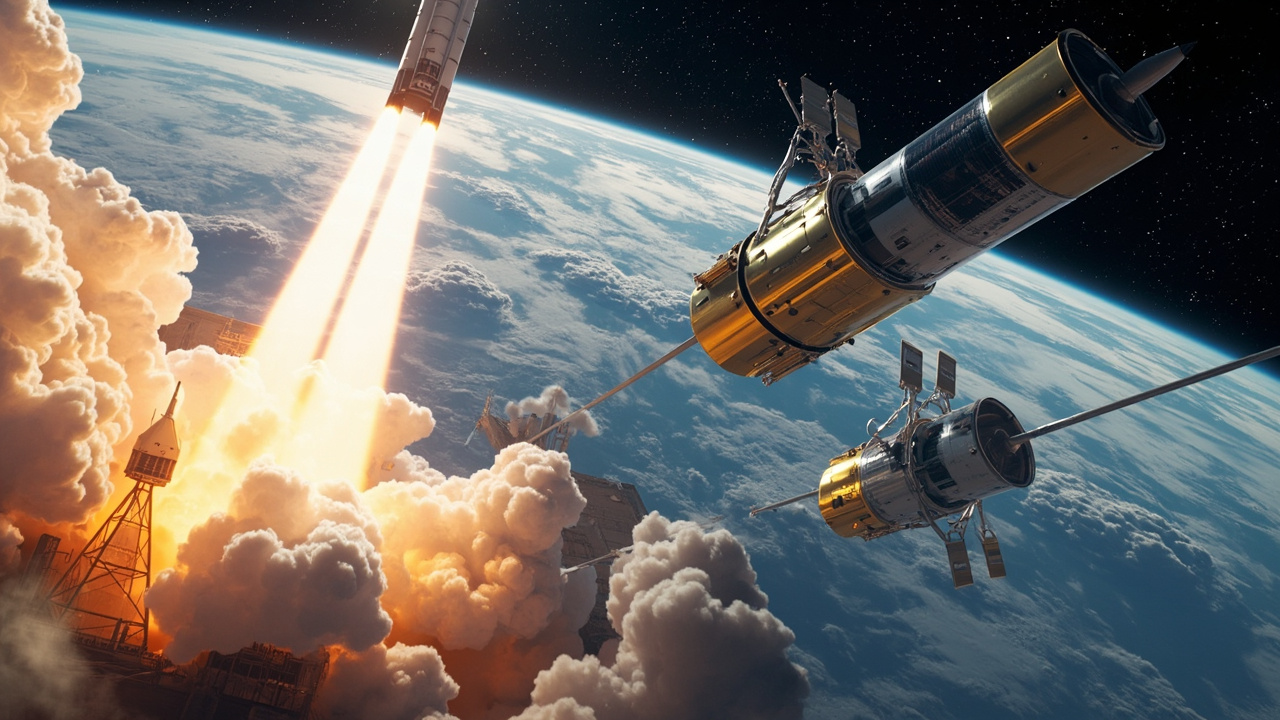
TL;DR: Three NASA-supported small spacecraft launched October 1, 2026, aboard SpaceX's Transporter-18 rideshare, including the first commercially operated debris-inspection mission funded by NASA.
A rideshare with three NASA jobs aboard
A SpaceX Falcon 9 rocket lifted off at 11:32 a.m. PDT on Thursday, Oct. 1, 2026, from Space Launch Complex 4 East at Vandenberg Space Force Base in California, according to NASA's blog titled NASA SmallSats Launch to Advance Science, Technology, Orbital Operations.
That flight was the company's Transporter-18 commercial rideshare mission. The mission carried 130 payloads headed to a Sun-synchronous orbit, with deployments planned over about 11 minutes starting around 54 minutes into flight, according to Spaceflight Now reporting titled Launch preview: More than 100 spacecraft hitch a ride to orbit on SpaceX's Transporter-18.
Three of the payloads were NASA-supported small spacecraft. NASA said the trio would demonstrate new propulsion technologies, study how galactic dust and high-energy radiation move through galaxies, and advance capabilities for inspecting inactive satellites.
NASA described the rideshare approach as a way for science and technology demonstrations to share a rocket with other government and commercial spacecraft. The agency said the arrangement creates additional opportunities to test emerging capabilities in orbit economically.
The booster for the mission carried tail number B1082, making its 25th flight after prior launches including NROL-145, USSF-62, OneWeb Launch 20, and 21 batches of Starlink satellites. Nearly seven and a half minutes after liftoff, the booster was targeted to land back at Landing Zone 4, which would be the 36th landing at that site and the 665th Falcon booster landing to date.
ASCENT test fires two thruster types from one tank
One NASA payload was the ASCENT Propulsion Dual Mode CubeSat. NASA's Marshall Space Flight Center in Huntsville, Alabama, leads the mission in collaboration with the Massachusetts Institute of Technology and Georgia Institute of Technology, and Rubicon Space Systems, a division of Plasma Processes.
The CubeSat carries a single chemical thruster and four electrospray thrusters. The chemical thruster is intended to demonstrate maneuvers requiring higher power, while the four electrospray thrusters are intended for lower-power operations.
Both systems use a common supply of Advanced Spacecraft Energetic Non-Toxic propellant, known as ASCENT. NASA described the propellant as a low-toxicity formulation that is safer to handle during spacecraft processing and has 50 percent higher specific impulse density than conventional propellants such as hydrazine.
The purpose is to show how a small spacecraft could gain the advantages of both propulsion types using the same propellant and feed system. NASA's Launch Services Program Office, based at Kennedy Space Center in Florida, manages the CubeSat Launch Initiative, which selected the ASCENT dual-mode propulsion demonstration in 2024.
Maverick Space Systems provided support during the integration campaign for the ASCENT mission, along with the other two NASA spacecraft on the flight.
SPRITE brings ultraviolet astrophysics in a shoebox
A second NASA-supported spacecraft was the Supernova Remnants and Proxies for ReIonization Testbed Experiment, called SPRITE. It was developed and operated by the University of Colorado Boulder's Laboratory for Atmospheric and Space Physics and funded by NASA's Astrophysics Division.
NASA said SPRITE would be the agency's first astrophysics CubeSat to detect a specific range of ultraviolet light that cannot be observed from the ground. That capability is intended to let SPRITE examine how gas, dust, and high-energy radiation move through galaxies and escape into the vast spaces between them.
The science goal is to offer new insight into how radiation transformed opaque, neutral gas that obscured the early universe and cleared the way for light to spread through the cosmos. During its one-year mission, SPRITE is planned to observe star-forming regions and the remnants of exploded stars in and near the Milky Way.
The spacecraft measures 13.5 inches long by 9 inches wide and high, about the dimensions of a shoebox. Despite that size, NASA said it uses highly sensitive detectors, specialized mirror coatings, and an innovative telescope design that could match the performance of some much larger space instruments.
NASA said the advanced technologies demonstrated by SPRITE in space will directly benefit development of future, larger-scale ultraviolet observatories. The CubeSat Launch Initiative selected SPRITE in 2021, and the initiative offers launch opportunities intended to give participants practical experience designing, developing, and flying hardware.
Otter begins NASA's first funded commercial inspection flight
The third NASA spacecraft was the Small Spacecraft Propulsion and Inspection Capability mission, known as SSPICY. For that mission, the aerospace firm Starfish Space will operate its Otter 24C spacecraft to inspect up to four inoperable satellites in low Earth orbit of U.S. origin, according to NASA.
Orbinauts reported in its article titled NASA's first commercial debris inspector has launched: Starfish Space's Otter will visit up to four dead satellites that the Starfish-built vehicle launched Oct. 1 and is due from 2027 to fly within hundreds of metres of defunct U.S. satellites to check their state.
Starfish Space, based in Tukwila, Washington, won the contract in 2024 under NASA's Small Business Innovation Research program. The company will receive $15 million over three years to carry out the mission, which NASA calls the first commercial space debris inspection it has funded.
SpaceX's flight timeline listed SSPICY Otter deploying about 1 hour and 3 minutes after liftoff. The Falcon 9 was bound for a sun-synchronous orbit. Orbinauts noted the Transporter-18 satellites were not yet in the public catalogue at the time of its Oct. 3 report, and that once Otter received a catalogue number it could be followed on a live map.
Starfish said the flight was its first Otter servicing vehicle, although the company had launched several missions to date. Orbinauts reported that two days after launch, the company had published no word on Otter's health, and that commissioning in orbit was the next step.
How Otter will approach dead satellites
The spacecraft is an Otter 24C with a mass of 335 kilograms. A low-thrust electric propulsion system will move it from one object to the next and bring it to within hundreds of metres of each target.
At close range, it will gather information about surface condition, geometry, and orbital characteristics. NASA said when it awarded the contract that data would also cover spin rate and spin axes.
NASA has not named the targets. Its mission page describes the candidates as inoperable space objects of U.S. origin such as satellites, rocket bodies, or other objects. Criteria listed by NASA are that each object be close to the orbit where SSPICY was released, of medium size, of U.S. origin, and in a circular orbit at least 400 kilometers up. In 2024, NASA said Otter would visit U.S.-owned defunct satellites that had agreed to be visited and inspected.
The mission is expected to operate for about two years, with inspections beginning in 2027. Both SSPICY and the ASCENT Propulsion Dual Mode mission are managed and funded by NASA's Small Spacecraft and Distributed Systems program within the agency's Research and Technology Mission Directorate at NASA Headquarters in Washington. The program is based at NASA's Ames Research Center in California's Silicon Valley.
Four technologies riding inside one servicer
NASA listed four pieces of Starfish technology on the flight, all carried on a spacecraft bus built by Astro Digital of Santa Clara, California.
The first is Manta, a jointed robotic boom that points the thruster. The second is CETACEAN, navigation software that uses computer vision and a stereoscopic camera to determine how a target is positioned and moving relative to Otter.
The third is CEPHALOPOD, guidance software that uses CETACEAN data to decide step by step whether to keep approaching or to abort. The fourth is Nautilus, a gripper that can dock with spacecraft never designed for docking. Docking is not among the mission's goals, although the hardware flies on SSPICY.
NASA calls electric propulsion an important enabling technology not typically used for rendezvous and proximity operations, making its use part of the test. The mission also tests an articulating robotic boom for directing thrust and computer-vision-based navigation software for approaching objects safely.
Starfish co-founder Austin Link said before launch that the first Otter was built, had a customer and a mission, and was going to space. The company lists SES, NASA, the U.S. Space Force, and the Space Development Agency among customers it is delivering Otter missions for.
Why inspection comes before servicing
Low Earth orbit holds the highest concentration of orbital debris. Satellites no longer in use can break apart or collide with one another, creating debris clouds.
NASA senior technical lead for in-space servicing, manufacturing and assembly Bo Naasz said when the contract was awarded that in-space inspection helps characterize the physical state of a satellite, gather data on what may leave spacecraft stranded, and improve understanding of fragmentations and collisions.
NASA said the technology demonstration and data from the inspections will help the agency and industry understand how spacecraft could inspect and eventually service or assist with disposal of objects in orbit. SSPICY builds on NASA investments in small-business technologies for future in-space servicing and orbital debris assessment.
A crowded week at both coasts
The Oct. 1 rideshare was one of three SpaceX Falcon launches that day. Earlier on Oct. 1, NASA's SpaceX Crew-13 mission launched at 11:10 a.m. EDT from Space Launch Complex 40 at Cape Canaveral Space Force Station in Florida, according to NASA.
That night, a Falcon Heavy launched the classified NROL-97 payload for the National Reconnaissance Office from Launch Complex 39A at Kennedy Space Center at 11:54 p.m. EDT. Spaceflight Now reported it was the first NRO payload to fly aboard a Falcon Heavy after 22 prior NRO flights on Falcon 9 rockets.
The center core, serial number B1106, was new and was expended. Side boosters B1104 and B1072 returned to Landing Zones 1 and 2 at Cape Canaveral Space Force Station. B1104 made its second flight and B1072 its fourth, both having last flown Aug. 30 to launch NASA's Nancy Grace Roman Space Telescope. The payload fairing had previously flown on the NROL-95 mission in July.
The mission was the first NRO mission procured in 2025 through the competitive National Security Space Launch Phase 3 Lane 2 contract. Spaceflight Now reported the day produced four booster landings in one day for the first time, including the two Falcon Heavy side boosters.
In a separate development covered in KeepTrack's report titled Falcon Heavy Flies First NRO Mission, X Report 3 Oct 2026, Rocket Lab signed its largest Electron launch service agreement to date, a 20-mission contract with Synspective to continue deploying the Japanese company's StriX synthetic aperture radar constellation. That partnership had already placed 13 StriX radar satellites into orbit since 2020.
Station crew handover sets up Oct. 7 departure
While the new small satellites began commissioning, NASA set a new target for the outgoing station crew. Following a review of weather and splashdown conditions off California, NASA and SpaceX targeted no earlier than 1:05 a.m. EDT on Wednesday, Oct. 7, for undocking of the Crew-12 mission from the International Space Station, according to NASA's blog titled NASA, SpaceX Set No Earlier Than Oct. 7 for Crew-12 Departure.
An Oct. 7 undocking would place NASA astronauts Jessica Meir and Jack Hathaway, European Space Agency astronaut Sophie Adenot, and Roscosmos cosmonaut Andrey Fedyaev on schedule to splash down off California about 11:25 a.m. on Thursday, Oct. 8. NASA said the exact splashdown time could adjust slightly depending on the return location selected.
Mission managers were to continue monitoring conditions in the recovery area, because undocking of the SpaceX Dragon depends on spacecraft readiness, recovery team readiness, weather, sea states, and other factors. NASA and SpaceX planned to select a specific splashdown time and location closer to undocking, with the next weather review about 48 hours before undocking.
On Sunday, Oct. 4, the departing crew members were to transfer mission responsibilities to their new crewmates. Meir was to hand command of the station to Roscosmos cosmonaut Pyotr Dubrov during a change-of-command and farewell ceremony beginning at 10:20 a.m. EDT.
Sources referenced
- NASA SmallSats Launch to Advance Science, Technology, Orbital Operations - NASA (https://www.nasa.gov/blogs/smallsatellites/2026/10/01/nasa-smallsats-launch-to-advance-science-technology-orbital-operations/)
- NASA's first commercial debris inspector has launched: Starfish Space's Otter will visit up to four dead satellites | Orbinauts (https://orbinauts.com/news/nasas-first-commercial-debris-inspector-has-launched/)