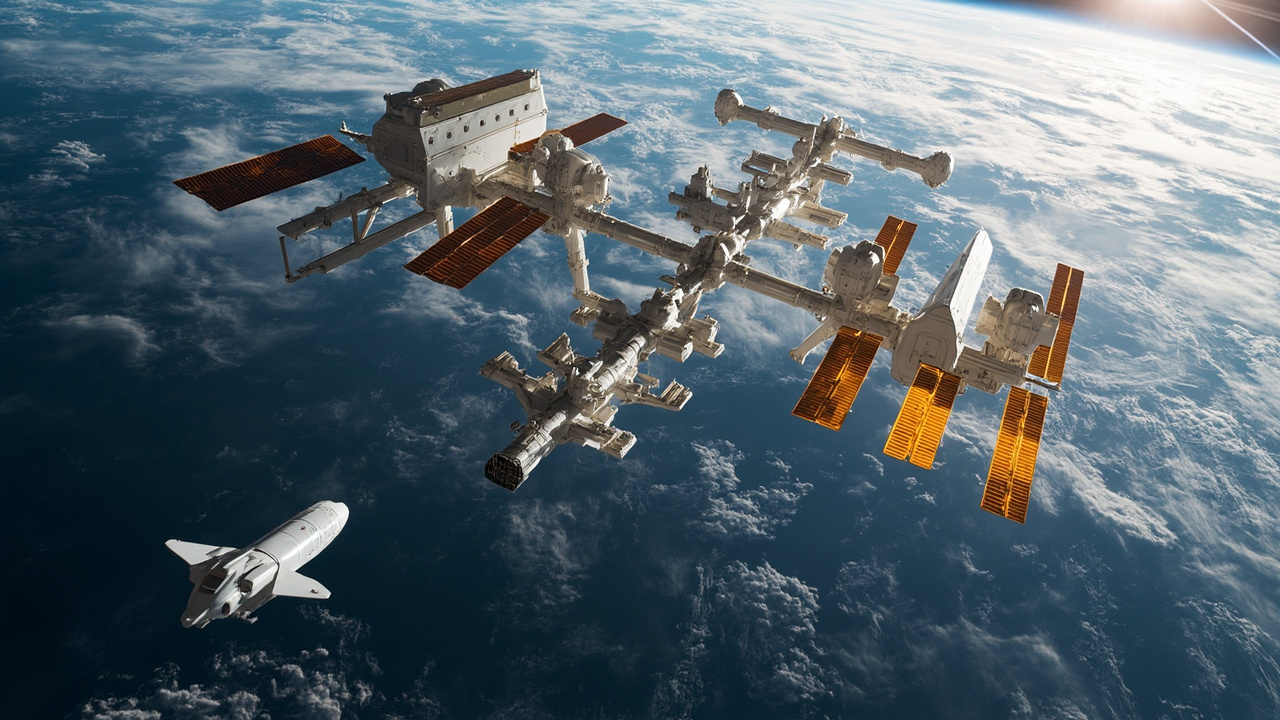
TL;DR: NASA released its final 360-page request for proposals on Oct. 9, 2026, asking U.S. companies to design, build and operate commercial stations to succeed the International Space Station, with bids due Dec. 8, 2026.
NASA moved to replace government ownership of crewed facilities in low Earth orbit with purchased services from privately owned destinations. According to NASA's announcement titled "NASA Seeks US Industry Plans for Commercial Space Stations," the agency released the final solicitation on Friday, Oct. 9, 2026, from NASA Headquarters in Washington. The release invites industry to submit plans for the next generation of commercial stations. NASA Administrator Jared Isaacman said the effort aligns with the President's National Space Policy and is intended to maintain a sustained American presence in low Earth orbit after the International Space Station retires.
What NASA released on Oct. 9
The solicitation is identified as the Commercial Low Earth Orbit Destination Contract, number 80JSC027R0004, issued through NASA Johnson Space Center in Houston, Texas. According to Ars Technica's report titled "NASA issues long-awaited call to industry for private space stations," the final request for proposals totals 360 pages plus attachments. A cover letter accompanying the package states the objective as ensuring NASA retains a sustained human presence in low Earth orbit for crew members to perform science and exploration.
Under the solicitation, NASA outlines requirements for design, building, testing, certification and operation of commercial destinations capable of providing end-to-end destination and transportation services for human spaceflight use. According to NASA, the contract structure will use firm-fixed-price, multi-award, indefinite-delivery/indefinite-quantity contracts supporting development, certification and services for continued research and exploration. NASA intends to select two or more contractors through early development, followed by a competitive task order for final design, test and evaluation, as well as certification and services from one or more contractors.
Deadlines and award schedule
Industry responses are due back to NASA on Dec. 8, 2026. According to NASA, proposals are due Tuesday, Dec. 8, with contract awards expected in spring 2027. Procurement records list the due time as 1 p.m. Central Time on Dec. 8, 2026, with electronic submission through the federal portal.
NASA said it plans to select two or more contractors in this phase and intends to make a final decision in April. Procurement records list the anticipated award date as April 15, 2027. According to Ars Technica, Phase 1 winners will be guaranteed at least $100 million. NASA said Phase 2 of the Commercial LEO Destinations competition, kicking off next year, will include funding for development and certification, and Phase 3 will include purchase of at least four missions for NASA astronauts to the private stations.
Past-performance material follows a separate schedule. Procurement records request Proposal Volume III on past performance two weeks earlier, on Nov. 24, 2026, Central Time. Questions on the solicitation are due by Oct. 21, 2026, at 1 p.m. Central Time, and telephone questions will not be accepted.
How the contract would work
The contract will be firm-fixed-price and indefinite-delivery/indefinite-quantity, with an initial ordering period of eight years from the contract effective date. Procurement records describe two option periods to extend ordering: a four-year Option Period 1 and a three-year Option Period 2, for a total potential ordering period of 15 years. The request for proposals and its attachments supersede the draft request for proposals.
The scope calls for a commercially owned and operated destination in low Earth orbit. Procurement records describe the work as design, build and operate a station, provide safe, reliable and cost-effective end-to-end services to succeed the International Space Station, and ensure sustained human presence for science and exploration. According to NASA, the task-order approach allows the agency to carry two or more providers through early development before competing later work for final design, test, evaluation, certification and services.
NASA also published a technical library under notice ID 80JSC025_CLDC_TECH_LIBRARY. Offerors are responsible for monitoring the federal website for amendments and downloading their own copies of the solicitation. The solicitation package includes the 360-page final request for proposals, a 55-page statement of work identified as Attachment J-01, and a 229-page data-requirements document identified as Attachment J-02.
Transportation approach eases burden on station bidders
One closely watched element involved crew and cargo transportation to the stations. According to Ars Technica, NASA had indicated in earlier discussions that it might leave acquiring transportation to contractors, requiring them to sell an end-to-end service to the agency. In the final request for proposals, NASA does not require contractors to provide proof of a signed contract with Boeing or another transportation provider, or even a letter of intent, as part of their bids.
NASA is offering to furnish transportation for the first four NASA service missions to the private stations. According to Ars Technica, that offer likely means NASA will help broker deals between the private station companies and Boeing. The issue has drawn attention because SpaceX has said it plans to retire the Crew Dragon spacecraft as soon as possible, and almost certainly when the International Space Station is deorbited in 2030 or 2032. According to Ars Technica, SpaceX has the only operational U.S. vehicle for such transportation and has not offered to sell seats to private station operators.
In the new documents, NASA assigns an explicit price to crew and cargo missions. For 2030, it estimates a four-seat crew flight will cost $325 million and a cargo flight $300 million. According to Ars Technica, furnishing the initial flights removes a significant burden from station providers already undertaking construction, testing and flight of orbital stations. Two weeks before the final solicitation, NASA provided an additional $359 million to support Boeing's ongoing efforts to certify its Starliner spacecraft for crewed missions to low Earth orbit.
Who is expected to compete
Bidders for this funding phase will certainly include Axiom Space, Voyager Space and Vast Space. According to Ars Technica, Blue Origin won an earlier round of funding from NASA, but questions remain about the company's commitment to the program. SpaceX appears unlikely to bid, at least for now.
Early industry reactions came on Friday afternoon while teams were still reviewing the package. Marshall Smith, chief executive of Voyager's Starlab space station, said in a statement reported by Ars Technica that the release was an important milestone and that NASA had incorporated industry and government feedback. An Axiom Space spokesperson said the team was actively reviewing the request and was energized for next steps, citing years of experience executing human spaceflight missions and developing orbital hardware. A Vast spokesperson said the company looked forward to competing to build the commercial successor to the International Space Station and that it was in final integration with Haven-1 and working toward a multi-module station capable of supporting continuous human presence.
How NASA shaped the final terms
NASA linked the final solicitation to its Ignition event earlier this year and to regular engagement with private industry on the future direction in low Earth orbit. According to NASA, that engagement included two requests for information in March to gather industry perspectives on destinations and transportation. The agency also published a draft request for proposals in July, followed by an industry day and one-on-one meetings that allowed interested companies to review and comment on the planned acquisition approach.
Isaacman said NASA had spent time since Ignition listening to industry and working through requirements for a successful transition. According to NASA, he said the opportunity is significant but the economics ultimately have to work, and that NASA wants credible plans, strong technical execution and companies prepared to invest in destinations that can serve NASA while developing additional customers and markets. He also said NASA will continue to need a place to conduct research, develop technologies, train crews and prepare for missions to the Moon and Mars, while commercial stations may provide that capability and allow NASA to concentrate resources on future missions.
A virtual pre-proposal conference is scheduled for Oct. 15, 2026, at 1 p.m. Central Time via Microsoft Teams. In-person sessions with a hybrid option are scheduled at the Gilruth Center on Oct. 16, 2026, limited to destination prime offerors. Participation is limited to ten individuals per company or team, and RSVPs were required by Oct. 13, 2026, at 1 p.m. Central Time. Attendance is recommended but not mandatory or a prerequisite for proposal submission.
Sources referenced
- NASA Seeks US Industry Plans for Commercial Space Stations - NASA (https://www.nasa.gov/news-release/nasa-seeks-us-industry-plans-for-commercial-space-stations/)
- NASA issues long-awaited call to industry for private space stations - Ars Technica (https://arstechnica.com/space/2026/10/nasa-issues-long-awaited-call-to-industry-for-private-space-stations/)