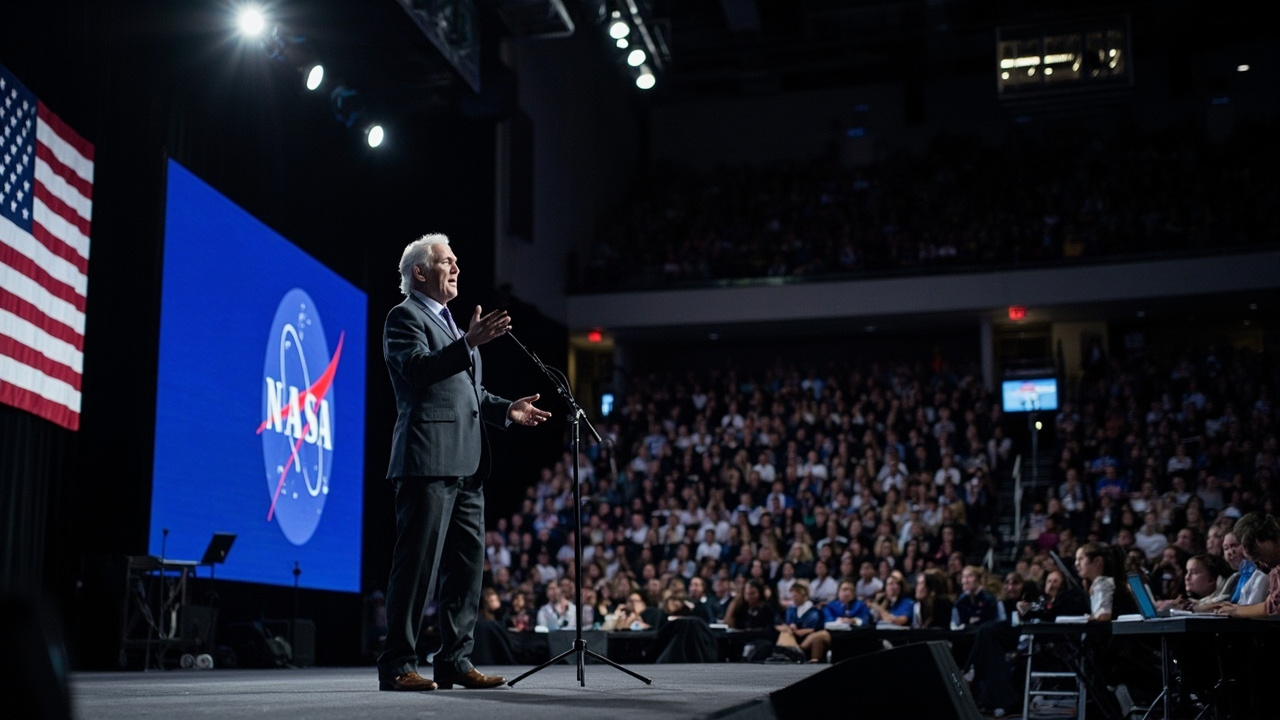
TL;DR: NASA Administrator Jared Isaacman brought the agency's Inspiration Tour to the University of Arizona on Sept. 23, 2026, drawing more than 650 students and community members to the Bear Down Building for a day built around student missions and Artemis-era jobs.
More than 650 students and community members filled the Bear Down Building on Wednesday as NASA Administrator Jared Isaacman brought the agency's Inspiration Tour to the University of Arizona in Tucson, according to University of Arizona News. The Sept. 23, 2026 visit, reported by Laine Kowalski for the Office of Research and Partnerships, was described as the only Inspiration Tour stop at an Arizona university.
The day paired a large town-hall style gathering in Bear Down Gym with a tour of the Applied Research Building, including the university's Multi-Mission Operations Center, according to University of Arizona News. KVOA reported that Isaacman met with students and researchers Wednesday morning and used a town hall in Bear Down Gym to highlight the school's role in NASA missions and the push to inspire future generations.
A town hall focused on the Artemis generation
Students from Tucson-area high schools, the University of Arizona, Pima Community College and Tohono O'odham Community College engaged directly with Isaacman, asking questions about space debris, black holes and the pace of space missions, according to University of Arizona News.
Isaacman told the audience that the university's optics work ranks among the best in the country, citing cameras supporting the James Webb Space Telescope and imagery from the Martian surface, according to University of Arizona News. In the same report, he urged students with talent and drive to take on problems that look impossible until solved, listing needed roles as engineers, scientists, technicians, entrepreneurs, researchers, operators, explorers and astronauts.
"You are all part of the Artemis generation, and America and NASA are very much back in the moon business," Isaacman said, as quoted by University of Arizona News.
KVOA reported a related message from the Bear Down Gym town hall, where Isaacman spoke about visiting local suppliers and the importance of new talent as NASA plans to return to the moon and build nuclear-powered spacecraft. KVOA quoted Isaacman saying the agency is building a moon base, going back to the moon and building nuclear power spaceships to go to Mars, adding that a very inspired and energized next generation will be needed to contribute.
University of Arizona News reported that the visit connected a space legacy stretching back more than 60 years with students and technologies shaping what comes next.
A partnership traced to the Ranger era
University of Arizona President Suresh Garimella said the university has been a NASA partner since the earliest days of the space age and that the relationship has only grown stronger, according to University of Arizona News. Garimella said students are involved in active NASA missions alongside scientists and engineers, and that the university opened that work to future students from high schools and community colleges across Southern Arizona.
The report describes the university as the top public university for space sciences in the nation. It traces contributions to NASA missions back to the Ranger era before Apollo, with later leading roles in OSIRIS-REx, which returned NASA's first asteroid sample to Earth, the James Webb Space Telescope, the Spitzer Space Telescope and the Hubble Space Telescope, according to University of Arizona News. The same report states that today the university ranks No. 1 in space sciences among U.S. public universities and No. 3 globally.
NASA Astrophysics Division Director Shawn Domagal-Goldman joined university leaders for the visit, appearing alongside Space Institute Director Erika Hamden, President Suresh Garimella, Administrator Jared Isaacman and Senior Vice President of Research Tomás Díaz de la Rubia, according to University of Arizona News.
Inside the Applied Research Building
Before the student event, Space Institute Director Erika Hamden and Tomás Díaz de la Rubia, senior vice president for research and partnerships, welcomed Isaacman and the NASA team to the Applied Research Building for a tour of research and engineering capabilities, according to University of Arizona News.
Díaz de la Rubia said space exploration is no longer the work of governments alone, noting that Isaacman commanded the first all-civilian orbital mission and understands how much the space enterprise is changing, according to University of Arizona News. He said universities matter more in the new era because fundamental science happens there, new technologies can be proven at exceptional value, and the talent for the enterprise is developed there. He said Isaacman saw all three in one building.
Stops included an anechoic chamber used to test satellite communications and the high bay housing the Magnum and Arizona Radio telescopes, according to University of Arizona News.
In the Multi-Mission Operations Center, where the university operates NASA's Pandora exoplanet satellite, Isaacman met with students and researchers working on missions and technologies spanning Earth orbit, Mars, the moon and beyond, according to University of Arizona News. KVOA similarly reported that Isaacman met with students and researchers as part of the Inspiration Tour.
Hamden said she was thrilled that the administrator saw the state-of-the-art facility and met the students who drive the work, adding that student involvement is an intrinsic part of many space missions and gives students experience building hardware that goes to space, according to University of Arizona News. She described the showcase as the tip of the iceberg for the work underway.
Student-built missions on display
On Aspera, a NASA SmallSat slated to launch in January, students are helping develop a mission that will study how galaxies form and evolve, according to University of Arizona News. For CatSat, a student-built SmallSat, the team is testing an inflatable antenna designed for high-speed communications, according to the same report.
CatSat student lead Walter Rahmer said sharing the work with a large NASA delegation is huge, as quoted by University of Arizona News.
Other groups are developing new ways to study the moon and Mars, according to University of Arizona News. The report notes that HiRISE has been capturing high-resolution images of Mars from NASA's Mars Reconnaissance Orbiter, with students involved in related work.
The emphasis on student operations was a recurring theme of the Applied Research Building presentations, where student researchers and faculty described missions inside the Mission Control Center, according to University of Arizona News. KVOA reported that Isaacman's tour continues with stops at other innovation hubs across the region after highlighting the university's role.
Scottsdale conversation looks at statewide coordination
The Tucson visit was not the only Arizona Space Institute-related event dated Sept. 23, 2026. The University of Arizona Scottsdale Center recently hosted the first of Space Rising's Space Blueprint Conversations, bringing together industry leaders to explore how Arizona can build a more connected and accessible space economy, according to the University of Arizona Scottsdale Center.
The conversation featured Space Institute Chief Scientist Dr. Walter Harris and Nicholas Busch of Radiall and was moderated by Space Rising co-founder Taryn Struck, according to the University of Arizona Scottsdale Center. Participants emphasized the need for stronger mechanisms and tools that enable organizations to find one another, collaborate more effectively and move ideas to action more quickly.
With federal opportunities increasingly awarded to regions that demonstrate statewide coordination, the Arizona Space Economy Coalition is being developed to strengthen Arizona's space ecosystem by connecting organizations, capabilities and opportunities throughout the state and beyond, according to the University of Arizona Scottsdale Center.
That framing links the student-mission showcase in Tucson with a broader statewide effort to connect university facilities, companies, researchers and program contacts. The Scottsdale report presents the coalition as a way to map who is active in Arizona space work and to build projects around gaps between capability and customer.
What the day signaled for Southern Arizona students
For students in the Bear Down Building, the message was direct: NASA leadership views the University of Arizona as a contributor to discovery missions and as a training ground for flight hardware, mission operations and research, according to University of Arizona News. The audience spanned high-school students, community-college students and university researchers, creating a pipeline from Southern Arizona classrooms to the Multi-Mission Operations Center.
For NASA, the stop put the administrator inside rooms where the Pandora exoplanet satellite is operated, where Aspera galaxy-science work is being prepared, where CatSat communications hardware is being tested, and where Mars imaging work continues, according to University of Arizona News. For Arizona's space sector, the Scottsdale discussion pointed to the next organizational step: clearer paths from facilities and research to customers, suppliers, primes and funding contacts, according to the University of Arizona Scottsdale Center.
Together, the two Sept. 23 reports describe a single-day picture of Arizona's space role: student teams presenting operating and near-term spacecraft in Tucson, NASA's administrator recruiting the next workforce in person, and industry and university participants in Scottsdale discussing how to make statewide collaboration faster and more visible.
Sources referenced
- NASA Administrator Jared Isaacman inspires U of A students to help shape the golden age of space exploration | University of Arizona News (https://news.arizona.edu/news/nasa-administrator-jared-isaacman-inspires-u-students-help-shape-golden-age-space-exploration)
- NASA chief visits U of A to inspire next generation of space explorers | kvoa.com (https://www.kvoa.com/news/local/nasa-chief-visits-u-of-a-to-inspire-next-generation-of-space-explorers/article_247233c4-59f9-47c6-9b65-ccd5098dd9a1.html)