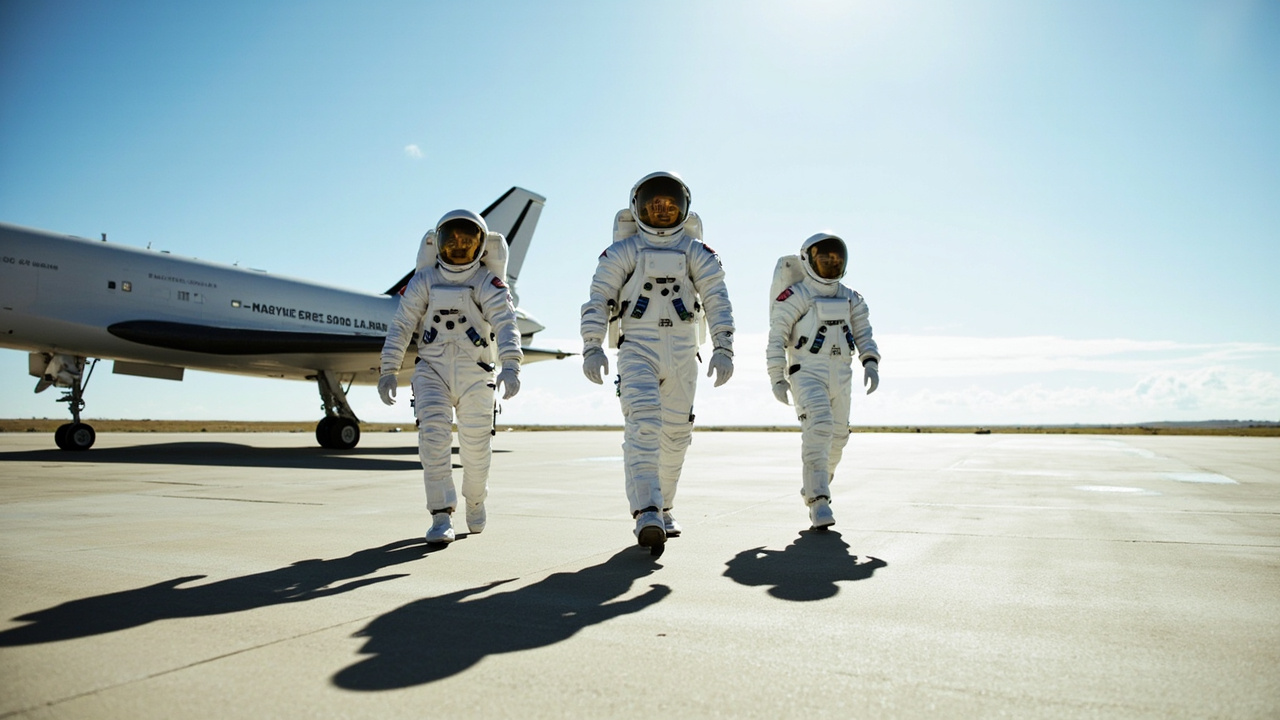
TL;DR: NASA's SpaceX Crew-13 — Jessica Watkins, Luke Delaney, Joshua Kutryk and Sergey Teteryatnikov — landed in Florida on Sept. 26, 2026, to begin final quarantine for a planned Oct. 1 launch to the space station.
The next crew bound for the International Space Station is now in Florida.
NASA astronauts Jessica Watkins and Luke Delaney, Canadian Space Agency astronaut Joshua Kutryk and Roscosmos cosmonaut Sergey Teteryatnikov touched down at NASA's Kennedy Space Center at 12:56 p.m. EDT on Saturday, Sept. 26, 2026, according to NASA's NASA’s SpaceX Crew-13 Lands at NASA Kennedy. The arrival moves the mission into its final week of preparation for liftoff aboard a SpaceX Falcon 9 rocket, targeted no earlier than 11:10 a.m. EDT Thursday, Oct. 1, from Space Launch Complex 40 at Cape Canaveral Space Force Station in Florida.
The four arrived at the Shuttle Landing Facility after a morning flight from NASA's Johnson Space Center in Houston that included a brief refueling stopover in Mississippi. A crew arrival media event was streamed live on NASA Kennedy's YouTube channel, featuring the crew as well as representatives from NASA Kennedy and the agency's Low Earth Orbit Program.
The touchdown sets up quarantine, suit checks, equipment reviews and mission briefings at Kennedy before the crew boards its Dragon spacecraft for a long-duration stay aboard the orbiting laboratory as part of Expedition 75.
A T-38 flight from Houston to the Space Coast
The crew traveled to Florida in T-38 jets, a longstanding NASA astronaut transport and training aircraft.
According to Spaceflight Now's Next crew bound for the space station arrive in Florida, Kutryk and Delaney piloted a pair of jets from Johnson Space Center and landed at Kennedy's Launch and Landing Facility under a largely cloud-less sky and with a light breeze. Watkins rode alongside Kutryk, while Teteryatnikov flew with Delaney.
An earlier NASA preview, NASA’s SpaceX Crew-13 On Way to Kennedy, said the crew took off in T-38s from Ellington Field near Johnson Space Center in Houston on Saturday morning and were expected to land around 1 p.m. EDT at Kennedy's Shuttle Landing Facility. Upon landing, the plan called for the crew to be greeted on the runway by representatives from NASA Kennedy and the Low Earth Orbit Program before speaking briefly with on-site media.
Spectrum News 13 reported in Crew-13 arrives at Kennedy Space Center before big launch that the jets were T-38N Talons and that Delaney and Kutryk flew the jets from outside Johnson Space Center earlier in the morning.
After remarks to media, NASA said the crew would go to the Astronaut Crew Quarters inside Kennedy's Neil A. Armstrong Operations and Checkout Building, where they will continue to quarantine and complete prelaunch preparations.
Meet the Crew-13 quartet
Crew-13 brings together two NASA astronauts, one Canadian astronaut and one Russian cosmonaut.
NASA astronaut Jessica Watkins serves as commander. NASA astronaut Luke Delaney serves as pilot. Kutryk, of the Canadian Space Agency, and Teteryatnikov, of Roscosmos, serve as mission specialists. Those roles were listed by NASA and confirmed in local coverage of the arrival.
The flight will be the second trip to space for Watkins and the first for the other three crew members, according to Spaceflight Now. Spectrum News 13 reported that Watkins previously flew as part of the Crew-4 mission in 2022 and spent 170 days in space.
Watkins told reporters at Kennedy that arriving as a crew reflected more than a year of joint training. "We are excited, we are ready to fly, we are ready to join the Expedition 75 crew," she said, in remarks described by Spaceflight Now.
The crew will join Expedition 75 after reaching the station, Spectrum News 13 reported. An expedition designation refers to the current crew increment aboard the International Space Station. The mission is planned as a multi-month stay of more than six months, during which the crew will conduct scientific investigations and examine how technology could work on future exploration missions.
Florida homecoming for the pilot
For Delaney, the arrival was a return to familiar ground.
Delaney is a Volusia County native, Spectrum News 13 reported, and the mission pilot for the SpaceX Dragon capsule. During a question-and-answer session with reporters, he was asked what it felt like to be about 50 miles from his hometown of DeBary.
Spaceflight Now reported that Delaney said coming to Kennedy and coming back to Florida was near and dear to his heart, noting that he grew up relatively nearby and watched Space Shuttle launches. Spectrum News 13 similarly reported that Delaney said he used to watch shuttle launches and that returning to Florida felt significant.
Delaney also thanked aircraft operations personnel who prepared the jets and supported what he described as a smooth flight to Florida, according to Spaceflight Now.
The Florida link adds local resonance to a mission otherwise defined by international partnership. Kennedy Space Center sits in Brevard County, roughly an hour's drive southeast of DeBary, although the sources did not state a driving distance and the crew's schedule leaves little time for sightseeing. The immediate focus is isolation, medical checks and vehicle familiarization before launch week events.
Canada's second launch of the year
Kutryk's arrival marks another milestone for Canada's space program.
He will be the second Canadian to head to space this year, following Jeremy Hansen's flight as part of the Artemis 2 mission in April, Spaceflight Now reported. Kutryk is a Canadian Space Agency mission specialist on Crew-13.
At the arrival event, Kutryk described the day as one of gratitude, saying he had flown into the Cape many times but that Saturday's arrival felt distinct because of the support from families, teams and crowds in Houston and Florida, as recounted by Spaceflight Now.
Canadian participation in station crew rotations reflects the broader international structure of the space station partnership, which includes NASA, the Canadian Space Agency, the European Space Agency, Japan and Russia. NASA's arrival announcement identified Kutryk with CSA and Teteryatnikov with Roscosmos, underscoring that structure.
Spectrum News 13 reported that Kutryk discussed a European Space Agency experiment involving an exercise device that could be used on the moon. The report did not provide additional technical details about the hardware, and NASA's arrival update did not list individual experiments.
Why launch moved from September to October
Crew-13 did not arrive on its original schedule.
The four crew members were originally slated to launch to the station on Sept. 12, but an oxidizer leak in their Dragon spacecraft, named Grace, led NASA and SpaceX to delay the mission while repairs were made, according to Spaceflight Now. NASA announced the delay in an Aug. 29 Commercial Crew Program blog post.
It was roughly two-and-a-half weeks before the next public update, in a Sept. 16 station blog post, in which NASA said SpaceX had successfully replaced an oxidizer valve in Dragon's propulsion system after a leak was detected earlier in processing, Spaceflight Now reported. The outlet said no further details were provided in either the station or Commercial Crew blogs.
Watkins thanked ground teams for identifying the issue in time and selecting the safest repair path, in response to a question from Spaceflight Now about the work. Her comment points to the cautious approach NASA and SpaceX take when a propulsion-system issue appears during processing, even if it forces a multi-week slip.
Spectrum News 13 likewise reported that an oxidizer leak discovered on Dragon's propulsion system pushed the mission back from a mid-September target. The outlet also reported that NASA had earlier moved Crew-13 forward from November to increase the frequency of U.S. crew rotations.
What happens during launch week
The crew's arrival marks the start of an intensive final phase at Kennedy.
NASA's Sept. 25 preview, NASA’s SpaceX Crew-13 Set for Saturday Arrival at NASA Kennedy, said arrival begins a period of suit checks, equipment reviews and mission briefings. NASA's landing report said crew members will spend the remaining days before launch in quarantine and conducting final preflight operations at Kennedy.
On Friday, NASA and SpaceX held a Flight Readiness Review at Kennedy to assess readiness to proceed toward final prelaunch preparations, according to Spaceflight Now. That work includes an engine test of the Falcon 9 rocket, scheduled for Sunday, and a launch-day rehearsal with the crew, planned for Tuesday.
Continuing updates throughout launch week were to be posted on the mission blog, @NASAKennedy on X, or NASA Kennedy on Facebook, NASA said.
The mission itself carries program history. Crew-13 is SpaceX's 13th crew rotation mission for NASA and the company's 14th flight carrying NASA astronauts to the station, including the Demo-2 test flight, according to NASA. Spectrum News 13 reported that the flight is part of NASA's Commercial Crew Program, through which NASA partners with private companies to transport astronauts to and from the station.
Science ahead on the station
Research will be central once Crew-13 reaches orbit.
NASA's arrival coverage did not detail the science manifest, but local and independent reporting at the arrival event pointed to experiments linked to future moon missions. Spectrum News 13 reported that the four will spend months conducting experiments intended to benefit the Artemis moon missions.
Watkins, a geologist by training, said she hoped her observations of Earth from the station could inform future lunar work, including how remote observations help scientists understand what to expect on the surface, according to Spectrum News 13. Kutryk pointed to a European Space Agency exercise-device experiment with possible lunar applications, the outlet reported.
NASA's broader Commercial Crew manifest typically pairs crew transport with a rotation of biology, physics, Earth science and technology demonstrations, but specific investigations for this increment were not enumerated in the arrival reports available by Sept. 26. More details about the launch were expected on the mission blog and NASA Kennedy social channels, NASA said.