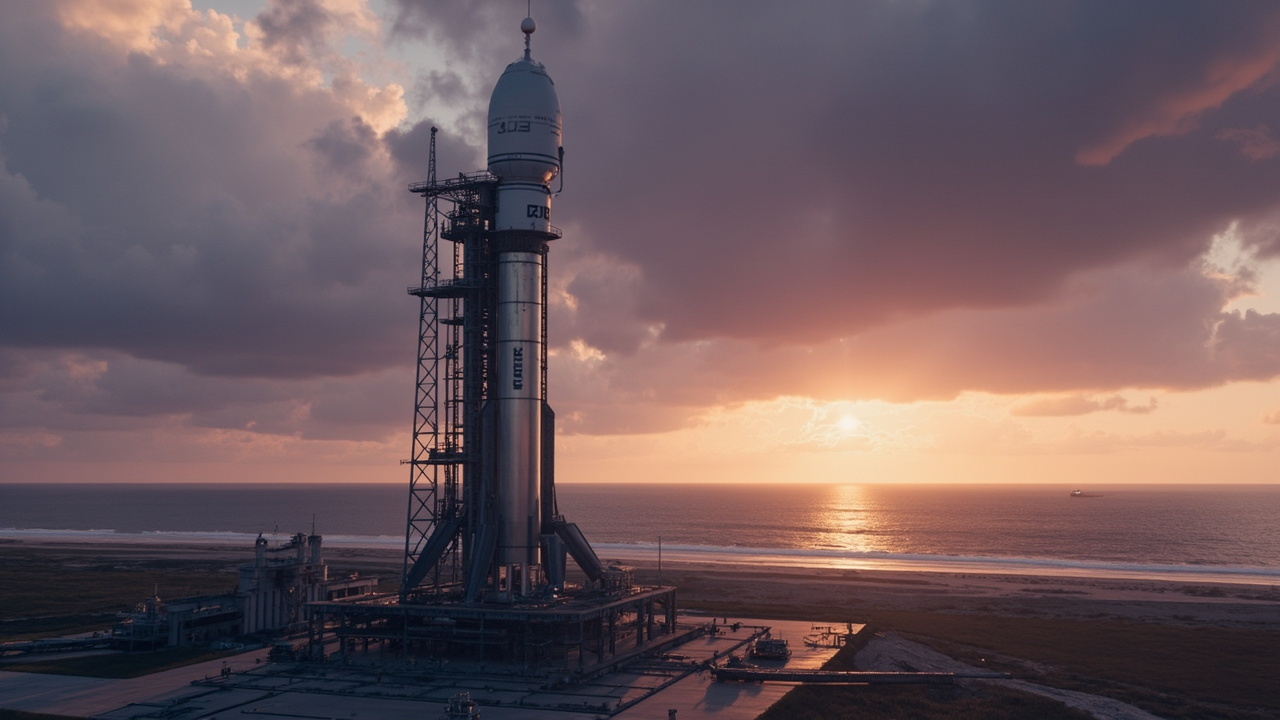
TL;DR: SpaceX scrubbed its Bandwagon-5 Falcon 9 launch on Monday, Oct. 19, because of bad weather in the booster recovery zone and reset liftoff for Tuesday, Oct. 20.
Scrub called for recovery weather
SpaceX called off the Monday, Oct. 19, attempt of the Bandwagon-5 rideshare mission due to poor weather in the booster recovery zone, according to Spaceflight Now. An update timed at 4:07 a.m. EDT (0807 UTC) on Oct. 19 confirmed the scrub and identified Tuesday, Oct. 20, as the next target.
The decision centered on conditions downrange in the Atlantic, not a problem with the rocket or payloads. SpaceX plans to return the Falcon 9 first stage to a droneship stationed in the Atlantic Ocean, according to SpaceX. When sea or wind conditions at that recovery location are out of limits, the company holds the countdown rather than risk the booster.
The mission had been scheduled to fly before dawn Monday from Cape Canaveral Space Force Station. Spaceflight Now reported live coverage of the countdown and the subsequent delay announcement. The scrub shifted a closely watched commercial rideshare flight by one day.
New launch time and place
The retargeted liftoff is scheduled for before dawn on Tuesday from Cape Canaveral Space Force Station, according to Spaceflight Now. The Falcon 9 will launch from Space Launch Complex 40 during an hour-long window that opens at 6:30 a.m. EDT (1030 UTC).
After leaving the pad, the rocket will fly on a southeasterly trajectory, according to Spaceflight Now. NASASpaceFlight.com also reports a southeasterly trajectory to low-Earth orbit from the same complex.
SpaceX lists the same Tuesday window, from 6:30 a.m. ET, with a backup opportunity on Wednesday, Oct. 21, using the same window, according to SpaceX. The company says a live webcast will begin about 15 minutes prior to liftoff and can be viewed on its site and on X @SpaceX.
Spaceflight Now said it would provide live coverage beginning about an hour prior to liftoff. The Tuesday attempt keeps the mission at the Florida range for a morning launch.
Improved forecast for Tuesday
Forecasters expect substantially better launch weather for the Tuesday window. The 45th Weather Squadron forecast a 90 percent chance for acceptable weather during the launch window, according to Spaceflight Now.
Launch weather officers linked the improvement to a cold front along southern Florida that is drifting slightly farther south, which should decrease high winds at liftoff compared with the window on Monday, Oct. 19, according to Spaceflight Now. The forecast also cites a moderate risk that weather at the recovery site for the first-stage booster will not be acceptable, an improvement over conditions forecast for Monday.
Officers also expect the Cumulus Cloud Rule to become less of a concern as high pressure shifts south, bringing increased subsidence and a further reduction in shower and cloud development, according to Spaceflight Now. They wrote that the probability of violation is significantly lower than for Monday morning’s window.
That combination — lower liftoff winds and fewer showers and clouds — underpins the decision to press toward Tuesday. Recovery-zone weather remains the remaining watch item.
Veteran booster B1085 and droneship plan
SpaceX will launch the mission using Falcon 9 first-stage booster tail number B1085, according to Spaceflight Now. The flight will be its 19th following launches of NASA’s Crew-9, Fram2, Firefly Blue Ghost Mission 1, RRT-1, SXM-10, SXM-11, MTG-S1, EchoStar25, and 10 batches of Starlink satellites.
SpaceX lists the same prior missions for the supporting booster, naming Crew-9, RRT-1, Firefly Blue Ghost Mission 1, Fram2, SXM-10, MTG-S1, EchoStar XXV, SXM-11, and 10 Starlink missions, according to SpaceX. NASASpaceFlight.com reports the same 19th-flight history for B1085.
Nearly nine minutes after liftoff, B1085 will target a landing on the droneship A Shortfall of Gravitas, according to Spaceflight Now and SpaceX. Spaceflight Now reports that a successful touchdown would be the 167th landing on that vessel and the 672nd Falcon booster landing to date.
The droneship recovery is central to SpaceX’s reuse model. For Bandwagon-5, the booster will come down downrange in the Atlantic after stage separation.
32-payload rideshare manifest
On board the mission are 32 payloads including CubeSats, microsats, and reentry vehicles, according to SpaceX. Spaceflight Now also reports 32 payloads aboard the Falcon 9 rocket.
NASASpaceFlight.com reports that payload deployment will begin at T+57 minutes 18 seconds, with the final Starfall payload scheduled for deployment at T+02 hours 48 minutes 28 seconds. SpaceX’s deployment timeline ends with Starfall deployment at 02:48:28 after liftoff, according to SpaceX.
The flight follows the successful Transporter-18 mission at the beginning of the month, according to NASASpaceFlight.com. Bandwagon missions serve mid-inclination low-Earth orbit, while Transporter missions serve a different orbit class.
NASASpaceFlight.com reports that SpaceX’s Transporter and Bandwagon rideshare missions allow small satellite companies and government and educational institutions to launch payloads of up to 50 kilograms for $350,000. The report describes the program as a more affordable route to space than a full Falcon 9 launch.
SpaceX Starfall capsule leads payloads
The highest-profile passenger is SpaceX’s uncrewed reentry Starfall capsule, according to Spaceflight Now. NASASpaceFlight.com reports that SpaceX is manifesting its second Starfall capsule on Bandwagon-5, mounted atop the satellite stack.
SpaceX first debuted the reentry capsule called Starfall in June, according to Spaceflight Now. During that mission, the company did not reveal that its spacecraft was onboard until fairly close to flight, shared only a rendering, and did not disclose during its launch broadcast when it would be deployed.
During the June 23 broadcast, avionics supply chain engineer and commentator Zachary Luppen said SpaceX had developed Starfall as a microgravity lab researchers and entrepreneurs can use to develop products and innovations, according to Spaceflight Now.
The Federal Aviation Administration noted in an environmental assessment that the vehicle is about 0.75 meters (2.5 feet) tall, 3.1 meters (10.2 feet) in diameter, and has a mass of about 2,100 kilograms (4,600 pounds), according to Spaceflight Now. The FAA said a single Starfall capsule can support up to 1,000 kilograms (2,200 pounds) of payload mass.
NASASpaceFlight.com reports the same dimensions — 3.1 meters in diameter, 0.75 meters in height, 2,100 kilograms in mass, and capacity for up to 1,000 kilograms of payload. SpaceX did not state what, if any, payloads were onboard this Starfall mission, according to Spaceflight Now.
NASASpaceFlight.com reports that Starfall Demo, a technology demonstration, launched June 23 on Falcon 9. The disk-shaped vehicle can remain in space indefinitely and can reenter and be recovered at any time.
The capsule uses a top plate with maneuvering thrusters, described as cold-gas nitrogen thrusters that orient the capsule correctly during reentry, according to NASASpaceFlight.com. It has a jettisonable heat shield and uses a parachute-assisted splashdown, with all elements recovered by SpaceX recovery vessels. Initial tests were planned to land in the Pacific Ocean around 1,300 kilometers off the coast of the United States or Mexico.
SpaceX will use the vehicle for point-to-point cargo delivery and for transporting goods manufactured in microgravity, according to NASASpaceFlight.com. Although currently launched aboard Falcon 9, the capsules ultimately will launch aboard Starship, with multiple capsules likely flying aboard the vehicle at one time.
Exolaunch, HawkEye, ICEYE and Xona satellites
Beyond Starfall, 20 of the remaining 31 payloads to be deployed were manifested by multinational mission management company Exolaunch, according to Spaceflight Now. NASASpaceFlight.com reports a larger Exolaunch role, with 22 customer satellites supported on Bandwagon-5.
Exolaunch has provided payloads for every SpaceX rideshare mission to date and has manifested 890 payloads across different launch vehicles, including Rocket Lab’s Electron and Arianespace’s Ariane 6, according to NASASpaceFlight.com.
The Exolaunch-manifested groups include four radio-frequency monitoring satellites from Virginia-based HawkEye 360, four communications satellites for Finnish microsatellite company ICEYE, and six navigation satellites from California-based Xona Space Systems, according to Spaceflight Now.
The Xona payloads are Pulsar-01, Pulsar-02, Pulsar-03, and Pulsar-04, which will form part of a larger constellation expected to have approximately 250 satellites, according to NASASpaceFlight.com. The constellation will provide a commercial positioning, navigation, and timing system as an alternative to the government-owned Global Positioning System.
Those satellites will orbit closer to Earth than traditional GPS satellites, allowing a signal at least 100 times stronger that can punch through interference, according to NASASpaceFlight.com. Another Exolaunch-manifested payload is Impulse Space’s LEO Express 4, an orbital transfer vehicle designed to host and deploy payloads within high-energy orbits using its Saiph thrusters.
In addition to hosting payloads, that spacecraft can perform rendezvous and proximity operations and space domain awareness, according to NASASpaceFlight.com. Three previous spacecraft flew aboard Falcon 9 Transporter missions in 2023 and 2025.
Varda, Portal, radar and imaging payloads
Starfall is not the only reentry vehicle onboard. Varda Space Industries, which focuses on pharmaceutical research missions, is launching its W-Series 7 spacecraft, which is about three times smaller than Starfall, according to Spaceflight Now.
Despite the name, W-7 will be Varda’s ninth reentry capsule launched to date, according to Spaceflight Now. W-8 and W-9 were launched earlier in October on the Transporter-18 mission. W-7 features the cancer drug called Protac and will study whether microgravity can improve its solubility.
Varda wrote that molecules in microgravity can crystallize differently than on Earth, potentially producing crystal forms with improved properties, including better solubility, according to Spaceflight Now. The company said a successful experiment could help turn powerful protein-degrading molecules into more practical cancer treatments.
Also onboard is the Starburst-1 demo mission from Portal Space Systems Inc., according to Spaceflight Now. The 260-kilogram spacecraft is designed to perform orbital maneuvers and support a customer payload of up to 50 kilograms. The company said the first demonstration is fully funded by Portal to prove capability ahead of customer missions, with customer flights advertised as starting in 2027.
Multiple synthetic aperture radar satellites are manifested, including four radar Earth-observation satellites from ICEYE, two high-resolution radar satellites from Capella Space, and two commercial radar payloads from Umbra Space, according to NASASpaceFlight.com. Such satellites use remote sensing to produce high-resolution imagery in any weather conditions, at any time of day.
In addition to supporting military applications, radar satellites can also measure and observe Earth’s surface features in extreme detail, according to NASASpaceFlight.com. Other payloads include Planet Labs’ Pelican-12, a very high-resolution optical imager set to join the larger Pelican constellation, and Starburst-1, an ESPA-class bus capable of rapid retasking, rendezvous and proximity operations, and orbital changes.
Starburst shares core systems and manufacturing with Supernova, a solar-thermal spacecraft engineered for maneuverability from low-Earth orbit to cislunar space, according to NASASpaceFlight.com.
Sources referenced
- Poor weather forces scrub of Monday launch attempt of Bandwagon-5, SpaceX now targeting Tuesday – Spaceflight Now (https://spaceflightnow.com/2026/10/18/live-coverage-spacex-to-launch-starfall-reentry-capsule-31-customer-payloads-on-bandwagon-5-rideshare-mission/)
- Bandwagon-5 Mission – SpaceX (https://www.spacex.com/launches/bandwagon5)