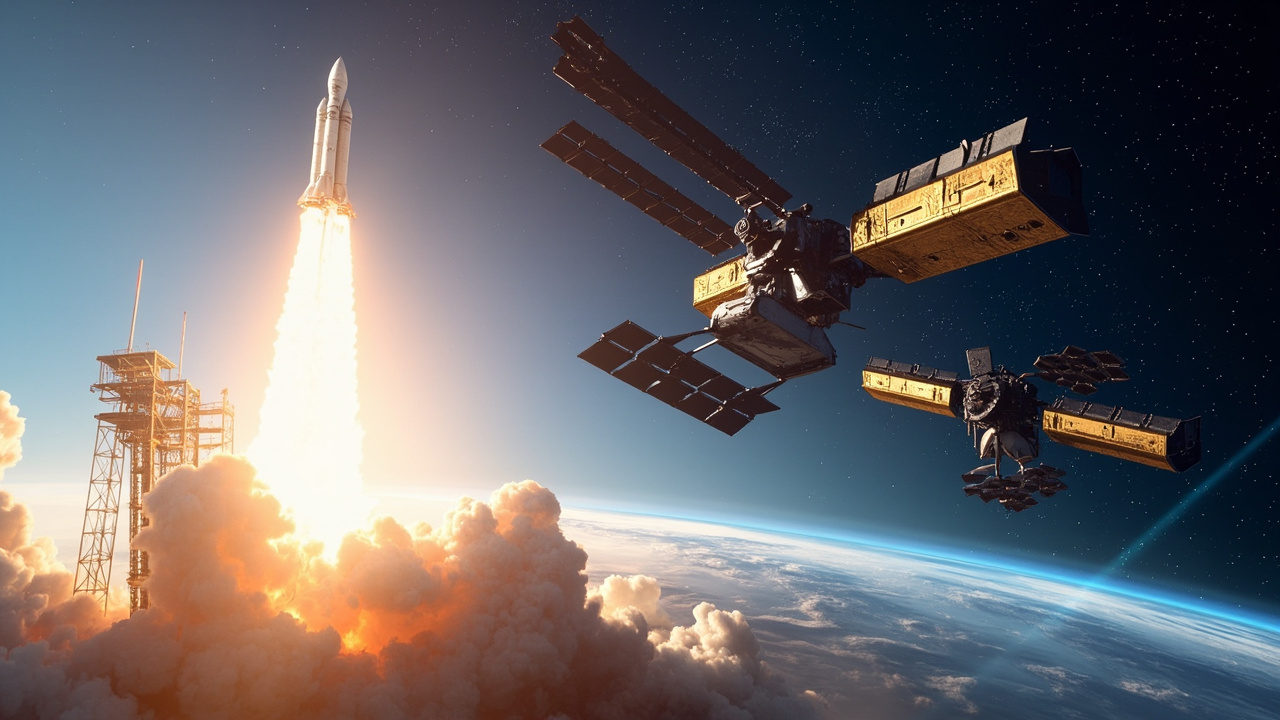
TL;DR: SpaceX completed its 700th Falcon launch on Sept. 13, 2026, sending SES's final three O3b mPOWER satellites toward medium Earth orbit, while Europe counted down to a Sept. 14 night launch of two Earth-observation satellites on Vega-C flight VV30.
A weekend of two launches on two sides of the Atlantic
On Sunday afternoon, Sept. 13, a SpaceX Falcon 9 lifted off from Florida carrying communications satellites. Hours later, on the evening of Sunday, Sept. 14, in South America, a European rocket stood ready to lift off with climate and vegetation missions.
According to Spaceflight Now, the Florida liftoff from Space Launch Complex 40 (SLC-40) at Cape Canaveral Space Force Station happened at 2:49 p.m. EDT (1849 UTC). The mission, designated O3b mPOWER-F, carried satellites F11, F12 and F13 on a trek to medium Earth orbit.
That flight was SpaceX's 700th Falcon rocket launch to date, split between 687 Falcon 9 rockets and 13 Falcon Heavy rockets, according to Spaceflight Now. The company described SES, the Luxembourg-based customer, as its oldest commercial customer.
Meanwhile in French Guiana, Europe's Vega-C rocket was encapsulated and awaiting liftoff at Europe's Spaceport, according to ESA. Launch was scheduled for that night: Sept. 15 at 03:21 CEST, which was Sept. 14 at 22:21 local time in Kourou.
The Vega-C mission, designated VV30, was to carry two separate Earth-observation satellites together: ESA's Fluorescence Explorer (FLEX) and the Copernicus Sentinel-3C satellite, according to ESA.
SpaceX milestone: 700th Falcon flight completes O3b mPOWER fleet
The three satellites launched from Florida were built by Boeing and were the final three to be added to the O3b mPOWER constellation, according to Spaceflight Now.
SES announced the successful launch of its eleventh, twelfth and thirteenth O3b mPOWER satellites on Sept. 13, 2026, according to SES's press release titled "SES's Final Three O3b mPOWER Satellites Successfully Launched." The release said the three satellites launched at 2:49 p.m. local time aboard a SpaceX Falcon 9 from SLC-40.
With this launch, the planned O3b mPOWER constellation reaches 13 spacecraft in medium Earth orbit, according to Spaceflight Now. The three satellites were to join 10 O3b mPOWER spacecraft already in operation, offering services ranging from tens of Mbps to multiple gigabits per second of capacity to any site, according to SES.
SES said the system is designed to offer high-performance connectivity services around the world, according to that SES release. The company said the new satellites, once operational by mid-2027, will support expanded high-performance connectivity capacity for enterprise, government, mobility and telecom customers operating in underserved, remote and demanding environments.
"This launch marks a defining milestone for SES as we complete the O3b mPOWER constellation and further strengthen our MEO capabilities," said Adel Al-Saleh, CEO of SES, according to SES.
Boeing, in a feature titled "Leveling up service with launch of last satellites" published Sept. 14, 2026, said the successful launch of F11, F12 and F13 completes the constellation and enables SES to significantly expand high-speed connectivity and improve digital services for customers worldwide.
According to Boeing, active customers using O3b mPOWER's network capabilities include cruise lines, government organizations, civil entities, mobile operators and commercial airlines.
"O3b mPOWER has produced our highest-performing satellites on orbit," Al-Saleh said, according to Boeing. "Launching F11, F12 and F13 marks SES' next step toward delivering the highest throughput, most efficient, and most flexible enterprise-grade satellite connectivity services to customers yet."
Booster B1080, pad 400 and droneship landing
SpaceX flew the mPOWER-F mission with Falcon 9 first-stage booster tail number B1080, according to Spaceflight Now. It was its 29th flight after launching four missions to the International Space Station, the European Space Agency's Euclid observatory, SES' Astra 1P, and 22 batches of Starlink satellites.
According to Space.com in its report titled "SpaceX launches 3 telecom satellites to orbit on 700th Falcon mission of all time (video)," it was the 29th flight for this particular booster, designated B1080, and the 105th Falcon 9 launch of the year.
Space.com reported that the Falcon 9's first stage came back to Earth a little less than nine minutes after launch, landing in the Atlantic Ocean on the SpaceX drone ship "A Shortfall of Gravitas."
According to Spaceflight Now, more than 8.5 minutes after liftoff, B1080 landed on the droneship A Shortfall of Gravitas stationed in the Atlantic Ocean. This was the 166th landing on this particular vessel and the 661st Falcon booster landing to date.
The launch was also the 400th orbital launch to take flight from SLC-40, of which SpaceX was responsible for launching 345, according to Spaceflight Now. The pad was outfitted with a crew and cargo access tower in 2023, allowing it to begin flying Dragon missions starting in March 2024, including by using B1080 to launch the CRS-30 mission.
Weather officers with the 45th Weather Squadron forecast a 60 percent chance for favorable weather at the opening of Sunday's launch window, according to Spaceflight Now. Meteorologists stated in their outlook that conditions deteriorated to 40 percent favorability by the end of the window.
According to Spaceflight Now, launch weather officers wrote that steering flow remained light leading into the primary launch window Sunday afternoon but would have a more defined offshore component, and that with the sea breeze over the Spaceport, the risk early in the window would be for showers and storms to quickly develop in the immediate vicinity.
From electrical issue to 13-satellite plan
The O3b mPOWER program grew from an original plan after technical trouble. According to Spaceflight Now, prior to the launches of the fifth and sixth satellites, an electrical issue was discovered that was found to impact both the broadband capacity and the estimated operational life of those satellites.
To compensate, changes were made to satellites 7-11 and two additional spacecraft were added to the constellation, according to Spaceflight Now. Satellite manufacturer Boeing announced the delivery of the final trio of satellites to SES in early September 2026.
According to Spaceflight Now, the first two satellites were launched on a SpaceX Falcon 9 on Dec. 16, 2022, with subsequent launches in pairs in April 2023, November 2023, December 2024 and July 2025.
Space.com reported that SpaceX has launched all of them, on six Falcon 9 launches beginning in December 2022, and that the O3b mPOWER satellites, built by Boeing, weigh about 3,750 pounds (1,700 kilograms) apiece.
Spaceflight Now reported that they each have a dry mass of 1,900 kg, according to SES.
According to Spaceflight Now, the newest satellites were scheduled to be released from the Falcon 9 rocket's second stage beginning nearly 34 minutes after liftoff, with deployment staggered by seven minutes.
Space.com reported that the satellites were deployed as scheduled, being released at an altitude of 5,000 miles (8,000 kilometers) over a 14-minute span starting roughly 33.5 minutes after launch.
Boeing said these satellites are expected to enter service by the middle of 2027 after completing their orbit-raising maneuvers and necessary checkouts and commissioning, according to Spaceflight Now. Boeing's Sept. 14 feature likewise said F11, F12 and F13 are forecast to enter service in mid-2027 after completing their orbit raising and initialization activities.
"The delivery of these final three satellites allows us to ramp up our constellation's capabilities to meet growing commercial and government demand," said Xavier Bertran, chief product and innovation officer of SES, in a statement, according to Spaceflight Now.
"The fully operational O3b mPOWER constellation proves the effectiveness of our software-defined payload technologies," said Ryan Reid, president of Boeing Satellite Systems International, according to Spaceflight Now.
According to Boeing, its payload technology enables the satellites to dynamically route bandwidth, focus beam power and adjust capacity in real time to match evolving connectivity needs.
Europe's double payload: FLEX and Sentinel-3C
As Florida teams recovered a booster, French Guiana teams prepared a double deployment.
According to ESA in its preview titled "FLEX and Sentinel-3C ready for liftoff on Vega-C," two Earth-observation satellites were encapsulated inside the nose cone of a Vega-C launcher and were awaiting liftoff at Europe's Spaceport in French Guiana.
While the FLEX mission will monitor the health of Earth's vegetation, Sentinel-3C, together with the two Sentinel-3 satellites already in orbit, will monitor oceans, land, ice and atmosphere for Copernicus, the Earth observation component of the European Union's Space Programme, according to ESA.
First, the vehicle was to deploy Sentinel-3C, and then after some launcher maneuvers, it was to be followed by FLEX, which is fitted inside the Vespa+R payload adapter, according to ESA.
In its program guide titled "Watch: FLEX and Sentinel-3C launch on Vega-C," ESA listed liftoff at 03:21 CEST, Sentinel-3C separation at 04:21 CEST, and FLEX separation at 05:17 CEST, with broadcast coverage starting at 02:50 CEST.
The Vega-C program is led by ESA, working with Avio as prime contractor and design authority, according to ESA. For this launch, flight VV30, Avio was also launch service operator.
According to ESA, Vega-C stands 35 meters tall, weighs 210 tonnes on the launch pad, can launch 2,300 kg into space, and reaches orbit with three solid-propellant-powered stages before the fourth liquid-propellant stage takes over for precise placement of satellites.
FLEX is an Earth Explorer mission dedicated to gathering data about the health of vegetation on a global scale by detecting the faint glow emitted by plants as they photosynthesize, according to ESA. Its Fluorescence Imaging Spectrometer can detect and measure this weak signal from an altitude of 814 km.
The mission is expected to produce global maps of vegetation fluorescence at a resolution of 300 meters by 300 meters, offering a new way to study how plants interact with the atmosphere and how carbon and water move through Earth's ecosystems, according to ESA.
Sentinel-3C carries four science instruments that capture data quickly across entire regions, according to ESA. Since the first Sentinel-3 satellite was launched a decade ago, the mission's data on oceans, land, ice and atmosphere have provided datasets for operational applications and scientific research, according to ESA.
Why the pair flies together
The two satellites were to ride together but operate in coordination with a third spacecraft.
According to ESA, FLEX will orbit in tandem with one of the Copernicus Sentinel-3 satellites. Sentinel-3 provides information on the atmosphere such as clouds, aerosols and water vapor as well as information about the land surface, such as surface temperature and type of land cover and additional vegetation parameters.
This integrated package of quasi-concurrent measurements promises to enable an unprecedented view of global vegetation function and status, according to ESA's launch broadcast guide.
During the routine operations phase Sentinel-3 is managed jointly by Eumetsat and ESA on behalf of the European Commission, according to ESA.
Sources referenced
- Live coverage: SpaceX to launch final 3 O3b mPOWER satellites for SES – Spaceflight Now (https://spaceflightnow.com/2026/09/13/live-coverage-spacex-to-launch-final-3-o3b-mpower-satellites-for-ses/)
- SpaceX launches 3 telecom satellites to orbit on 700th Falcon mission of all time (video) | Space (https://www.space.com/space-exploration/launches-spacecraft/spacex-launches-3-telecom-satellites-to-orbit-on-700th-falcon-mission-of-all-time-video)