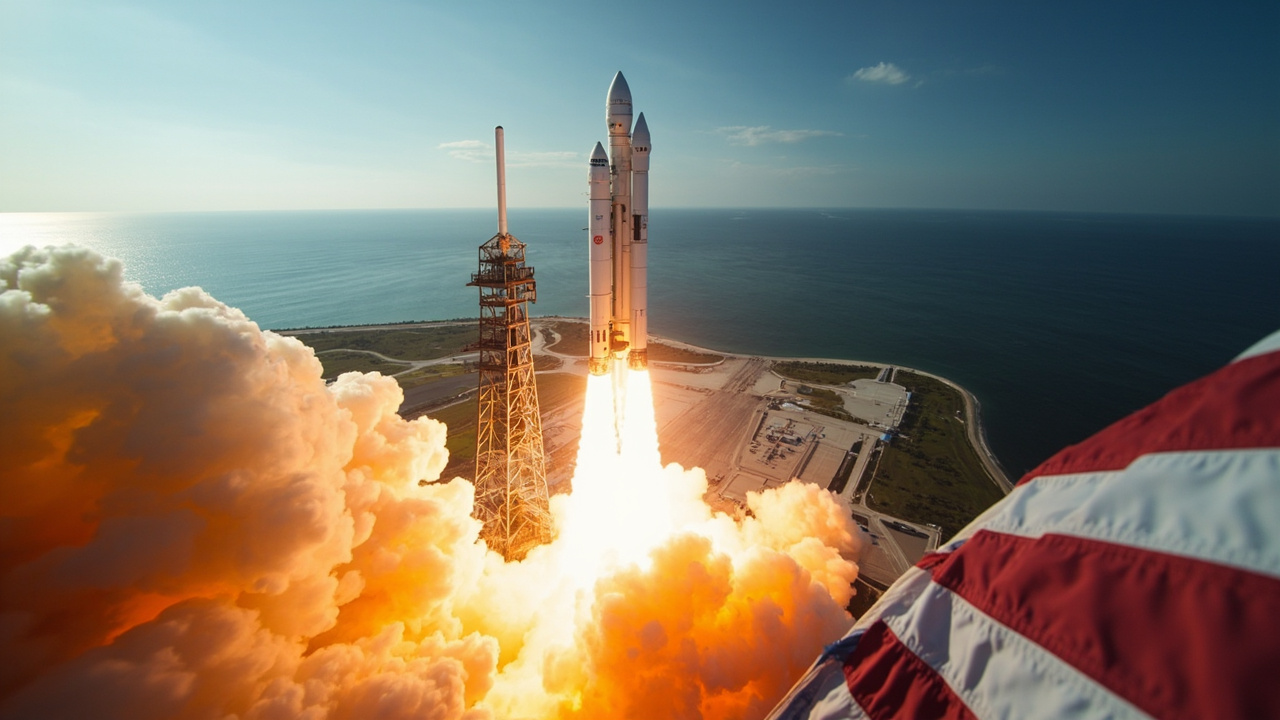
TL;DR: SpaceX completed its 700th Falcon-family launch on Sept. 13, 2026, sending SES's final three O3b mPOWER satellites toward medium Earth orbit from Cape Canaveral.
Falcon 700 Ends With A Trio Bound For Medium Earth Orbit
A Falcon 9 carrying SES satellites F11, F12 and F13 lifted off from Space Launch Complex 40 at Cape Canaveral Space Force Station at 2:49 p.m. EDT on Sunday, Sept. 13, 2026. The flight completed the 13-spacecraft O3b mPOWER constellation and marked 700 launches for SpaceX's Falcon family, divided between 687 Falcon 9 rockets and 13 Falcon Heavy rockets, according to Spaceflight Now.
The customer was SES, described as SpaceX's oldest commercial customer. The payload was designated O3b mPOWER-F. The three Boeing-built spacecraft were headed for medium Earth orbit, or MEO. It was also reported as the 105th Falcon 9 launch of the year and SpaceX's 107th orbital mission of the year overall, with the Falcon Heavy accounting for the other two orbital flights, according to Space.com.
The first stage used for the mission was booster B1080, making its 29th flight. A little less than nine minutes after launch, and more than 8.5 minutes after liftoff by another timing account, the stage returned and touched down on the drone ship A Shortfall of Gravitas in the Atlantic Ocean. That recovery was the 166th landing on that particular vessel and the 661st Falcon booster landing to date.
Why launch No. 700 mattered
A two-decade ledger from Falcon 1 to Falcon Heavy
The 700-mission total spans three Falcon variants. The family began when Falcon 1 debuted in March 2006, flew five times with two successes, and then yielded to Falcon 9 in 2010. The Falcon 9 has performed the large majority of family flights, while the still-active Falcon Heavy has launched 13 times to date, according to Space.com.
The Sept. 13 mission added another entry to the Falcon 9 column. It was the 105th Falcon 9 flight of 2026. At the company level, it was the 107th orbital mission of the year, leaving two 2026 orbital missions for Falcon Heavy.
SpaceX had also flown two suborbital Starship test flights in 2026 and was preparing for a third flight that was expected to take the large vehicle orbital for the first time.
For SES, based in Luxembourg, the significance was completion rather than counting. Ten O3b mPOWER spacecraft were already operating in MEO before launch day. The three new arrivals were intended to bring the system to its full planned strength of 13.
What flew: F11, F12 and F13
Three Boeing satellites close a six-launch sequence
The mission carried O3b mPOWER satellites numbered F11, F12 and F13. They were the final three additions to the constellation and were built by Boeing.
SES lists each spacecraft with a dry mass of 1,900 kilograms, according to Spaceflight Now. A separate mission description put the weight of each satellite at about 3,750 pounds, or 1,700 kilograms apiece, according to Space.com. SpaceX has launched all of the constellation's spacecraft across six Falcon 9 launches beginning in December 2022.
The sequence began with the first two satellites on Dec. 16, 2022. Later launches carried pairs in April 2023, November 2023, December 2024 and July 2025. Sunday's three-satellite flight was therefore both the sixth Falcon 9 launch for the program and the first in the series to carry three at once.
Before the fifth and sixth satellites launched, engineers identified an electrical issue that affected broadband capacity and estimated operational life. In response, designers revised satellites 7 through 11 and added two more spacecraft to the constellation plan. Boeing announced delivery of the final trio to SES in early September 2026.
SES chief product and innovation officer Xavier Bertran said delivery of the final three would allow the company to expand constellation capabilities for commercial and government demand, adding that performance from the 10 satellites already on orbit validated the architecture. Boeing Satellite Systems International president Ryan Reid said the fully operational constellation demonstrated software-defined payload technology for commercial, joint-force and allied military customers.
SES described the resulting system as purpose-built for predictable low latency, exceptional throughput and flexibility for industries where uptime is essential. The company also said the design pairs software-defined satellites with ground and software systems intended to maintain performance as bandwidth demand increases.
Where it launched: Pad 40's 400th orbital flight
Cape Canaveral milestone inside a company milestone
Liftoff came from Space Launch Complex 40, or SLC-40, at Cape Canaveral Space Force Station in Florida. The launch window lasted 87 minutes, with a backup opportunity available Sept. 14 at the same time, according to local coverage by WESH.
The mission was the 400th orbital launch from SLC-40. SpaceX was responsible for 345 of those 400 flights. The pad received a crew and cargo access tower in 2023, enabling it to begin flying Dragon missions in March 2024. That Dragon capability at the pad also began with B1080, which launched the CRS-30 cargo mission.
Brevard County emergency managers deactivated launch-support operations shortly after the successful liftoff, according to live updates from Florida Today. SpaceX released liftoff video and separate video of the booster landing.
The eastward trajectory sent the Falcon 9 over the Atlantic toward the recovery ship. Because the first stage was targeted for a drone-ship landing at sea rather than a return to land, no Central Florida sonic booms were expected.
How weather shaped the afternoon
Sea breeze, storms and a late improvement
The 45th Weather Squadron forecast a 60 percent chance of favorable weather at the opening of Sunday's window. Forecasters said conditions would deteriorate to 40 percent favorability by the end of the window.
The concern was afternoon convection tied to the sea breeze. Launch weather officers wrote that steering flow remained light ahead of the primary window but was expected to gain a more defined offshore component. High-resolution models suggested that shift would slow development of the east-coast sea breeze until near the start of the window.
With the sea breeze over the spaceport, the early-window risk was showers and storms developing nearby. Later in the window, activity was expected to move inland before collisions between ongoing storms and lingering cells drifted back toward the spaceport.
By launch webcast time, the estimated chance of acceptable weather had improved to about 75 percent, with cumulus clouds and thunderstorm development remaining near Launch Complex 40, according to live updates from Florida Today. Liftoff proceeded at the planned 2:49 p.m. opening.
How the booster and upper stage performed
B1080's 29th flight and a droneship landing
B1080 entered the mission with an extensive flight history. It previously launched four missions to the International Space Station, the European Space Agency's Euclid observatory, SES's Astra 1P spacecraft and 22 batches of Starlink satellites, according to Spaceflight Now. Other mission histories also associate the booster with Axiom missions Ax-2 and Ax-3, CRS-30, Northrop Grumman's NG-21 cargo flight and 22 Starlink missions, according to Florida Today.
After stage separation, the Falcon 9 first stage flew east and landed on A Shortfall of Gravitas. That was its 29th mission and the booster's latest reuse milestone.
Meanwhile, the Falcon 9 upper stage continued toward MEO with the three SES payloads. Release was planned to begin nearly 34 minutes after liftoff, with deployments separated by seven minutes. Another mission account placed release at an altitude of 5,000 miles, or 8,000 kilometers, across a 14-minute span beginning roughly 33.5 minutes after launch, according to Space.com.
What happens next for O3b mPOWER
Orbit-raising, testing and service entry by mid-2027
The satellites were not expected to enter commercial service immediately. Boeing said the spacecraft were expected to enter service by the middle of 2027 after orbit-raising maneuvers, checkout and commissioning.
Once operational, the 13-satellite constellation is intended to supply high-throughput, low-latency connectivity from MEO. SES pointed to growing commercial and government demand as the reason for expanding the system from its earlier plan.
The Sept. 13 flight therefore closed the deployment phase while opening a months-long commissioning phase. The next publicly known steps were raising the three new spacecraft to their operational orbits and verifying them alongside the 10 already in service before SES declares the full system ready.
Sources referenced
- SpaceX launches 700th Falcon rocket, carries final 3 O3b mPOWER satellites to orbit for SES – Spaceflight Now (https://spaceflightnow.com/2026/09/13/live-coverage-spacex-to-launch-final-3-o3b-mpower-satellites-for-ses/)
- SpaceX launches 3 telecom satellites to orbit on 700th Falcon mission of all time (video) | Space (https://www.space.com/space-exploration/launches-spacecraft/spacex-launches-3-telecom-satellites-to-orbit-on-700th-falcon-mission-of-all-time-video)