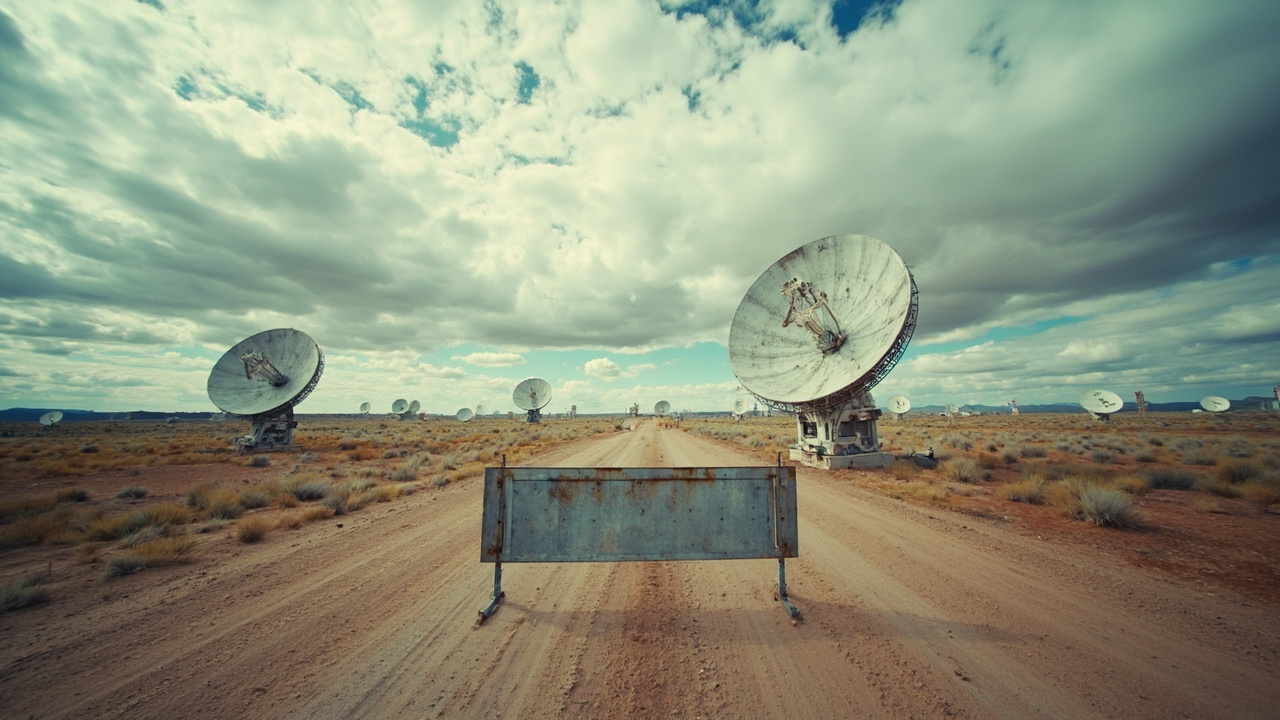
TL;DR: The National Radio Astronomy Observatory canceled in-person attendance at its October 10 Very Large Array Open House after flooding damaged roads and closed State Route 60, and it will stream three scheduled talks online instead.
NRAO cancels in-person VLA Open House
The U.S. National Science Foundation Very Large Array Open House planned for Saturday, October 10, 2026, will not take place in person. National Radio Astronomy Observatory ticketing information states that the event was canceled because of road damage from recent flooding.
The same ticketing information links the cancellation to the subsequent closure of St. Rt. 60. The observatory's news listing describes the gathering as the annual Fall Open House and lists its planned hours as 9:00 a.m. to 4:00 p.m., according to News – National Radio Astronomy Observatory.
An update posted October 5, 2026, on the ticketing page repeats that the October 10 Open House was canceled for road damage from recent flooding. The page labels the Fall Open House 2026 entry as canceled.
The observatory also addressed travel conditions around the site. The ticketing page states that the Very Large Array cannot be reached by State Route 60 coming from the east. It states that the New Mexico Department of Transportation has issued travel guidance for detours to St. Rt. 60.
Additional travel information came from state and county agencies. The ticketing page states that New Mexico Roads and the Socorro County Office of Emergency Management have issued travel guidance for alternate routes. It advises drivers to use caution because roads may be difficult to drive and states that four-wheel-drive vehicles are recommended.
Three talks move to YouTube and Facebook
Although visitors will not gather for the Open House, the scheduled presentations will still be available remotely. The ticketing page states that the planned talks will be livestreamed with question-and-answer sessions on NRAO's YouTube Channel and Facebook Page starting at 10 AM MDT.
A message shared by NRAO on October 6, 2026, provided the same livestream plan, according to the observatory's LinkedIn update titled In lieu of the in-person VLA Open House. That update states that the talks will be livestreamed with Q&A on NRAO's YouTube Channel and Facebook Page.
The lineup contains three presentations on Saturday, October 10. The ticketing page lists a 10 AM MDT talk by Ylva Pihlstrom, Deputy Assistant Director for New Mexico Operations, titled “Radio Astronomy in New Mexico.”
The second presentation is scheduled for 11 AM MDT. The ticketing page identifies the speaker as Jill Malusky, News Manager, and gives the title as “NRAO Telescopes On Screen.”
The third presentation is scheduled for 12 PM MDT. The ticketing page identifies the speaker as Rob Selina, Project Engineer for ngVLA, and gives the title as “The next generation Very Large Array.”
The October 6 LinkedIn update lists the same three times, speakers, roles, and titles. It places Pihlstrom at 10 AM MDT, Malusky at 11 AM MDT, and Selina at 12 PM MDT.
The online format preserves the question-and-answer element. Both the ticketing page and the October 6 update describe the remote presentations as livestreamed with Q&A.
Visitor Center stays open with weekend tours
The cancellation does not close the local visitor facilities. The ticketing page states that the VLA Visitor Center remains open during regular hours.
Free public tours also remain available. The ticketing page states that free public tours are still available on Saturdays and Sundays for visitors coming to the NSF VLA from the west and alternate routes.
That distinction matters because eastern access is affected. The ticketing page states that the site cannot be accessed by State Route 60 coming from the east, while access from the west and alternate routes is the route mentioned for weekend tour visitors.
The observatory's earlier LinkedIn information about the cancellation likewise stated that the VLA Visitor Center remains open during regular hours, according to the update titled UPDATE: The NSF Very Large Array Open House planned for Saturday, October 10, 2026. That update also stated that free public tours remain available on Saturdays and Sundays for visitors arriving from the west and alternate routes.
Road guidance remains important for anyone considering a trip. The ticketing page points visitors to detour information from the New Mexico Department of Transportation. It separately points to alternate-route guidance from New Mexico Roads and the Socorro County Office of Emergency Management.
The caution about driving conditions is explicit. Drivers are advised to use caution because roads may be difficult to drive, and four-wheel-drive vehicles are recommended, according to the ticketing information.
Next Open House is scheduled for April
Visitors seeking a future in-person Open House have a date to note. The ticketing page states that the next VLA Open House is planned for April 24, 2027.
The ticketing page does not list program details for that future event. It presents April 24, 2027, as the planned date following the canceled October 10, 2026, gathering.
The October cancellation notice originally described an all-day program. The NRAO news listing gave the canceled October 10 event's hours as 9:00 a.m. to 4:00 p.m.
The replacement online program is shorter and focused on talks. The three livestreamed presentations are listed at 10 AM, 11 AM, and 12 PM MDT, with Q&A included.
ALMA workshop in Concepción closes in-person signups
A separate NRAO-supported training event also reached a registration milestone on October 6. A workshop page titled ALMA Data Reduction Workshop in Concepción carries the note: “[Note October 6, 2026] In-person registration is now closed.” The same note states that online registration remains open.
The workshop is scheduled for Thursday, October 22, and Friday, October 23, 2026. The listed time is 10 AM to 4:00 PM, and the location is Universidad de Concepción, Departamento de Astronomía.
The Universidad de Concepción will host the two-day workshop on ALMA Data Processing on October 22 and 23. The workshop page states that the program will focus on tools and methods used to reduce and analyze ALMA data from scratch.
The listed technical scope begins with calibration and imaging. It continues through moment maps and physical quantities, according to the workshop page.
Hands-on instruction is part of the plan. The page states that the workshop includes hands-on sessions with CASA and CARTA.
Remote attendance is available. The page states that remote attendance will also be possible.
Language arrangements are also specified. The page states that the workshop will be held in English, with the possibility of asking questions in English, Spanish, or French.
Meals, fees, capacity, and support
The Concepción workshop page states that there are no registration fees. It also states that lunch will be provided each day to all in-person participants.
A registration deadline affected meal eligibility. The page states that the registration deadline to qualify for free meals was October 5. It states that registrations will remain open afterward, but lunch will not be included.
Capacity at the physical venue was limited. A note dated October 1, 2026, stated that in-person registration might close soon because the auditorium's capacity of 50 attendees was nearly reached.
The October 6 note then recorded the outcome. In-person registration closed, while online registration stayed open.
Support for the event comes from a U.S. radio-astronomy center. The page states that the event is supported by the North American ALMA Science Center of the National Radio Astronomy Observatory.
The page names Carla Cornil-Baïotto as an ALMA Ambassador in connection with the workshop. It also states that all attendees are expected to abide by the NRAO Code of Conduct.
Together, the two October 6 developments show a practical shift in NRAO public activities. One New Mexico event lost its in-person component because of flood-damaged roads and a highway closure, while one Chile-based training event filled its 50-person room and kept its remote door open.