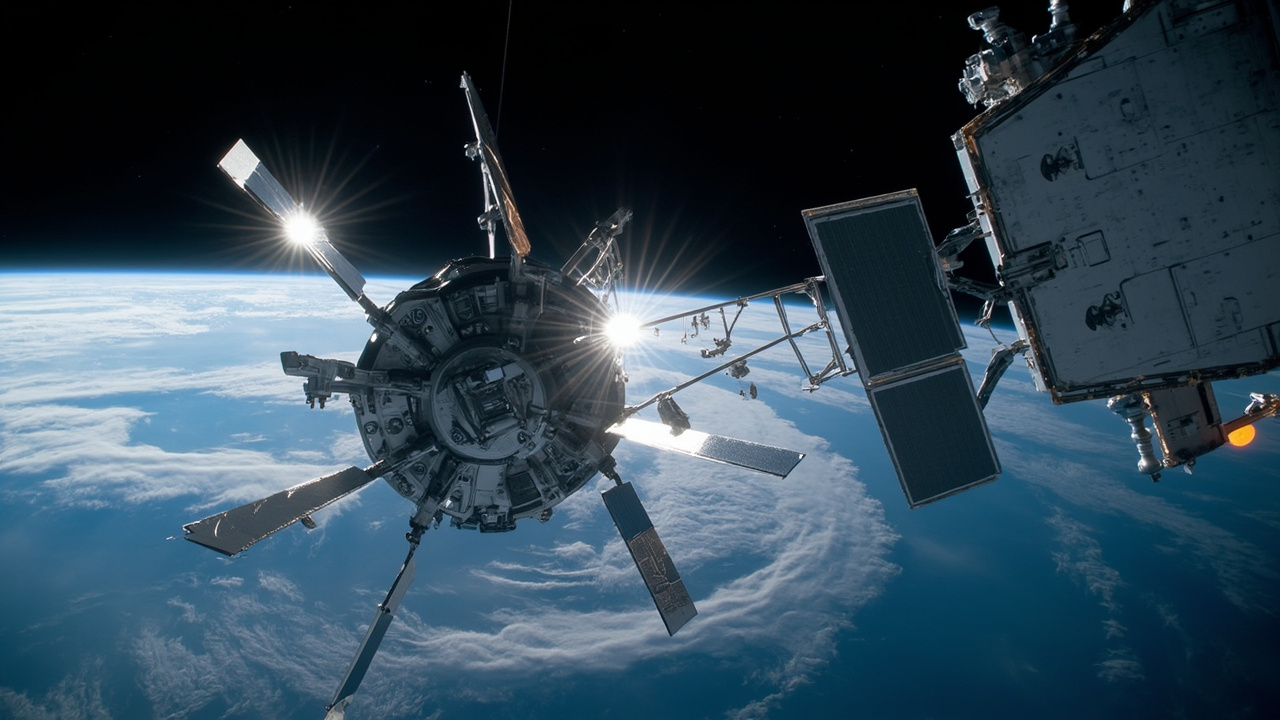
TL;DR: A commercial spacecraft sent to save NASA's aging Swift telescope got within miles of it but will not attempt a capture, and NASA says the rescue effort has become a short technology demonstration before reentry.
Katalyst Space is wrapping up flight operations for its LINK servicing vehicle after NASA and the company scaled back a plan to grapple NASA's Neil Gehrels Swift Observatory and lift it to a higher orbit, according to SpaceNews and NASA Science.
The outcome leaves Swift without the altitude boost intended to prolong its mission. Swift has resumed limited science observations while its low orbit continues to decay, and LINK is using its remaining weeks to test servicing hardware and proximity flight, according to NASA Science.
Rescue attempt becomes demonstration flight
LINK launched in early July on a mission to attach to Swift and raise its orbit before Swift reentered in the coming months, according to The Space Review.
NASA and Katalyst announced Aug. 19 that they had jointly agreed to abandon efforts to raise Swift's orbit, according to The Space Review. The spacecraft is a gamma-ray telescope in a decaying orbit, according to the same account.
A few weeks after launch, Link suffered attitude-control problems caused by the loss of two of its three reaction wheels, according to The Space Review. While engineers had stabilized the spacecraft using spacecraft thrusters to restore control, the company and the agency concluded it was no longer feasible for Link to attach to Swift and boost it, according to the same report.
NASA and Katalyst scaled back a mission that would have used LINK to boost Swift to a higher altitude because of attitude-control issues with LINK, according to NASA Science. Katalyst continues to demonstrate as many of LINK's capabilities in space as possible to collect data to inform future spacecraft servicing technology and operations, according to NASA Science.
Shawn Domagal-Goldman, director of NASA's astrophysics division, described the effort as a high-risk, high-reward mission in an agency statement quoted by The Space Review. The statement said the timeline had been driven by solar activity, that the teams had hoped for more science from Swift, and that the takeaways would be worthwhile either way.
How close LINK came to Swift
This week, Katalyst conducted in-space tests and maneuvers to exercise the capabilities of its robotic servicing spacecraft LINK, according to NASA Science.
Over the past few days, Katalyst raised LINK's orbit and made adjustments to align with Swift's orbit, according to NASA Science. The team also deployed all three of LINK's robotic arms and fired all three of the electric propulsion thrusters at the same time, according to the same update.
An image captured by the spacecraft on Aug. 30, 2026, shows LINK firing all three of its xenon-fueled thrusters simultaneously, according to NASA Science. Another image shows a solar panel on LINK as seen in orbit in an image captured by one of LINK's cameras on Aug. 24, 2026, according to NASA Science.
LINK came within 7.5 to 9 miles, or 12 to 15 kilometers, of Swift, according to NASA Science. LINK will not make any closer approach to Swift throughout its remaining operations in orbit, according to the same update.
WASHINGTON-based reporting on Sept. 5 described Katalyst as wrapping up operations of a spacecraft intended to reboost a NASA space telescope but which instead became a technology demonstration for satellite servicing, according to SpaceNews. The Katalyst team estimates LINK will deorbit after another 2 to 3 weeks, according to NASA Science.
That proximity work provided an opportunity to demonstrate technologies that could be used for future in-space servicing missions, according to Space.com. Instead of capture and boost, LINK was expected to rendezvous with Swift and perform proximity operations, according to the same report.
Why engineers ruled out capture
Company chief executive Ghonhee Lee emphasized the knowledge gained from the servicing effort during an interview at the Small Satellite Conference in Salt Lake City, according to The Space Review.
Lee said the company had kicked off the mission in earnest at SmallSat the prior year, when it was not yet on contract for the flight implementation phase but was in negotiations with Northrop Grumman to secure a Pegasus launch needed given Swift's orbit, according to The Space Review. He described moving from a clean-sheet design to physical hardware shipped for flight, according to the same account.
The first reaction wheel malfunctioned in July because of what he described as immense thermal loading on power electronics, according to The Space Review. He described that heating as essentially a result of interactions among flight software, guidance, navigation and control, and physical hardware in off-nominal cases not seen in ground testing, according to the same report. That heating burned out switches and kept the spacecraft from operating that reaction wheel, according to The Space Review. The second wheel failed in a slightly different situation that he did not elaborate upon, according to the same account.
The failures prompted intensive work to restore control using both the main propulsion system, a set of three Hall-effect thrusters, and reaction control system thrusters, according to The Space Review. Lee said personnel worked continuously to make that happen, according to the same report.
NASA provided guidance, navigation and control and attitude-control specialists who worked alongside company engineers, according to The Space Review. Engineers managed to reduce LINK's spin and regain attitude control, according to Space.com.
That recovery work depleted propellant reserves, according to The Space Review. Lee said the teams concluded they did not have the fuel to do a meaningful boost of Swift, alongside concerns about the ability to effectively grapple the spacecraft, according to the same account. The decision to call off the reboost attempt played out over about two weeks, according to The Space Review.
LINK had developed attitude-control problems in late July that caused it to spin and disrupted communications, according to Space.com. Two of the spacecraft's three reaction wheels were found to be inoperable, while its cold-gas thruster system also experienced some loss of functionality, according to the same report.
Swift returns to science with limited time
Mission controllers restarted two of Swift's three science instruments, its X-ray Telescope and Ultraviolet/Optical Telescope, on Aug. 26, according to Space.com.
Both instruments had been shut down in February as part of an effort to minimize atmospheric drag and keep the aging spacecraft in orbit long enough for another spacecraft to reach and boost it, according to an Aug. 28 statement from NASA cited by Space.com.
Swift's third instrument, the Burst Alert Telescope, remains offline, according to Space.com. Operations of that instrument were halted in April to conserve power, allowing controllers to position Swift's solar panels in a way that further reduced drag from interaction with Earth's atmosphere, according to the same report. NASA said the mission team hopes to resume data collection with the instrument within the next few weeks, according to Space.com.
In more than 21 years, Swift has served as a NASA tool for studying the cosmos across a wide range of light, rapidly pointing at short-lived outbursts and sending alerts to other facilities in space and on the ground to help coordinate follow-up observations, according to the NASA statement cited by Space.com.
Launched in 2004, Swift was originally designed for a two-year mission studying gamma-ray bursts, described as the most powerful explosions in the universe, according to Space.com. More than two decades later, the observatory continues to detect and rapidly follow up on fleeting cosmic events in gamma-ray, X-ray, ultraviolet and visible light while alerting other observatories, according to the same report.
LINK launched July 3 aboard a Northrop Grumman Pegasus XL rocket with the goal of rendezvousing with Swift, grabbing the observatory and raising its orbit, according to Space.com.
A decaying orbit and expanding atmosphere
Unlike some spacecraft in low Earth orbit, Swift does not have a propulsion system capable of counteracting atmospheric drag, according to Space.com. Increased solar activity has heated and expanded Earth's upper atmosphere, increasing drag on Swift and causing its orbit to decay faster than previously expected, according to the same report.
NASA's low-drag operations had been expected to keep Swift above about 185 miles, or 300 kilometers, until October, according to Space.com. Below that threshold, operating the observatory becomes increasingly difficult and its descent accelerates, according to the same account.
Now that science operations have resumed and the planned orbital boost is off the table, NASA expects Swift to reach that critical altitude within the next one to two months, according to Space.com. Without intervention, the observatory is likely to fall back to Earth later this year, mostly burning up as it reenters the atmosphere, according to the same report.
NASA and Katalyst had originally pursued the boost because Swift was expected to reenter in the coming months without a higher orbit, according to The Space Review.
What the flight still tests for servicing
Even without a grapple, the teams framed the remaining flight as a check of rendezvous and proximity operations, sensors, robotic arms and electric propulsion, according to NASA Science and The Space Review.
The plan described in late August was to maneuver toward Swift, get within close proximity and image Swift with onboard sensors, according to The Space Review. That was described as a useful exercise of rendezvous and proximity sensors that could be checked against ground testing and models to assess applicability to future missions, according to the same account.
Orbital tracking data showed Link raising its orbit slightly over several days to get closer to Swift, according to The Space Review. Lee said at that time that he expected the rendezvous effort to take on the order of a couple of weeks, according to the same report.
The Sept. 4 NASA update said the thruster firing, arm deployments and orbit alignment were intended to exercise servicing capabilities and inform future operations, according to NASA Science. Readers can monitor the Swift blog for more updates at the agency's Swift blog page, according to NASA Science.