TL;DR: Astronomers used a new “transmission strings” method with JWST to map the true asymmetric shape of hot Jupiter WASP-17b’s atmosphere for the first time.
A circle that is not a circle
The atmosphere of the exoplanet WASP-17b is broadly circular but measurably asymmetric, with one side more extended than the other, according to the University of Bristol. The result is described as the first application of a method called “transmission strings” to unravel an exoplanet’s uneven contours.
The study was co-led by Cornell University in the United States and the University of Bristol in the United Kingdom, according to the University of Bristol. Its results were published in the journal Nature Astronomy in a paper titled “A Spatial Map of the Atmospheric Limb of a Hot Jupiter” by Dr. Lili Alderson and colleagues.
WASP-17b is described as a “hot Jupiter” orbiting a star some 1,300 light-years from Earth, according to the University of Bristol. The authors state in the arXiv preprint titled “A Spatial Map of the Atmospheric Limb of a Hot Jupiter” that the planet has an equilibrium temperature of 1,760 K, a radius of 1.9 Jupiter radii and a mass of 0.5 Jupiter masses.
That highly inflated atmosphere gives what the preprint calls a signal-to-noise ratio extremely favourable for atmospheric characterisation. The new work analysed light spanning 0.6–12 micrometers around the transmitting atmosphere as a function of angle, according to that preprint.
Who developed transmission strings
The “transmission strings” method was developed at Bristol by astrophysicists Dr. David Grant and Dr. Hannah Wakeford, according to the University of Bristol. Wakeford is an associate professor in astrophysics at the University of Bristol.
Lead author Dr. Lili Alderson is a Klarman Postdoctoral Fellow at Cornell University, according to the University of Bristol. Alderson began the investigation at the University of Bristol, where she earned her doctoral degree in physics.
Alderson said the work is proof of concept that planets are in fact 3D objects, according to the University of Bristol. Alderson said what theory predicts should be happening as planets go around their star is happening, and that moving beyond computational exercises to see it for real is a different matter.
Wakeford said the combined numbers showed a structured, dynamical picture of a giant world more than 1,000 light-years away, according to the University of Bristol. Wakeford described planets as temperamental and their atmospheres as complex and chaotic.
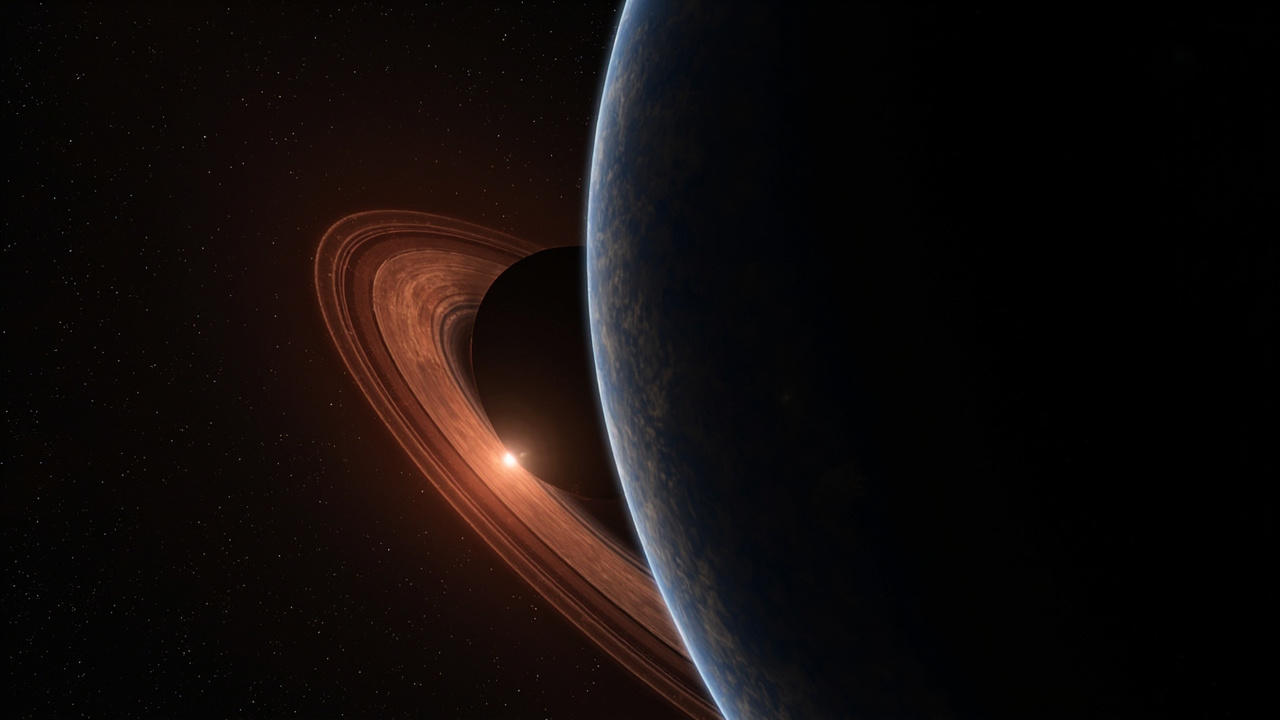
The image mapping the shape was credited to Engine House and Hannah Wakeford, according to the University of Bristol.
How transit mapping differs from averaging
Earlier JWST work pioneered a technique called eclipse mapping, which measures changes in light as an exoplanet moves behind its host star, according to the University of Bristol. The new approach is also called transit mapping.
Transmission strings tracks the planet as it crosses in front of the star, capturing light filtered around the edge of the planet’s atmosphere, or limb, from different angles, according to the University of Bristol. Traditional modelling, by contrast, extracts a spectrum only as an average across the entire limb.
Alderson said the technique does not assume the atmosphere is a circle with the same radius all the way around, according to the University of Bristol. Alderson said it can pull out different distances from the centre to the edge around the limb.
The preprint states that traditional observations of the transmitting limb assume a single radius around the limb, producing a limb-average transmission spectrum. It states that such observations can probe atmospheric properties but are limited in assessing spatial variation.
With transmission strings, the team states it can extract hemispheric east-to-west asymmetries and map equator-to-pole variations around the transmitting atmosphere, according to the arXiv preprint titled “A Spatial Map of the Atmospheric Limb of a Hot Jupiter.” The preprint describes this as the first application of the transmission strings method.
Evening side puffed up, morning side cooler
The researchers found a hot, inflated region where theory and previous modelling indicated one should be on WASP-17b, on the “evening” side of its equator, according to the University of Bristol. There, jets of wind transport heat from the permanently illuminated day side toward the permanently shadowed night side, inflating the atmosphere relative to the cooler “morning” side of the equator.
The preprint quantifies that contrast as a transition in thermal scale height around the limb, with an approximately 650 K temperature difference between the two terminators. It gives a morning temperature of 858 K, with uncertainties of plus 434 K and minus 233 K, and an evening temperature of 1,522 K, with uncertainties of plus 116 K and minus 114 K.
Alderson said theory predicts the morning and evening sides should have a strong temperature difference and that WASP-17b fits that trend, according to the University of Bristol. Alderson described the agreement as pretty much what researchers thought it would be.
The work also reports temperature shifts from equator to poles and between permanent day and night sides, according to the University of Bristol. Those findings about chemical composition and temperature are described as consistent with theoretical predictions and other modelling techniques.
The preprint states the results are consistent with both nightside emission and dayside eclipse mapping measurements. It describes the combined data as a comprehensive set of observations for a transiting exoplanet.
Water and carbon dioxide held steady
The team was able to constrain the abundances of water, H2O, and carbon dioxide, CO2, to constant values around the limb, according to the arXiv preprint titled “A Spatial Map of the Atmospheric Limb of a Hot Jupiter.” The preprint states those measurements provide observational constraints for results from global circulation models.
Earlier limb-averaged JWST spectra from the same observing program had revealed atmospheric absorption from H2O, CO2, potassium and H-, according to that preprint. That earlier analysis placed upper limits on methane, sulfur dioxide, sodium, hydrogen sulfide and carbon monoxide.
When combined with optical spectra from Hubble STIS spanning 0.3–1 micrometer, the existing JWST spectra had also constrained the presence and particle size of silicon dioxide aerosols, according to that preprint. In emission, the planet shows absorption predominantly from H2O and CO2, with a nightside study using NIRSpec/G395H showing the emergence of sulfur dioxide absorption on the nightside, according to that preprint.
The new findings are described as creating one of the most comprehensive 3D views of an exoplanet atmosphere, according to the University of Bristol. That 3D view is described as an important benchmark for comparison with the more than 6,000 other exoplanets confirmed to date.
The JWST data behind the map
The research analysed data collected by the JWST Telescope Scientist Deep Reconnaissance of Exoplanet Atmospheres through Multi-instrument Spectroscopy program, abbreviated TST DREAMS, according to the University of Bristol. The observations were part of Guaranteed Time Observations.
The preprint identifies the instruments as JWST NIRISS/SOSS, NIRSpec/G395H and MIRI/LRS, taken as part of program GTO-1353. It refers to additional work by Lewis and colleagues in preparation on the limb-averaged transmission spectrum.
The work was funded by NASA, the UK Research and Innovation Science and Technology Facilities Council and the Klarman Fellowship, according to the University of Bristol.
Wakeford said having a robust mathematical model to apply to the state-of-the-art data is incredibly exciting, according to the University of Bristol. Wakeford called the results a demonstration of dynamics in multidimensional worlds.
The team states the successful demonstration on WASP-17b paves the way for mapping many more candidates, according to the University of Bristol. The process is starting to differentiate conditions across latitudes, beyond just day and night sides, and is described as a first step toward mapping weather-scale patterns in exoplanet climates.
Sources referenced
- Trailblazing technique uncovers real shape of scorching-hot exoplanet atmosphere | University of Bristol (https://www.bristol.ac.uk/news/2026/october/trailblazing-technique-uncovers-real-shape-of-scorching-hot-exoplanet-atmosphere.html)
- A Spatial Map of the Atmospheric Limb of a Hot Jupiter - arXiv (https://arxiv.org/html/2610.18806v1)