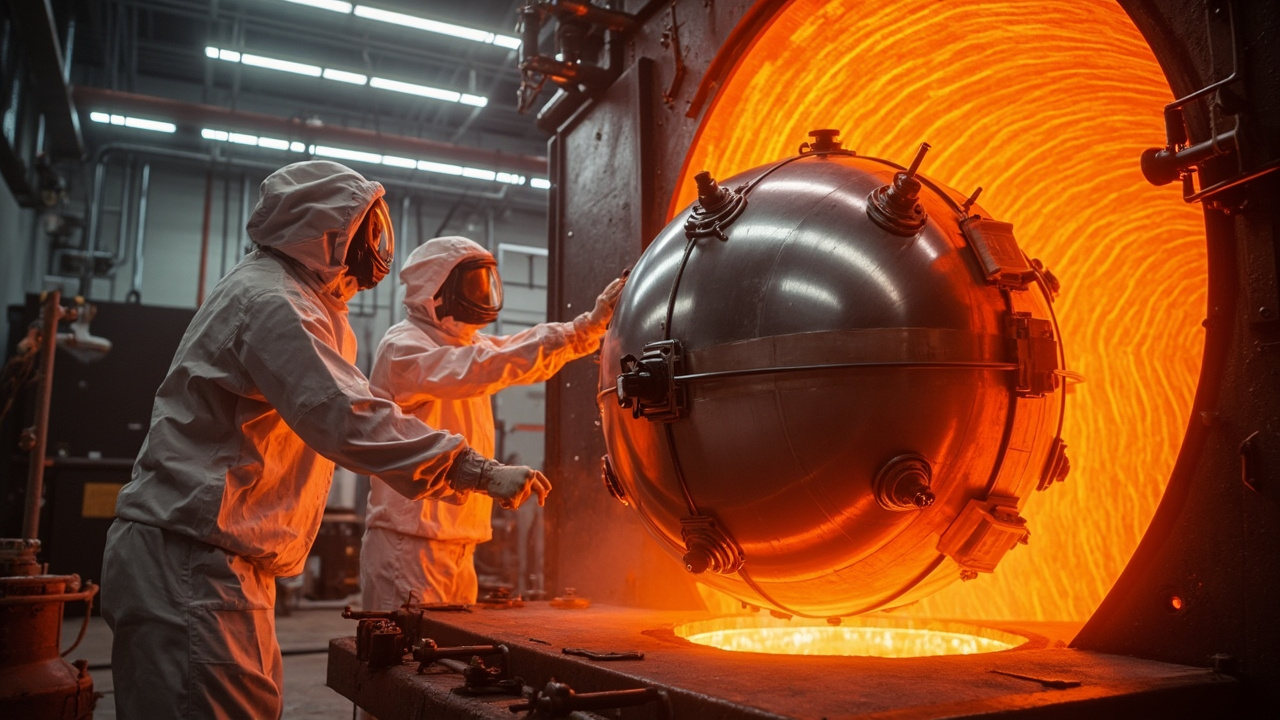
TL;DR: NASA's yoga-ball-sized DAVINCI probe model survived six rapid heatings to 869°F in a Pennsylvania furnace, clearing a key step toward a future dive through Venus' toxic atmosphere.
NASA reported on September 24, 2026 that an engineering model of its DAVINCI descent probe passed a demanding heat trial designed to mimic a real fall to the surface of Venus.
Six runs to Venus temperature
The test campaign ran from Aug. 28 to Sept. 10, according to NASA’s DAVINCI Beats Heat in Preparation for Blistering Venus Descent. Engineers took the engineering model to a furnace at Rex Heat Treat in Bedford, Pennsylvania.
That site was chosen because it is one of few facilities capable of heating hardware to Venus-like temperatures as rapidly as the probe will experience, NASA reported. The team slid the yoga ball-sized vessel into a ceramic-lined chamber with heat-scorched walls.
Operators then raised the temperature to 869 F, or 465 C, over the course of about an hour. That pace matches the heating the probe will undergo during its descent to the surface of Venus.
They then repeated the thermal cycling process five more times, for six total exposures. The engineering model made it through every cycle unscathed, NASA reported, showing it can survive extreme temperatures and protect delicate scientific instruments while traveling through the Venus atmosphere.
During testing, hardware simulating the instruments was monitored with more than 100 thermal sensors. Technician Christopher Matthews removed the lift brackets used to hoist the probe into the furnace, in photos released with the report.
Why the pace matters as much as the peak
A slow laboratory soak can show material limits. For DAVINCI, the rate of heating is central because the descent timeline compresses the entire heat pulse into less than an hour.
“The experiment was a rousing success, with six runs to Venus’ surface temperature on our descent timeline of 55–60 minutes with full internal instrumentation,” said Jim Garvin, the principal investigator for DAVINCI at NASA’s Goddard Space Flight Center in Greenbelt, Maryland.
Garvin added that there had not been such a complete assessment of spacecraft-scale hardware at Venus temperatures in the United States since the mid-1970s.
The result is bounded to the article tested. It demonstrates that this engineering development unit protected simulated internal hardware through six cycles on that 55- to 60-minute profile. NASA said the mission is still working toward approval to move into the final design and fabrication phase, so the test does not represent flight qualification of the final probe.
A probe built to keep heat out and let gas in
DAVINCI stands for Deep Atmosphere Venus Investigation of Noble gases, Chemistry, and Imaging. The spacecraft is being developed to travel to Venus to investigate unsolved puzzles, including whether the planet once had oceans and was habitable, like Earth.
To explore those questions, the spacecraft will release a probe that will withstand extreme heat for nearly an hour as it descends through the toxic atmosphere, collecting data along the way.
“It’s a huge engineering challenge given how harsh the Venus environment is,” said Kristen Brown, the DAVINCI probe manager at NASA Goddard. “We had to create a system that can protect the instruments from the planet’s overwhelming heat while strategically letting in its high-temperature gases to study through special inlet ports.”
That controlled intake is essential. The insulated vessel must keep destructive heat outside while deliberately admitting atmospheric gas for measurement.
The probe design uses a corrosion resistant, strong-yet-lightweight titanium shell. Inside, a suite of instruments is planned to sample the composition of Venusian atmospheric gases to determine what molecules they are made of and to study atmospheric structure.
It will also carry cameras intended to take the highest-resolution images of the Venus surface ever obtained. Scientists plan to use those images to make a 3D map. A radio system will send data back to the spacecraft flying 5,600 miles, or 9,000 kilometers, overhead during the descent.
Two milestones on an accelerated schedule
NASA said this heat testing follows a campaign earlier this summer to demonstrate the probe’s imaging system. Together, the two efforts represent the mission’s major 2026 technology demonstrations to date.
“The DAVINCI team has now met both of the major mission milestones this year on an accelerated timeline,” Garvin said.
The next programmatic step is gaining approval to enter final design and fabrication. NASA has not announced a launch date in the September 24 report, and the report describes the mission as in development rather than in flight.
If approved to proceed, DAVINCI would seek to explain why Earth’s “twin” turned out so different from Earth. Venus is similar in size to Earth but now has a dense toxic atmosphere and surface temperatures near 869 F.
Earth comparison: Arctic ice holds low after Sept. 12 minimum
The Venus result arrived during a busy week for NASA Earth and planetary science. On Sept. 23, NASA and the National Snow and Ice Data Center at the University of Colorado Boulder reported that Arctic sea ice reached its 2026 annual minimum extent on Sept. 12, as detailed in Arctic Sea Ice Reaches 2026 Annual Minimum Extent.
Ice covered an estimated 1.78 million square miles, or 4.6 million square kilometers. That extent tied 2008, 2010 and 2025 for the 10th-lowest minimum in the satellite record.
The past 20 years, from 2007 through 2026, have produced the 20 lowest annual Arctic minimum extents observed since continuous satellite measurements began in late 1978. Arctic ice typically grows during dark autumn and winter and retreats in spring and summer to a September low, with weather causing substantial year-to-year differences.
Linette Boisvert, a sea ice scientist at NASA’s Goddard Space Flight Center in Greenbelt, Maryland, said increased cloud cover over the last decade has prevented solar radiation from further accelerating melt. That has contributed to relatively stable September extent in recent years.
“We’ve plateaued, but we’re still low relative to the earlier part of the record,” said Walt Meier, a senior research scientist at NSIDC.
At the opposite pole, Antarctic sea ice was approaching its annual maximum after an August fluctuation. Sea ice around Antarctica declined by roughly 116,000 square miles, or 300,000 square kilometers, over a six-day period before seasonal growth resumed.
Meier said the decline appeared linked to weather that pushed and compacted thin, mobile ice near its outer edge. “Those types of things happen all the time,” Meier said. “But the magnitude of it certainly is unusual.”
Researchers noted that Antarctic ice varies more year to year than Arctic ice because, unlike the Arctic, it is not surrounded by land and can respond more freely to wind and weather. Antarctic maximum extent has generally been lower in recent years, but Boisvert and Meier remained cautious about describing a long-term trend because of that variability.
The polar record began with NASA’s Nimbus-7 satellite in October 1978, continued with Defense Meteorological Satellite Program satellites beginning in 1987 and NASA’s Aqua satellite from 2002 to 2011, and now uses the Advanced Microwave Scanning Radiometer 2, launched in 2012 aboard the Japan Aerospace Exploration Agency’s GCOM-W satellite. Antarctic ice typically reaches maximum in late September or early October, with a formal 2026 maximum announcement to follow confirmation that growth has ended.
Mars comparison: three water episodes in Jezero Crater
Venus researchers want to know whether Venus once had oceans. On Mars, NASA’s Perseverance rover is finding new detail about repeated water activity in Jezero Crater, reported Sept. 21 and summarized Sept. 24 in independent coverage.
When Perseverance reached the inner edge of Jezero in September 2023, scientists expected sedimentary rocks along the shoreline of an ancient lake. The area, called the Margin Unit, hugs the crater rim, and orbiters had detected strong carbonate signals. On Earth, carbonates often form in shallow lake and ocean settings capable of supporting life.
Instead, the rover found igneous rock formed from magma deep underground or volcanic activity at the surface, according to NASA Discovery Reveals Complex Water Systems on Early Mars. Mineral crystals in igneous rocks preserve details about when they formed. Here they recorded at least three separate interactions with water, the study team reported in the journal Communications Earth & Environment.
The findings relied on SuperCam, mounted on the rover’s mast, which determines mineralogy from reflected light. When the team selects a target, SuperCam can fire its laser up to 21 feet, or 6.5 meters, away. The spectrum of the resulting plasma reveals chemistry. Perseverance analyzed more than 185 bedrock targets across the unit.
Perseverance explored the Margin Unit across about 870 feet, or 265 meters, of elevation. At higher elevations it found coarse-grained crystalline rock with olivine, made of magnesium and iron, that formed as magma cooled slowly underground and reached the surface only after overlying ground eroded. Lower on the former lakebed, olivine grains were fractured with silica between them.
When water interacts with olivine on Earth, the reaction can release hydrogen, a potential food source for some microbes, and leave behind carbonate and silica that can preserve traces of past microbial activity.
The team can determine sequence but not age. First, carbon-dioxide-rich groundwater reacted with olivine, producing carbonate ridges in fractures at low elevations. Those fracture fills now stand in relief as softer surrounding rock wears away.
A second episode may have involved the lake that once filled Jezero. Some Margin Unit rocks contain silica, and more silica appears in rocks that sat below the water line. Turning olivine into carbonate can leave silica behind, said Eleni Ravanis, a planetary scientist at the University of Hawaii at Manoa and a study coauthor.
Last came a vein-forming event in the eastern Margin Unit, about 10 inches, or 25 centimeters, thick, creating calcium sulfate and fluorite. Fluorite typically forms when hot water circulates through volcanic rocks, pointing to a later heated groundwater event.
“Before we arrived at the Margin Unit, the main hypothesis — derived from orbital observations — was that the carbonate seen from orbit formed from interaction with the lake that existed in Jezero Crater,” said Candice Bedford, a research scientist at Purdue University in West Lafayette, Indiana, and the study’s lead author. “But now we know that this location became a sort of crossroads for aqueous systems.”
Bedford noted that Jezero sits inside one of the largest exposures of carbonate on Mars, extending the relevance beyond the crater. She added: “If there is one thing I have learned after 10 years working with Mars rovers, it is that Mars constantly throws surprises at you.”
Together, the three reports show a common method: use orbiters and rovers, furnaces and satellites, to test ideas formed from a distance. For Venus, the next test is to turn a heat-surviving model into flight hardware ready for a one-hour fall through acid clouds toward 869-degree terrain.