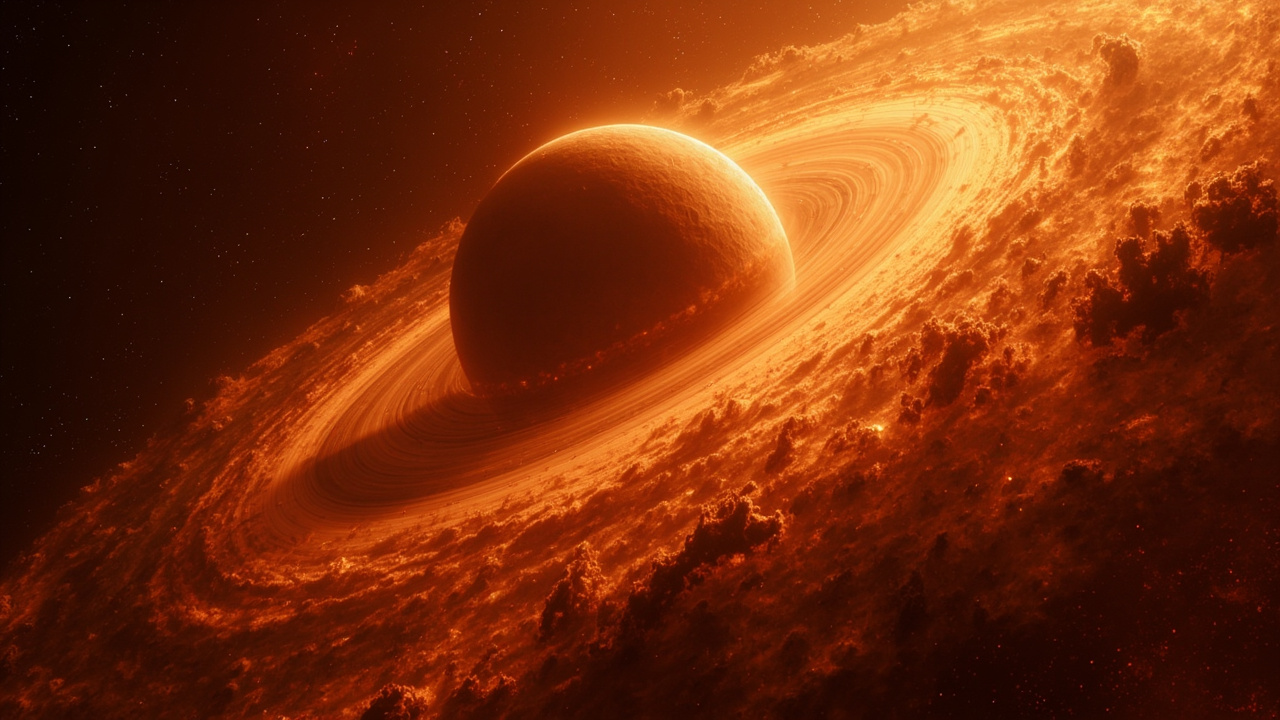
TL;DR: Astronomers confirmed Elias 2-24 b, a Jupiter-scale world less than 1 million years old 450 light-years away, as the youngest exoplanet on record.
Astronomers have confirmed the youngest exoplanet found to date, a still-forming giant named Elias 2-24 b that is less than 1 million years old and sits inside the dusty disk where it was born.
The world orbits a newborn star about 450 light-years from Earth and remains embedded in swirling gas and dust, according to reporting by Space.com on the discovery. Researchers estimate its mass at roughly two to four times that of Jupiter, making it an unusually large infant.
The confirmation was published Sept. 16 in the journal The Astrophysical Journal Letters, as described by Space.com and Live Science. The work was led by Andrea Bernardi, a doctoral candidate at Universidad Diego Portales in Chile.
A newborn found in old telescope files
The team did not use a brand-new observation to make the breakthrough. Instead, researchers re-examined archival data collected by the W.M. Keck Observatory in Hawaii, according to Space.com.
Those Keck observations used a coronagraph, an instrument that blocks direct starlight so much fainter nearby objects can be seen. By suppressing the glare of the host star, the instrument allowed light associated with the planet to be recorded directly.
The researchers searched coronagraph data for seven distant stars, each surrounded by a disk where planets might be assembling, according to Space.com. Only the Elias 2-24 system yielded a confirmed planet in the narrow gap examined in the new analysis.
According to the study abstract posted to arXiv, the observations were obtained with the Keck/NIRC2 vortex coronagraph between May and June 2018 in the L-prime and M-s bands. All seven targets hosted protoplanetary disks with gaps or cavities that could trace ongoing planet formation.
Where the planet sits
The confirmed object lies within a narrow gap in the protoplanetary disk around the star Elias 2-24, according to the arXiv abstract. Its measured separation is 394 plus or minus 31 milliarcseconds, corresponding to 54.9 plus or minus 4.3 astronomical units.
Its position angle was measured at 298.8 plus or minus 3.2 degrees, according to that same study summary. That location places it inside the disk opening previously suspected to harbor a forming planet.
Live Science reported that the planet is almost twice as far from its home star as Neptune is from the sun. Space.com described it as still resting in the gas and dust where it formed, about 450 light-years from Earth.
The mass inferred from the infrared brightness is between 1.9 and 4.0 Jupiter masses when compared with 1-million-year theoretical models and without including extra brightness from accretion, according to the arXiv abstract. That range agrees with estimates based on the properties of the gap and modeled interactions between the planet and the disk.
A clue first seen in 2017
Astronomers first noticed a gap in the Elias 2-24 disk in 2017, according to Live Science. That opening strongly suggested that disk material had gravitationally clumped together and that a planet had cleared its orbit.
Follow-up work with the Atacama Large Millimeter/submillimeter Array in Chile and the European Southern Observatory's Very Large Telescope, also in Chile, added evidence that something might lie inside the gap, according to Space.com. The object was not directly established as a planet at that time.
The new study combined observations from Keck, ALMA and the Very Large Telescope to examine the gap more closely, Live Science reported. The combined data allowed the team to directly image Elias 2-24 b and confirm its existence.
"The planets should be found within the gaps, since they are carving them," Bernardi said, as quoted by Space.com. The team reported that Elias 2-24 b was found exactly in that predicted location.
Why age matters
At less than 1 million years old, Elias 2-24 b is by far the youngest planet ever found, according to Space.com. Live Science likewise described it as less than 1 million years old and likely still accumulating material from the surrounding disk.
The previous record for youngest exoplanet was described as a four-way tie among four worlds all more than 5 million years old, according to Space.com, citing co-author Lucas Cieza. Cieza is a professor at the Instituto de Estudios Astrofísicos in Chile.
Live Science placed that history in a longer sequence. It reported that the youngest-known exoplanets, including several worlds orbiting the star PDS 70, were long thought to be around 5 million years old because telescopes could not detect planets until they had cleared a large enough gap.
More recent advances then lowered the limit, according to Live Science. Those steps included TIDYE-1b, believed to be around 3 million years old and discovered in 2024, and AB Aurigae b, detected in 2025 and estimated to be as young as 2 million years old.
Elias 2-24 b is therefore at least twice as young as any previously known exoplanet, Live Science reported. Space.com similarly emphasized that despite its Jupiter-like heft, the new world is by far the youngest planet identified.
"What makes Elias 2-24 b so remarkable is its age," Bernardi said in a statement quoted by Live Science. The statement added that because the planet is still actively accreting material, researchers can observe a formation stage rarely seen directly.
A test for how giant planets grow
The gap containing Elias 2-24 b points to formation through core accretion, in which a core of heavy elements rapidly gathers surrounding gas, according to the arXiv abstract. The abstract describes the confirmed object as a core-accretion planet in the narrow gap of the Elias 2-24 disk.
That interpretation matters because giant-planet formation is expected to compete with the dispersal of disk gas within a few million years. A Jupiter-scale planet already carving a gap before age 1 million years indicates that buildup can proceed very early.
"Our planet-formation models already struggled to explain the previous record holders for the youngest known planet," Cieza said in a statement quoted by Space.com. He added that Elias 2-24 b shows that even current best models are still missing some important processes.
Live Science quoted Cieza in similar terms, reporting that the find shows that current planet-formation models are missing important processes. The outlet also noted that the discovery gives scientists a rare opportunity to fill gaps in understanding of the initial stages of planet formation.
The new world could also illuminate how planets including Earth took shape, according to Live Science. Because Elias 2-24 b is still gathering material, its brightness and surroundings preserve information about early growth that older planets no longer display.
How the detection was validated
The team processed the Keck data with a custom pipeline based on the VIP Python package, according to the arXiv abstract. The processed images used angular differential imaging and reference differential imaging combined with principal component analysis.
The researchers then derived five-sigma contrast curves and detection limits for all targets, according to the same summary. For the surveyed systems, those limits reached sensitivities down to 1 to 11 Jupiter masses at separations beyond about 0.25 arcseconds.
Elias 2-24 b, with an age of no more than about 1 million years, is described in that summary as the youngest exoplanet discovered to date. Its confirmation, the authors wrote, has important implications for planet-formation timescales and for the origin of gaps seen in very young disks.
"The galaxy churns out new stars and planets continuously, so there are many in every stage of evolution," Cieza said, as quoted by Space.com. He said telescopes remain largely unable to detect these infant planets, leaving a large gap in what can be observed.
What more powerful coronagraphs could do
Researchers hope that more direct observations will become possible with the Coronagraph Instrument aboard NASA's Nancy Grace Roman Space Telescope, according to Space.com. That telescope launched Aug. 30, and its coronagraph was described as the most advanced coronagraph ever launched to space.
Scientists expect that instrument to allow more detailed study of exoplanets and their atmospheres, Space.com reported. Because Elias 2-24 b lies near the limit of what current telescopes can detect, such instruments should make similar detections easier.
"We usually hear about telescopes working separately, but this confirmation was possible only by using multiple telescopes together," Bernardi said, as quoted by Space.com. He said Elias 2-24 b is at the limit of current detection capability, but new instruments such as Roman should improve the search.
For now, the record belongs to a massive infant still glowing as material falls onto it inside its birth disk. Its youth, mass, orbit and gap-carving location together make it a benchmark for testing how quickly giant worlds can assemble.
Sources referenced
- Scientists find youngest exoplanet on record — a 'newborn' named Elias | Space (https://www.space.com/astronomy/exoplanets/scientists-find-youngest-exoplanet-on-record-a-newborn-named-elias)
- Giant 'baby' exoplanet Elias 2-24 b is the youngest alien world scientists have ever seen | Live Science (https://www.livescience.com/space/exoplanets/this-million-year-old-baby-planet-is-the-youngest-world-scientists-have-ever-discovered)